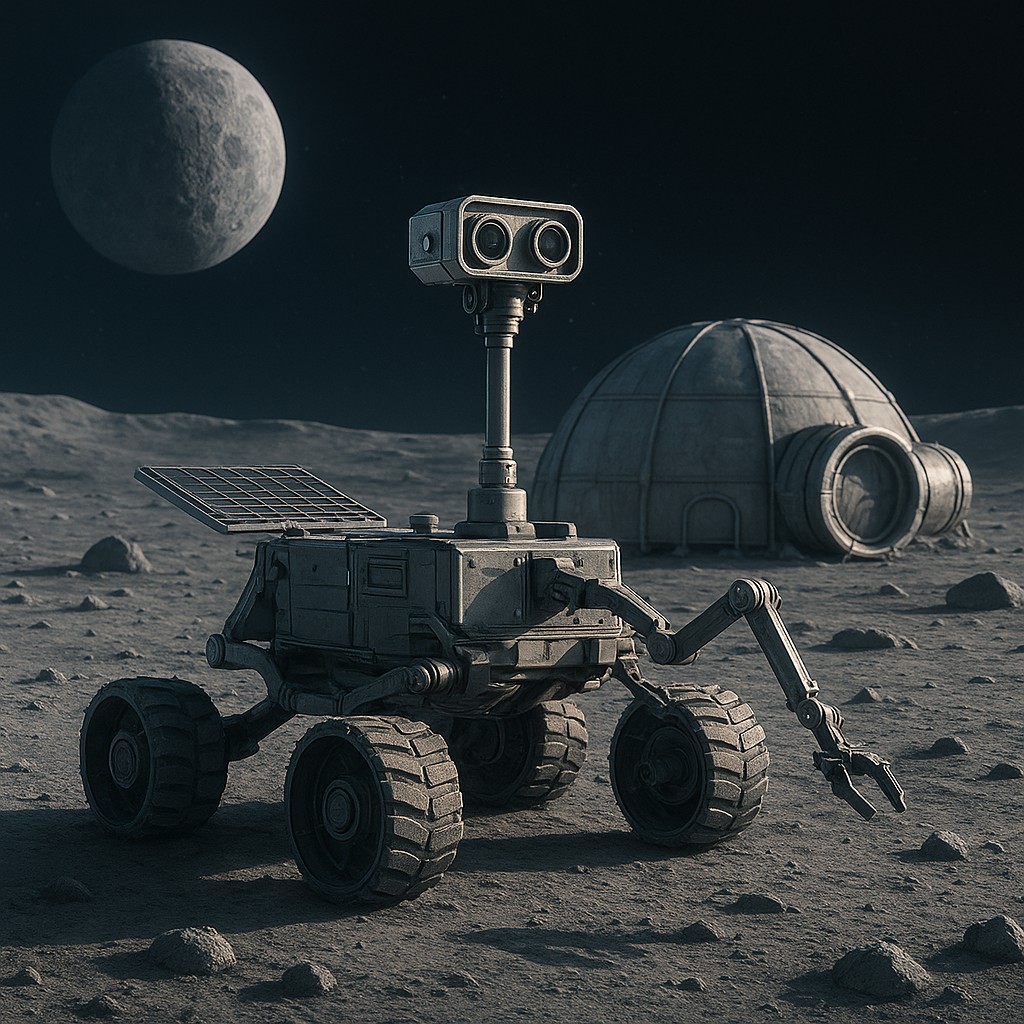
The moon is often romanticized in poetry as a celestial lantern, a gentle glow that guides travelers through the darkness. However, to an engineer tasked with landing a rover or building a habitat on the lunar surface, the moon is less of a lantern and more of a brutal, unforgiving machine. Its environment is defined not just by the vacuum of space, but by a rhythmic, merciless cycle of temperature swings that act like a giant cosmic accordion. Our current challenge in space exploration is shifting from simply getting there to staying there. That requires us to stop thinking about materials as static blocks and start treating them as dynamic, shifting systems that breathe with the heat.
The primary obstacle for any permanent lunar outpost is the lunar night. It is a frozen era lasting roughly fourteen Earth days, where temperatures plummet to cryogenic lows. When we ship machines from Earth, we carry our terrestrial intuition with us, assuming metal is a rigid, reliable constant. Yet, on the Moon, a standard aluminum beam behaves nothing like a beam sitting in a warehouse in Ohio. It is a temperamental object that actively tries to tear itself away from its neighbors or crush its own joints as it shrinks during the long wait for the sun to rise. To succeed in the lunar age, we must stop building rigid structures and start designing machines that understand the physics of thermal contraction as deeply as they understand their own mechanical purpose.
The Tyranny of Differential Expansion
At the heart of every mechanical failure on the Moon lies a concept known as differential thermal expansion. Every material has a unique expansion rate, which is a numerical value representing how much it protests when forced to change size due to heat. Aluminum expands and contracts with enthusiasm, while steel is a bit more restrained, and ceramics or specialized composites might barely move at all. If you bolt an aluminum housing to a steel frame and leave them sitting in the path of a lunar sunset, you are creating a recipe for disaster that would make any structural engineer cringe.
As the lunar surface loses the sun's warmth and slides into the sub-zero chill of the night, your machine begins an internal tug-of-war. The aluminum tries to shrink significantly, pulling away from the bolts, while the steel frame offers stubborn resistance. This creates massive internal stress at the connection points. It can warp thin sensor housings, shatter glass seals, or cause mechanical joints to seize so tightly they essentially weld themselves together from the pressure. We are not just fighting the cold; we are fighting the fact that our assembly contains multiple materials that are constantly arguing with each other about how much space they should occupy.
Designing Joints That Actually Can Dance
The classical approach to mechanical engineering involves creating parts with tight tolerances, where surfaces are machined to fit together with near-perfect precision to prevent wobbling and wear. On the lunar surface, this precision is a liability. If your joint is machined to a ten-thousandth of an inch at room temperature, it will likely be hopelessly jammed by the time the temperature drops by two hundred degrees. Designing for the Moon requires us to embrace a kind of mechanical looseness that feels counterintuitive to anyone trained on terrestrial standards.
Instead of rigid connections, engineers are turning toward flexible thermal gaskets and compliant mechanisms that act like shock absorbers for thermal stress. Think of these as the mechanical equivalent of a winter coat that expands and contracts with the wearer. By using materials with low thermal expansion or incorporating bellows and accordion-like interfaces, we allow the machine the freedom to shift within its frame without exerting force on its neighbors. These interfaces prevent the structural jamming that has historically crippled lunar landing gear and robotic solar arrays. It is a move away from the static, unyielding perfection of the factory floor and toward the organic, adaptive flexibility of a living organism that adjusts to the climate.
The Alchemy of Shape Memory Alloys
Perhaps the most exciting shift in lunar architecture is the movement toward shape-memory alloys, or SMAs. These materials possess a kind of institutional memory. They can be deformed, twisted, and bent, yet they return to their original, programmed shape when exposed to a specific temperature. In the context of the lunar night, SMAs are a miracle of material science. Instead of fighting the environment to maintain a static shape, we can design components that are intended to shift into a new, efficient configuration as the temperature drops.
If we integrate these alloys into the support struts of a habitat or the wheels of a rover, we turn the moon's thermal energy into a tool rather than a burden. As the mercury drops, the SMA elements contract in a predictable rhythm that mimics the thermal profile of the surrounding lunar soil. This ensures that the base of a structure stays seated firmly on the regolith, or lunar soil, without introducing uneven pressure points that could crack the structure. By utilizing these alloys, we are no longer just insulating a machine; we are creating a symbiotic relationship between the outpost and the lunar environment.
The Myth of Industrial Rigidity
A common misconception in space hardware design is that strength is always synonymous with stiffness. We often assume that if a part is stiff, it is robust, and if it is flexible, it is weak. However, in the cryo-environments of the lunar south pole, stiffness is the fastest path to a snapped rod or a sheared-off bolt. A material that is too stiff cannot shed the energy contained within thermal oscillations, leading to brittleness and failure under cryogenic fatigue. To build a future on the Moon, we have to unlearn the idea that our hardware should remain a static monument to its original design specification.
| Material Characteristic |
Earth-Based Assumption |
Lunar Requirement |
| Material Fit |
Tight, precise tolerances |
Loose, compliant interfaces |
| Thermal Response |
Minimal shifts expected |
Significant contraction accommodated |
| Structural Goal |
Maximum rigidity |
Adaptive, flexible endurance |
| Primary Stressor |
Mechanical load (gravity) |
Thermal load (temperature cycles) |
This table illustrates the fundamental disconnect between how we build on Earth and how we must build for the frontier. While we are used to building for the gravity of our home planet, the Moon demands we build for the temperature of the void. We are moving from an era of brute-force engineering, where we simply add more heaters and thicker shields to solve problems, to an era of intelligent mechanics, where the physical properties of the materials themselves do the work of managing the environment.
Stepping Into the Long Frozen Night
The dream of a permanent lunar outpost is within our grasp, but it will not be achieved by dumping terrestrial supply chains onto the moon and hoping for the best. Survival on the lunar frontier is not merely a matter of packing extra batteries or thicker insulation. It is a design philosophy that recognizes the moon as a kinetic, responsive, and temperamental partner. When we embrace the physics of expansion and contraction - when we allow our machines to bow, fold, and shift with the descent of the night - we are doing more than just protecting sensitive electronics. We are proving that humanity is ready to move beyond the fragile boundaries of our home world.
As you look toward the next generation of lunar exploration, remember that every successful mission will be a tribute to our ability to build not just with steel, but with wisdom. We are learning to dance with the moonlight, turning an environment of extreme cold into a testbed for the most resilient machines we have ever created. The lunar night is no longer a stop sign; it is a catalyst for elegant, adaptive, and truly extraterrestrial engineering. You have the curiosity required to understand these systems, and that same spark of inquiry is exactly what will power the architects, geologists, and engineers of the next century. Stay curious, stay observant, and never underestimate the beauty of a well-engineered joint, because one day, it might just be the thing that keeps humanity breathing under the vast, silent moon.