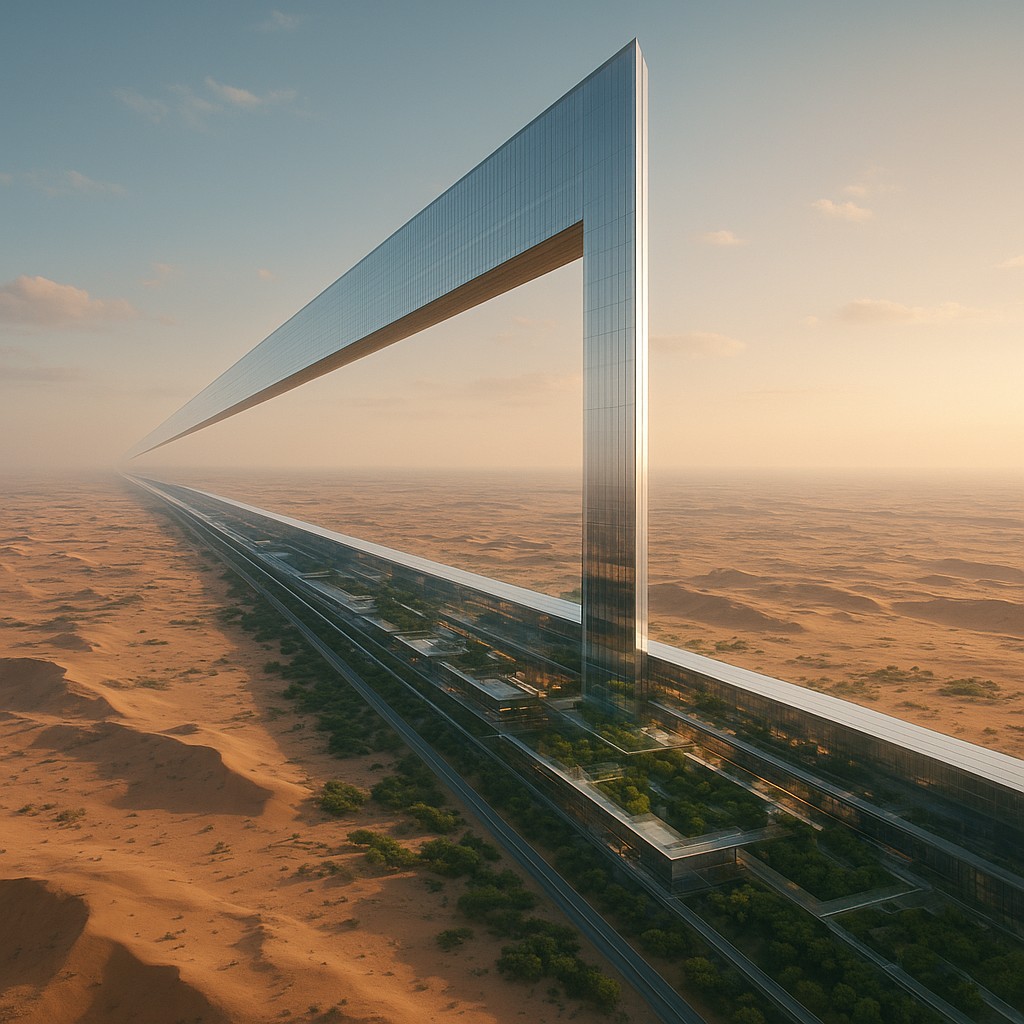
Imagine a city that breaks every rule of urban planning we have followed since the invention of the wheel. Instead of a messy, sprawling web of asphalt and smog that swallows the countryside, picture a single, shimmering silver streak cutting across the desert. This is the vision behind THE LINE, the centerpiece of Saudi Arabia’s NEOM project. It is not merely a building or a neighborhood, but an entire 105-mile (170-kilometer) metropolis contained within two parallel, mirror-clad walls. By stacking its functions vertically rather than spreading them out horizontally, the project aims to protect 95 percent of the surrounding wilderness while housing millions of people on a remarkably small footprint.
The sheer boldness of the project has made it a lightning rod for both wonder and doubt. To some, it is the ultimate answer to housing shortages and the climate crisis - a living laboratory for the technologies of tomorrow. To others, it feels like a science-fiction fever dream that defies the laws of logistics and biology. Whether you see it as a utopia or a massive engineering gamble, THE LINE is undeniably one of the most significant architectural undertakings of our century. Understanding it requires looking past the polished computer-generated images to examine the physics, the philosophy, and the gritty reality of building a linear world from scratch.
The Architecture of a Continental Spine
Traditional cities are circles that keep expanding, leading to long commutes and "dead zones" clogged with traffic. THE LINE flips this geometry. The plans call for a structure only 200 meters wide but 500 meters tall - higher than most iconic skyscrapers, including the Empire State Building. By keeping the city narrow and long, planners believe they can strip away the need for cars and roads entirely. Instead of a street grid, the city is organized into modules that stack homes, businesses, and parks on top of one another.
This concept is called "Zero Gravity Urbanism." The idea is that you should never be more than a five-minute walk from anything you need, whether that is a grocery store, a park, or your office. Because everything is layered vertically, the city uses the third dimension to save time. Residents might take an elevator to reach a "beach" on the tenth floor or walk across a bridge to a library on the thirtieth. This removes the carbon footprint of a daily commute and, in theory, gives hours of free time back to the average person. Even the mirrored exterior serves a purpose beyond looks; it is designed to help the massive structure blend into the desert, reflecting the sky and sand to soften its visual impact on the horizon.
Physics and Feasibility in the Desert Heat
Building such a massive, continuous structure presents structural challenges that keep engineers awake at night. When you build something 170 kilometers long, you have to account for the curve of the Earth and the way materials expand in the heat. Steel and concrete grow when it is hot and shrink when it is cold. In a desert where temperatures swing wildly between noon and midnight, a single solid wall would eventually crack or buckle under the stress. To solve this, the city is designed as a series of separate modules that are linked together but can move independently, much like the cars of a very long train.
Ventilation is another major hurdle. Keeping millions of people cool inside a giant glass box during a Saudi Arabian summer is a tall order. Designers are using a mix of natural airflow and high-tech shading. The city is positioned to catch the prevailing winds from the Red Sea, funneling them through the "canyon" of the structure to create a natural cooling effect. Additionally, the roof will be covered in greenery to create a cooler microclimate. While critics worry the energy needed to maintain these conditions will be enormous, developers insist the entire city will run on 100 percent renewable energy, primarily the solar and wind power that are abundant in the region.
Moving Millions on a Linear Track
Since there are no cars, the "circulatory system" of THE LINE is its high-speed rail. While the surface levels are reserved for pedestrians and parks, the "basement" serves as a high-speed transit layer. The goal is to allow a resident to travel from one end of the 170-kilometer city to the other in just 20 minutes. Achieving this requires a train that can travel faster than 500 kilometers per hour, which is quicker than almost any commercial high-speed rail in operation today. This transit system acts as the city’s spine, with frequent stops connecting the different modules.
The logistics are fascinating but complex. If the train breaks down, does the whole city grind to a halt? To prevent this, the system is expected to use multiple tracks and AI-driven schedules to ensure people keep moving. On a more local level, an intermediate layer will handle freight and service robots. The vision is for a city where you never see a delivery truck; instead, an automated system whisks packages and groceries through hidden tunnels directly to your module. This separation of "human layers" and "utility layers" is meant to make daily life as quiet and peaceful as possible.
Comparing the Vision with Modern Reality
To grasp the scale of THE LINE, it helps to compare its goals with the cities we live in today. Most existing urban areas were built for horses and then adapted for cars, leading to the traffic and inefficiency we face every morning. THE LINE is an attempt to build for the human body and a data-driven future from day one.
| Feature |
Typical Modern City |
THE LINE Vision |
| Primary Transit |
Cars and buses |
High-speed rail and walking |
| Footprint |
Sprawling (thousands of sq km) |
Compact (only 34 sq km) |
| Green Space |
Scattered parks |
95% of land protected |
| Commute Time |
30 to 60 minutes on average |
Max 20 minutes end-to-end |
| Energy Source |
Mixed (mostly fossil fuels) |
100% Renewable |
| Structure |
Random skyscrapers |
Integrated Zero Gravity Urbanism |
While these comparisons show a clear lead in efficiency, real-world construction is often more complicated than a chart suggests. Recent reports from late 2024 and early 2025 indicate the project may follow a "phased" approach. Rather than finishing the full 170 kilometers in one giant leap, the focus has shifted to completing a core 2.4-kilometer section by 2030 to house the first wave of residents. This change reflects the massive financial and logistical pressure of trying to build the most complex structure in human history on a tight deadline.
The Role of Artificial Intelligence and Big Data
THE LINE is often called a "cognitive city." Unlike a "smart city" that simply uses sensors to monitor traffic, a cognitive city is designed to learn from and predict what its residents need. In this vision, 90 percent of the data generated in the city will be used to improve services. For example, the city’s AI might notice that a certain park gets too crowded on Tuesday afternoons and adjust transit schedules or lighting in other areas to encourage people to use different spaces. This level of coordination requires a massive digital infrastructure that some find exciting, while others find it a bit too invasive.
Privacy advocates often ask how much data the city will collect. Developers argue that this data is a "utility of the future," just like water or electricity. By knowing where food is needed, where waste is being produced, and how people move, the city can operate with zero waste and peak efficiency. It is a trade-off: losing a bit of anonymity in exchange for a world where you never wait for a train, the lights never go out, and the air is always perfectly filtered. This "digital twin" of the city also allows engineers to simulate and fix problems before they ever happen in the real world.
Environmental Paradoxes and Sustainability
One of the biggest selling points of THE LINE is its respect for nature. By building upward instead of outward, the project saves a vast amount of desert habitat that would otherwise be destroyed by roads and suburbs. However, the environmental cost of construction itself is hard to ignore. Producing the massive amounts of steel, glass, and concrete needed for two 500-meter-tall walls creates a significant "carbon debt." To offset this, NEOM recently announced a 700 million SAR concrete factory that focuses on carbon capture - a technology that traps carbon dioxide before it enters the atmosphere.
There is also the question of local wildlife. A 170-kilometer wall could act as a giant barrier for migratory birds and land animals. To address this, the design includes corridors and openings that allow animals to pass through. The mirrored glass also poses a risk to birds, though designers say they are testing specialized coatings that birds can see but humans cannot. The success of THE LINE as a "green" project will ultimately depend on whether its long-term energy savings can outweigh the massive environmental cost of building it.
Addressing Common Doubts and Myths
When a project is this ambitious, myths tend to grow faster than the buildings. One common misconception is that THE LINE is just a "vanity project" with no real plans for residents. In reality, Saudi Arabia is facing a huge population boom and needs new urban centers to move its economy away from oil. Another myth is that the city will be an elite playground for the wealthy. While there will be luxury areas, the plan includes housing for a wide range of incomes, as the city needs teachers, technicians, and service workers to function.
Another frequent criticism is that the city is "physically impossible." While a 170-kilometer continuous building has never been attempted, the individual technologies - high-speed rail, vertical farming, and renewable energy - already exist. The challenge is not inventing new physics, but rather the massive scale of the integration. This is a mountain of project management, not a scientific impossibility. Focusing on smaller sections first shows that planners are being practical about these hurdles, adjusting their timelines to match the reality of global supply chains and labor markets.
A New Blueprint for Human Habitats
Whether THE LINE reaches its full 170-kilometer length by the original deadline or becomes a series of high-tech hubs connected over several decades, it has already achieved one goal: it has forced us to rethink the purpose of a city. For the last century, we have accepted that city life means noise, pollution, and hours wasted in traffic. We have accepted that nature is a place you have to drive two hours to reach. THE LINE challenges those ideas by proposing a life where the "great outdoors" is always five minutes away and the city itself is a quiet, walkable sanctuary.
This project is a bold experiment in how humanity can thrive on a warming planet. It asks if we can live with a smaller footprint while enjoying a higher quality of life through the clever use of technology and vertical space. As the first modules rise from the desert sands and the foundations are poured, the world is watching. If it succeeds even partially, it could provide a template for future developments in crowded coastal areas or harsh environments. THE LINE is a reminder that the future is not just something that happens to us; it is something we can design, build, and refine one module at a time.