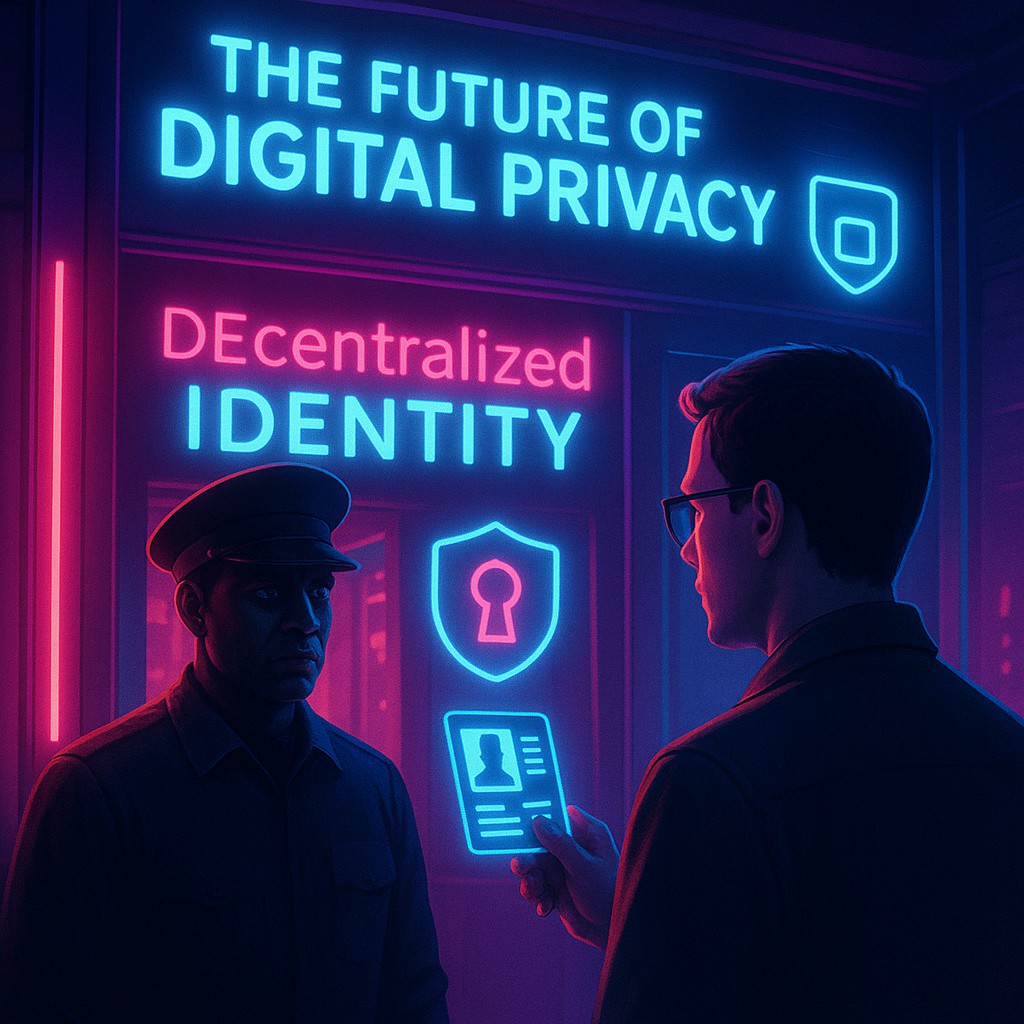
Imagine standing at the door of a crowded, neon-lit club where the bouncer asks for your ID. You pull out your wallet and hand over a plastic card. Suddenly, this stranger knows your full name, your home address, your exact height, and precisely how many days it has been since you were born. In that moment, you have traded a massive amount of personal information just to prove one simple fact: that you are over twenty-one. This "all or nothing" approach to identity has been the standard for decades, but it leaves a digital footprint that is increasingly vulnerable to leaks, hacks, and unwanted tracking in our hyper-connected world.
Digital privacy is currently undergoing a radical change, shifting from a defensive goal of "protecting data" to a proactive strategy of "data minimization" (collecting as little as possible). We are entering an era where decentralized identity systems allow us to navigate the internet with the precision of a ghost. Instead of handing over digital "birth certificates" to every website we visit, we are starting to use math-based tools to answer specific questions without revealing the records behind them. It is a shift from sharing who we are to simply proving what we are allowed to do. This evolution is not just about better encryption; it is about taking back our personal stories from the giant databases that have held them for far too long.
The Magic of Knowing Without Knowing
At the heart of this privacy revolution lies a concept that sounds like science fiction: Zero-Knowledge Proofs, or ZKPs. To understand how they work, imagine a giant "Where’s Waldo?" book. You want to prove to a friend that you found Waldo, but you do not want to show them where he is on the page. To do this, you take a massive sheet of cardboard with a tiny hole cut in the center. You slide the book behind the cardboard until Waldo appears in the hole. Your friend can now see Waldo and knows for a fact that you found him. However, because the rest of the page is covered, they have "zero knowledge" of his coordinates or what the rest of the map looks like.
In the digital world, ZKPs work through complex math rather than cardboard cutouts. When a website asks for your age, your digital wallet does not send your birthday. Instead, it runs a math problem that checks your government-issued ID locally on your phone and creates a "voucher." This voucher is a cryptographic proof that essentially says, "The math checks out; this person is over eighteen." The website receives this digital "Yes" and nothing else. They do not get your name, your photo, or - most importantly - a piece of data that they could lose in a future security breach. This makes the interaction fast and far more secure for everyone.
By moving the verification process to the "edge" (your own device) rather than a central server, we get rid of the "honey pots" of data that hackers love to target. In the old model, a company might store millions of birthdays. If they get hacked, that data is gone forever. In a decentralized model using ZKPs, the company never has the data to begin with. They only hold the "proof," which expires or becomes useless once the transaction is over. It is a fundamental shift that replaces the "trust me" model of the internet with a "verify me" model that respects personal boundaries.
Flipping the Script on Data Collection
The current internet economy is built on selling user data, often justified by the need for security or a "personalized experience." However, decentralized identity protocols turn this logic upside down by introducing "Self-Sovereign Identity." In this framework, you are the sole owner of your identity details. These details are verified by trusted groups, such as a local government or a school, and then stored as "verifiable credentials" in your private digital wallet. You decide when to show them and, through the power of ZKPs, exactly how much to reveal.
This technology solves the old tug-of-war between convenience and security. Usually, if you want more security, you have to deal with more "friction," like long forms and dozens of passwords. If you want convenience, you usually have to sacrifice privacy by clicking a "Log in with" button from a tech giant. Decentralized identity offers a third path. You can enjoy the ease of a one-click login while keeping the fortress-level privacy of staying anonymous. The following table shows the major differences between the old systems and the decentralized future.
| Feature |
Traditional Centralized Identity |
Decentralized Identity (ZKPs) |
| Data Storage |
Stored in corporate or government databases. |
Stored locally on the user's phone or device. |
| Privacy Level |
High exposure; full records shared with third parties. |
Zero-knowledge; only specific facts are shared. |
| Security Risk |
Large "honey pots" are targets for hackers. |
Spread-out risk; no central database to breach. |
| User Control |
Third parties control access and can "cancel" you. |
The individual owns and manages their own digital keys. |
| Authentication |
Passwords and physical paper documents. |
Digital signatures and mathematical proofs. |
While this table highlights the benefits, it is important to see that decentralized identity is not just a tool for hiding; it is a tool for empowerment. It allows for "selective disclosure," meaning you could prove you have a university degree without revealing your GPA, or prove you earn enough to rent an apartment without showing your entire bank statement. This level of control is something the physical world has never been able to offer.
The Physics of Digital Sovereignty
The mechanics of this system rely on a decentralized ledger, often a blockchain, which acts as a global, unchangeable phone book. This ledger does not store your personal information; that would be a privacy nightmare. Instead, it stores "public keys" and "revocation lists" (checklists of canceled IDs). When a government office issues you a digital residency permit, they sign it with their digital key and give it to you. When you want to prove your residency to a utility company, your app shows them the permit. The utility company looks at the ledger to see if the government’s signature is valid and hasn't been canceled.
The beauty of this setup is that the government does not need to be involved in the actual transaction between you and the company. They do not know who you are dealing with or when you are using your ID. This cuts the "surveillance link" that usually exists when we use centralized logins. It also prevents any single group from being able to "turn off" your identity across the entire web. In a decentralized system, as long as you have your private keys, you have the proof of who you are.
However, this new power comes with real responsibility. In the traditional world, if you lose your passport, you go to the embassy for a new one. In the decentralized world, your "private key" is the literal mathematical lock on your identity. If you lose that key and have not set up a recovery method, those proofs are gone for good. There is no "forgot password" link for the laws of math. This is why many new systems are building "social recovery" features, where you can pick a few trusted friends or extra devices to help you get back in without ever giving them your private data.
Mastering the Art of Data Minimization
We often think of data as an asset, but for many companies, it is actually a liability. Every piece of sensitive information a company holds is a potential lawsuit or a brand-destroying headline. By using decentralized identity, companies can stop being "data hoarders" and focus on being "service providers." This shift is incredibly helpful for industries where checking age or location is required by law. By using ZKP-based age checks, a gaming site or social media app can follow the law perfectly without ever touching a child’s birthday or a user’s social security number.
There is a common misunderstanding that this technology is only for people with something to hide. That logic is as flawed as saying you only need curtains on your windows if you are a criminal. Privacy is a basic human need for dignity and freedom. Using a decentralized identity is not about lying; it is about context. You are a different "version" of yourself to your doctor than you are to your boss or a casual gaming site. These protocols let you show the right version for each situation without leaking your entire life history at every turn.
As we move forward, we are also seeing the rise of "Decentralized Identifiers" (DIDs). These are a new type of digital address that you own and control. Unlike a username or an email address owned by a company, a DID is created by you. It can be linked to any number of "verifiable credentials," creating a flexible identity that moves with you from one app to the next.
- Portability: You can move your reputation and credentials between platforms without starting over.
- Security: Mathematical signatures ensure that your credentials cannot be faked by others.
- Efficiency: No more scanning passports or waiting days for manual checks; it happens in milliseconds.
- Autonomy: You are the "root" of your own digital life, not just a line in a corporate database.
These systems are already appearing in small ways, from digital driver's licenses to "Proof of Personhood" checks that prove a user is a human and not a bot without identifying exactly which human they are. As the technology matures, it will likely become the invisible backbone of the internet, working quietly in the background to keep our personal lives personal.
Stepping Into a More Private Future
The shift toward decentralized identity is more than just a tech upgrade; it is a total redesign of how we trust one another online. By mastering data minimization and zero-knowledge proofs, we are building an internet that is more resilient and more human. We are moving away from a world where we are tracked by every click and toward one where we have the power to share only what is necessary, when it is necessary, and with whom we choose.
As you explore this new frontier, remember that the goal is not to disappear, but to appear with intention. Use the tools that let you own your digital self, and stay curious as the technology grows. The power to prove your age, your home, or your skills without giving up your privacy is a massive step forward. It allows us to keep the mystery of our own lives while still being part of the modern world. You are the architect of your digital footprint, and you finally have the tools to build a path that is both secure and uniquely yours.