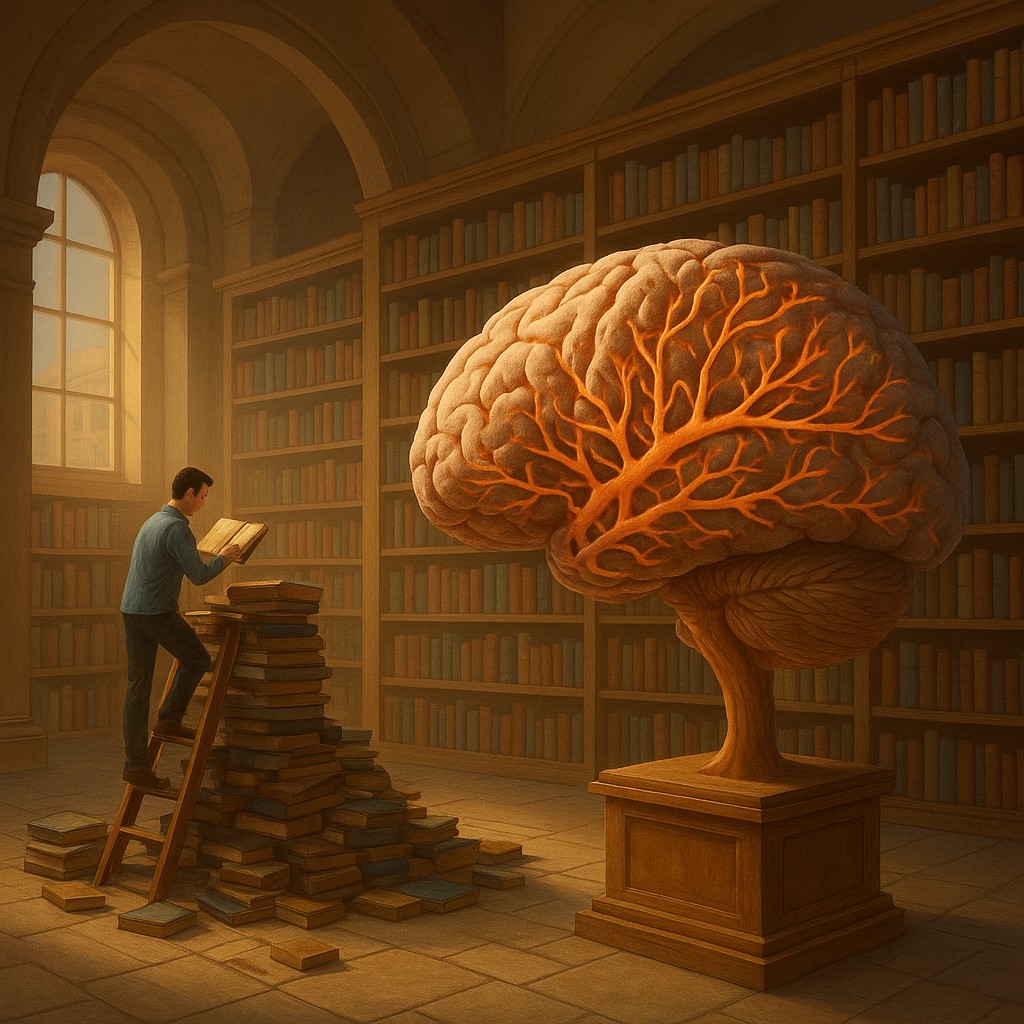
Imagine for a moment that you decided to build a library. At first, you are so excited that you order every book ever printed, in every language, on every possible subject. You stack them in the hallways, pile them on the stairs, and cram them into the bathrooms. Soon, your library is so cluttered that you cannot find the one book you need to bake bread or fix a flat tire. The sheer volume of "possibility" has created a massive bottleneck. To make the library useful again, you have to start throwing things away, specifically the books you never open.
This is exactly how your brain works during your first two decades. You aren't born with a lean, efficient thinking machine; you are born with a chaotic, overcrowded warehouse of potential connections. As you grow, your brain undergoes a radical transformation called synaptic pruning. It is a biological "edit" where your nervous system decides which neural pathways are worth keeping and which are just taking up space. By the time you reach adulthood, your brain actually has fewer connections than it did when you were five years old, but those remaining links are faster, stronger, and much better suited for your daily life.
The Architectural Chaos of the Infant Mind
When a baby is born, their brain is a frantic hive of activity. In the first few years, the brain undergoes a process called synaptogenesis, which is just a technical term for growing synapses (the gaps between brain cells where signals jump) at a staggering rate. By age two or three, a child’s brain has roughly double the number of synapses it will have in adulthood. This is why toddlers are such incredible learning sponges. They can pick up the nuances of a language, the physics of a falling spoon, and their parents' complex social cues all at once because their brains are wired to say "yes" to every piece of incoming data.
However, there is a major downside to being too connected. If every nerve cell is talking to every other cell, the "noise" becomes overwhelming. Imagine trying to have a private conversation in a room where 500 people are shouting at the top of their lungs. Your brain needs a way to quiet the crowd so the important voices can be heard. This is where the "gardener" comes in. Your brain identifies the pathways used most often, like the one that recognizes the sound of "Mama" or the one that controls the muscles for walking. These paths are marked as essential, while the ones that haven't been touched in months are scheduled for demolition.
This process is not a sign of decay; it is the ultimate form of streamlining. By removing the "extra" wires, the brain saves a huge amount of energy. Brains are expensive to run, consuming about 20 percent of your total daily calories. Keeping a trillion unused connections alive would be like paying rent on thousands of empty apartments. Synaptic pruning ensures your energy goes toward the skills and memories that actually help you navigate your world. It is the transition from being a "jack of all trades" to being a specialized expert in being you.
The Biological Scissors and Shuttles
So, how does the brain actually "cut" a connection? It isn't as if a tiny person with a pair of shears is wandering through your head. Instead, the process is driven by chemical signals and specialized cells called microglia. Microglia act as the brain's immune system or its "trash collectors." When a synapse is used frequently, it gets "tagged" with certain proteins that act like a protective coating. When a synapse sits idle, it lacks these tags, signaling to the microglia that the connection is no longer needed. The microglia then move in, break down the connection, and recycle the raw materials for other uses.
While the "waste" is being cleared out, another process called myelination happens at the same time to the pathways that remain. Think of myelination as wrapping a copper wire in high-quality rubber insulation. A fatty substance called myelin coats the nerve cells, which prevents electrical signals from leaking out and allows them to travel up to 100 times faster than they would on an uninsulated wire. This creates a powerful "use it or lose it" dynamic. The more you practice a skill, the more myelin wraps around that circuit, making it less likely to be pruned away.
This dual system of pruning the weak and insulating the strong explains why childhood experiences have such a deep impact on adult life. If a child spends years playing the violin, those specific motor and hearing circuits are heavily insulated and protected. Even if that person never picks up a violin again after age twenty, the circuit might be "set" in stone, allowing them to play a piece decades later with surprising ease. Conversely, if a child is never exposed to a second language during these peak pruning years, the brain may permanently dissolve the circuits needed to tell the difference between certain foreign sounds, making it much harder to sound like a native speaker later in life.
Timing the Great Neural Clear-Out
Pruning does not happen all at once; it moves through the brain in waves, traveling from the back to the front. This sequence helps explain why humans behave so differently at various stages of life. The first areas to be polished are the sensory and motor regions at the back of the brain. This is why young children become physically coordinated and gain sharp eyesight and hearing relatively early. They are "pruning" their way toward mastering their own bodies.
The last area to go through this refinement is the prefrontal cortex, the "CEO" of the brain located right behind your forehead. This region handles high-level tasks like impulse control, long-term planning, and weighing consequences. In most people, the prefrontal cortex doesn't finish its major pruning phase until the mid-twenties. This explains a lot of teenage behavior. A teenager might have a highly developed emotional center but a prefrontal cortex that is still a cluttered mess of slow-moving connections. They feel the "drive" to do something risky, but the "brakes" aren't fully wired yet.
| Developmental Stage |
Brain Activity Level |
Primary Pruning Focus |
Behavioral Impact |
| Infancy (0-3) |
Explosion of synapses |
Growth, tiny amount of pruning |
Rapid learning of everything |
| Childhood (4-12) |
Strategic refinement |
Sensory and motor skills |
Coordination and language |
| Adolescence (13-20) |
Massive "clear-out" |
Prefrontal cortex (late stage) |
High emotion, risk-taking |
| Adulthood (25+) |
Stable and specialized |
Maintenance and efficiency |
Expertise, slower new learning |
As the table shows, there is a trade-off between "plasticity" (the ability to change) and "efficiency" (the ability to perform). A child's brain is incredibly plastic, meaning it can recover from injuries or learn new systems easily, but it is not very efficient. It is easily distracted and lacks the "shortcuts" that adults use to process information quickly. An adult brain is a fine-tuned machine, capable of complex logic and rapid execution, but it is much more resistant to fundamental change. We become "set" in our ways because our neural paths have been paved over with thick layers of myelin.
Debunking the Myths of Brain Growth
There is a common mistake in thinking that our brains stop growing after childhood, or that we only use ten percent of our brain. Both are false. Synaptic pruning proves that we use our entire brain, but we use it differently as we age. The "ten percent" myth likely started because people saw we had fewer connections as adults and assumed we were losing our potential. In reality, we are just using a more refined version of it. It is the difference between a rough block of marble and a finished statue; the statue has less stone, but it has much more meaning and purpose.
Another myth is that pruning is a "bad" thing. We usually think of losing things as a negative, but in the brain, "loss" is the key to intelligence. People with certain conditions, such as autism or macrocephaly (an enlarged head), sometimes show signs of "under-pruning." Their brains keep too many connections, which can lead to sensory overload and trouble making sense of information. Without the biological "editor" deleting the fluff, the brain becomes overwhelmed by its own complexity. Pruning is not a loss of intelligence; it is the refinement of it.
Finally, while the most aggressive pruning happens in youth, our brains never completely stop changing. A smaller, more subtle version of this process continues throughout our lives, a concept known as neuroplasticity. While you won't experience another massive "clearance sale" like you did in your teens, you can still strengthen or weaken connections by choosing how you spend your time. If you start a new hobby at fifty, you are still telling your brain to protect those new synapses and prune away the ones related to old habits. The "sculpting" just happens at a slower pace.
The Power of Conscious Architecture
Understanding synaptic pruning changes how we look at our daily habits. It teaches us that the brain is not a static object like a computer hard drive, but a living forest that reacts to the sunlight of our attention. Every time you practice a skill, you are "watering" those neural pathways, signaling that they are too important to be cut. Every time you scroll mindlessly through a phone screen instead of doing deep work, you are neglecting those "deep thinking" circuits, making them prime targets for the trash collector.
This reality is both sobering and empowering. It is sobering because it means "lazy" habits are physically carving themselves into our anatomy. If we spend our younger years avoiding challenges, our brain will prune away the resilience and problem-solving circuits we might need later. But it is empowering because we are the architects of our own minds. If you want to be someone who is good at math, calm under pressure, or skilled at a craft, you simply have to use those "muscles" consistently until your brain realizes they are essential.
Your brain wants to be efficient. It wants to help you survive in the world you actually live in, not the world of "what if." By embracing the "use it or lose it" nature of your biology, you can take an active role in the sculpting process. You aren't just learning a skill; you are physically shaping the machine that interprets your reality. Choose your "books" wisely and read them often, because the gardener is always watching, ready to clear the path for whatever you value most.