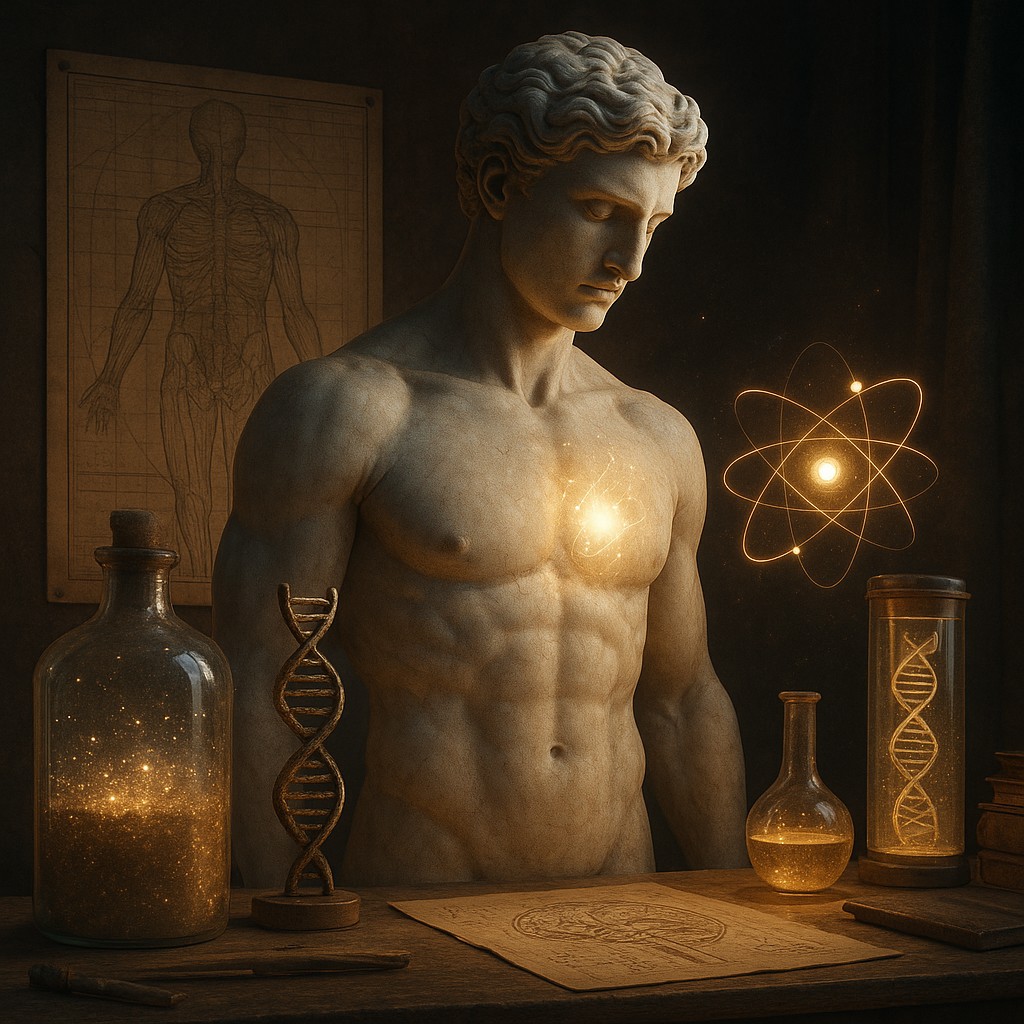
Imagine for a moment that you have been handed the blueprints to the most complex machine in the known universe. You are standing in a cosmic workshop, surrounded by jars of stardust, strands of DNA, and the flickering light of consciousness. Your task is to assemble a "perfect" human being. It is an intoxicating thought, isn't it? We have spent thousands of years trying to figure out what that even means. From the marble statues of ancient Greece that sought mathematical symmetry to modern biohackers trying to time their sleep cycles with laser precision, humanity has always been obsessed with an "ideal" version of itself. Yet, the closer we look, the more we realize that perfection is not a fixed goal but a delicate, constant dance between conflicting powers.
The trouble with defining perfection is that we often mistake "flawless" for "perfect." In engineering, a flawless machine never breaks, but in biology and psychology, a flawless person would be a fragile one. If you never failed, you would never learn; if you never felt pain, you would never look for safety; if you never felt sorrow, you would have no way to measure joy. The perfect human, therefore, is not a superhero carved out of unmoving granite. Instead, they are a masterpiece of adaptability - a curious blend of physical toughness, emotional depth, and a hunger for understanding. They fit into the world not by dominating it, but by living in harmony with it in a way that lifts everyone around them.
The Biological Power of Balance and Change
When we think about a physically perfect human, our minds often drift toward the Olympics. We imagine the sprinting speed of a cheetah, the strength of a gorilla, and the long life of a giant tortoise. However, true biological perfection lies in being an all-rounder rather than a specialist. A person built only for strength would struggle in a marathon, and one built only for speed might lack the strong immune system needed to survive a changing environment. The perfect biological specimen is a generalist. They have a heart and lungs that thrive under stress and a nervous system that knows exactly when to switch from "fight or flight" to "rest and digest." This balance ensures the body does not burn itself out by staying on high alert when there is no danger in sight.
Beyond muscles and bones, the perfect human's brain would be their greatest asset. We often focus on raw IQ, but the ideal mind is defined by neuroplasticity - the brain's ability to rewire itself and form new connections throughout life. This means the perfect human is always a student. Their brain is not a dusty library of old facts but a living laboratory. They can unlearn a bad habit as quickly as they can pick up a new language or a complex hobby. This physical flexibility allows them to age well, keeping their mind sharp because they never stop questioning their own beliefs. Their body is a finely tuned instrument, not because it never gets sick or tired, but because it earns its way back to health with remarkable efficiency.
The Foundation of Character and Personality
While physical health provides the base, the structure of a perfect human is built from character and emotional intelligence. In a world that often rewards "looking out for number one," the ideal person understands that humans are social animals whose survival and happiness are tied to the group. This person has a high degree of empathy, but not the kind that leaves them paralyzed by the world's suffering. Instead, they practice "compassionate detachment," where they can feel for others and understand their views without losing their own sense of self. They are the person who listens more than they speak - not because they have nothing to say, but because they know that every person they meet is a hidden world waiting to be explored.
Honesty is another cornerstone, yet the perfect human isn't "brutally" honest. Brutal honesty is often more about the cruelty than the truth. The ideal person practices "kind honesty," which aims to build up rather than tear down. They have rock-solid integrity, meaning their inner values match their public actions. You don't have to wonder who they are when no one is looking, because they are the same person in the dark as they are in the spotlight. This consistency creates a sense of safety for those around them. They act as a "psychological anchor," providing a calm presence in high-stress moments. By keeping their ego in check, they let others shine, realizing that true greatness is measured by how many people you inspire, not by how many people you stand above.
The Three Pillars of Human Excellence
To better understand how these different traits work together, it helps to look at the three main areas where we measure human quality. No single pillar makes someone perfect; rather, it is the overlap of all three that creates a balanced, successful life. These can be broken down into physical, intellectual, and social spheres.
| Category |
Key Quality |
Real-World Application |
| Physical |
Homeostasis |
The ability to stay stable inside while dealing with outside stresses like cold, heat, or illness. |
| Intellectual |
Intellectual Humility |
Recognizing that your own beliefs might be wrong, which leads to a constant search for truth. |
| Social |
Altruistic Reciprocity |
Doing kind acts that strengthen the community, creating a rising tide that lifts all boats. |
As the table shows, being "perfect" in any category isn't about having the "most" of something. It is not about being the most muscular, the smartest, or the most popular. It is about the quality of how you interact with the world. Intellectual humility, for example, is much more "perfect" than knowing everything. A person who thinks they know everything has reached a dead end; a person who remains humble is an endless vessel for growth. This framework suggests that perfection is an active process of self-correction and intentional action.
The Spark of Curiosity and Logical Thinking
What truly sets the perfect human apart from a high-functioning machine is the quality of their thoughts. If you were to look inside the mind of our ideal human, you wouldn't find a rigid set of rules. Instead, you would find a vibrant sense of curiosity. To the perfect human, the world is endlessly interesting. They find wonder in the veins of a leaf and in the complex systems of a modern city. This curiosity isn't just about collecting trivia; it is the fuel for critical thinking. They have the rare ability to hold two opposing ideas in their mind at once and still function. They don't jump to conclusions or fall for the easy comfort of "us versus them" thinking.
Furthermore, the perfect thinker understands their own biases. We all have them - evolution hardwired us to prefer what is familiar and to fear what is different. The ideal person recognizes these mental shortcuts and actively works to get past them. They ask themselves, "Why do I believe this?" and "What if I am wrong?" This level of self-awareness is the ultimate defense against the tribalism and misinformation that plague our modern world. By being a "rational optimist," they realize that while the world has flaws, it can be improved through steady, thoughtful effort. They don't just think for the sake of it; they think to act, turning their ideas into real benefits for the world.
Debunking the Myth of the Flawless Life
One of the biggest myths about a "perfect" person is that they lead a life free of conflict, sadness, or mistakes. We see filtered images on social media and think, "That is what perfection looks like." In reality, that is just a polished surface. A life without struggle is like a muscle that never lifts a weight; it becomes weak and withers. The perfect human does not avoid failure; they use it. They see every mistake not as a stain on their character, but as a vital piece of information. This shift in perspective is what psychologists call a "growth mindset" - the understanding that our abilities are not set in stone but are like gardens that require constant care.
Another common myth is that the perfect human is entirely self-sufficient, a "lone wolf" who needs no one. Science tells us the exact opposite. Human beings are the most cooperative species on the planet, and our greatest achievements - from the pyramids to the moon landing - were the result of working together. The perfect human knows when to ask for help and when to lean on others. Vulnerability is not a weakness here; it is a profound strength because it builds trust. By being open about their own limits, the ideal person makes it okay for others to be honest about theirs. This creates a culture where people can actually solve problems instead of wasting energy pretending they don't have any.
Living with Purpose and Clear Ethics
The final piece of the puzzle is a sense of purpose. A perfect human who has health, intelligence, and social skills but uses them for nothing is like a high-performance sports car parked forever in a garage. Perfection requires a direction. This doesn't mean everyone has to save the world, but it does mean having an "ethical North Star." The ideal human acts in a way that reduces suffering and increases well-being. They understand the idea of "stewardship" - the duty to leave the planet slightly better than they found it. This could show up as raising kind children, creating beautiful art, or simply being a reliable neighbor.
This ethical clarity provides a sense of peace that money cannot buy. When your actions match your values, you experience "eudaimonia," an ancient term for "flourishing" or deep well-being. It is different from simple happiness, which can be fleeting and depends on outside events. Eudaimonia is the deep satisfaction of knowing you are meeting your potential and helping something larger than yourself. The perfect human, then, is a "meaning-maker." They take the raw, often chaotic experiences of life and weave them into a story of growth. They are the heroes of their own lives, but they are also the most supportive sidekicks in the lives of others.
Unfolding Your Own Potential
As we have seen, the "perfect" human being isn't a distant, cold ideal found in a textbook. They are not a person without scars or a mind without doubts. Perfection is found in the way someone handles their flaws. It is found in the toughness of a body that keeps moving, the humility of a mind that keeps learning, and the warmth of a heart that stays open. You might realize that many of the traits we have discussed are things you already have or are working on. Perfection is not a finish line you cross; it is the quality of the journey you take. It is the decision to be a little more curious today than you were yesterday, and a little kinder tomorrow than you are today.
When you stop chasing the impossible ghost of flawlessness, you free yourself to pursue the very possible goal of excellence. You are a biological wonder, a social builder, and a storyteller all wrapped into one. By embracing the complexity of your own nature - the messy parts along with the brilliant ones - you start to live out the very perfection we have been describing. The blueprints for the ideal human aren't locked away in a cosmic workshop; they are written in your every choice. You have the power to sharpen your character and your mind. In doing so, you don't just find the perfect human being; you become the most authentic, vibrant, and impactful version of yourself, which is the only kind of perfection that truly matters.