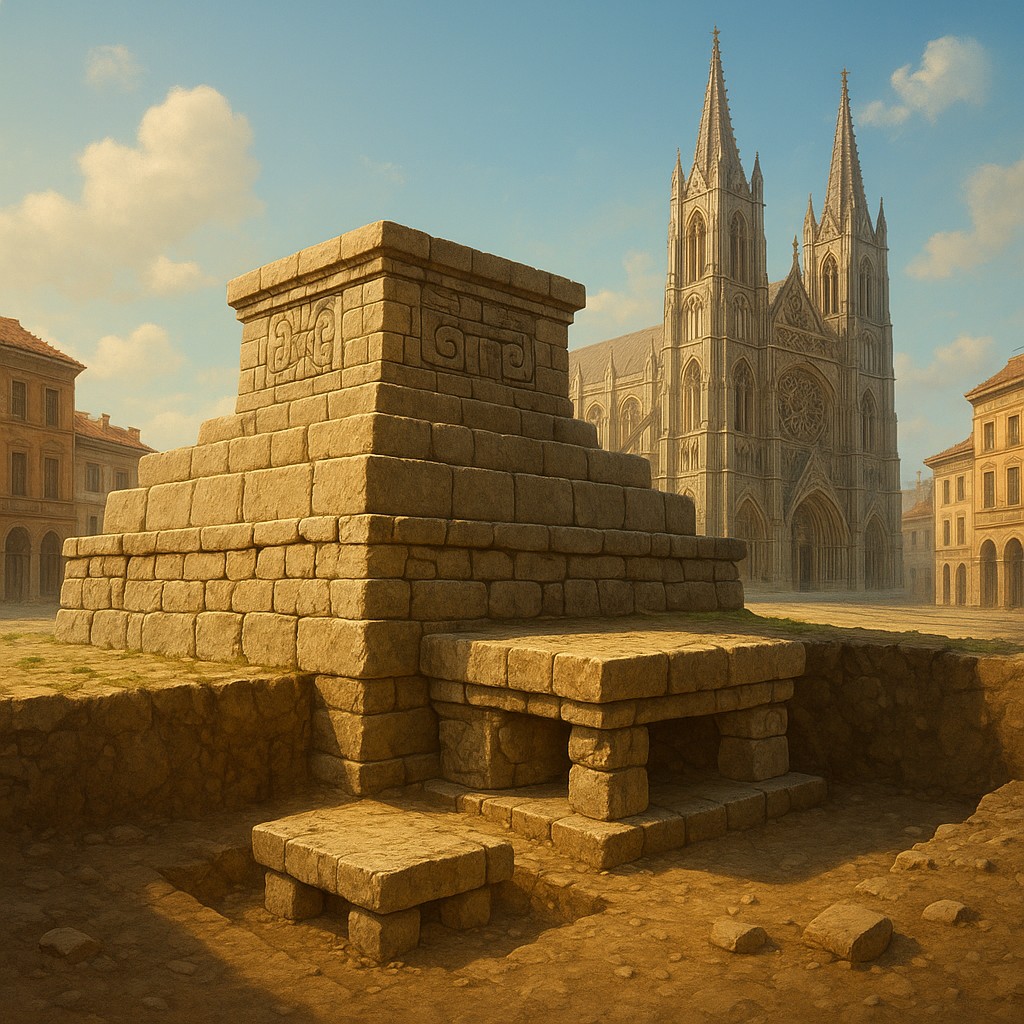
Imagine walking through the streets of a modern European city or an ancient Mexican valley. You see a grand cathedral with spires reaching for the clouds, or perhaps a mosque decorated with complex geometric tiles. To most people, these are monuments to a single faith, frozen in time. However, if you were to peel back the floorboards or dig beneath the foundations, you might find something startling: the stone altar of a Roman god, the charred remains of a Viking hearth, or the precisely carved base of an Aztec temple. This isn't just a result of urban crowding or a lack of space. It is a calculated, brilliant, and often messy strategy known as religious superimposition.
When a new religion enters a region, it faces a massive challenge: how do you convince people to stop doing what their ancestors have done for a thousand years? Humans are creatures of habit, and sacred habits are the hardest to break. We become attached to the way the light hits a specific mountain peak at dawn, or how a cool spring feels on a dusty afternoon. Instead of trying to erase these deep memories of the land, historical leaders often chose to "rebrand" them. By building a new house of worship directly on top of the old one, they captured the existing spiritual energy of the location and pointed it toward a new god. It was the ultimate architectural "hack" for social engineering.
The Psychology of Spiritual Geography
To understand why this happened, we have to stop thinking of religions as just sets of abstract ideas and start seeing them as physical experiences. For much of human history, "the sacred" wasn't something you just read about in a book; it was a place you went. People believed in "thin places," where the boundary between the human world and the divine felt paper-thin. These were often natural landmarks, such as waterfalls, ancient oak groves, or heights that felt closer to the heavens. If a community has spent generations trekking to a specific hilltop to pray for rain, they aren't going to stop just because a new priest tells them to. To them, the hill itself is holy.
Conquering or converting forces recognized that blocking access to that hill would spark a rebellion. If they built their new temple five miles away in a convenient flat field, nobody would show up. The solution was to occupy the "spiritual high ground." By placing the new altar exactly where the old one stood, the new religion took over the "muscle memory" of the faithful. People would keep coming to the same spot, walking the same paths, and making similar gestures, but under a different name. This reduced the "friction of conversion," making the transition feel less like a violent break and more like a natural change.
Pope Gregory and the Art of the Soft Pivot
One of the most famous examples of this strategy comes from the year 601 AD. Pope Gregory the Great sent a letter to a missionary named Mellitus, who was on his way to convert the Anglo-Saxons in England. Initially, the plan was to destroy pagan temples. However, Gregory had a change of heart and ordered a shift in strategy that would shape the landscape of Europe for centuries. He instructed Mellitus not to tear down the temples, but to "purify" them.
The logic was purely psychological. Gregory argued that if the temples were well-built, they should be cleaned with holy water and repurposed. If local people saw their familiar places of worship being used, they would be more likely to visit them and, eventually, accept the new faith. He even suggested replacing traditional animal sacrifices with Christian feasts. Instead of killing oxen for idols, the people would kill oxen for a community meal to celebrate a saint’s day. It was a masterpiece of cultural recycling. This is why you will often find ancient yew trees, some older than Christianity itself, sitting right in the middle of English churchyards. The trees were the original sacred markers; the church was simply built to match them.
A Tale of Two Cities: Cordoba and Cholula
The practice of superimposition is not limited to one part of the world or one faith. It is a global phenomenon that shows the universal mechanics of power and tradition. Two of the most striking examples are in Spain and Mexico, where layers of stone tell a story of shifting empires.
In Cordoba, Spain, the Great Mosque-Cathedral is a literal sandwich of history. Originally a Christian church, the site was transformed into one of the most magnificent mosques in the Islamic world during the 8th century. When Christians reclaimed the city centuries later, they didn't tear it down. They were so moved by its beauty that they built a Renaissance cathedral nave right in the middle of the mosque’s forest of arches. Today, you can stand in a spot where the architecture shifts from Islamic horseshoe arches to Gothic vaulted ceilings in the blink of an eye. The site remained sacred to the city, even as the "owners" changed.
Across the ocean in Mexico, the Great Pyramid of Cholula offers a more dramatic example. To the naked eye, it looks like a large hill topped by a colonial Spanish church. In reality, that "hill" is the largest pyramid ever built by volume, dedicated to the god Quetzalcoatl. When the Spanish arrived, they built the Church of Our Lady of Remedies directly on the summit. This wasn't just about height; it was about decapitating the old religious order and placing the new one on top. By occupying the peak of the pyramid, the church literally stood on the shoulders of the old gods, making it impossible for the local people to ignore the new social order.
| Feature |
Religious Superimposition |
Accidental Architectural Overlap |
| Main Intent |
Strategic continuity and social control. |
Efficient use of space in crowded cities. |
| How Sites Are Chosen |
Based on the spiritual fame of the location. |
Based on property lines and stable soil. |
| Visual Evidence |
Intentional reuse of sacred pillars or altars. |
Random mix of shop, home, and government ruins. |
| Impact on Locals |
Eases the transition by using old habits. |
Usually causes building and traffic problems. |
| Symbolic Power |
Claims "victory" over the previous god. |
Represents urban growth and the economy. |
Distinguishing Strategy from Urban Clutter
It is important to distinguish between intentional superimposition and what we might call "urban lasagna." In ancient cities like Rome, Istanbul, or Cairo, humans have been building on top of one another for thousands of years simply because there is nowhere else to go. This is accidental overlap. If a coffee shop is built over the ruins of a Roman laundry, it isn't a religious statement; it’s just how real estate works in a crowded world.
Religious superimposition is different because it focuses on "sacred geography." In the ancient world, not all space was equal. A spring that never ran dry or a cave with a strange echo was seen as fundamentally different from the dirt ten feet away. When you see a church built on a remote, inconvenient mountain peak, or a mosque built over a specific thermal spring, you are looking at a strategic choice. The builders went out of their way to be there. They struggled with difficult terrain and expensive logistics just to ensure they were standing on a pre-existing "power spot." This distinction helps us realize that history isn't just a pile of trash; it’s a series of deliberate choices about which symbols are worth keeping and which must be overwritten.
The Mechanism of Spoliation
Architecturally, this process often involved "spolia," which is a historical term for "stealing old materials to build new things." If you look closely at the pillars in many ancient mosques or early churches, you might notice that the columns don't quite match. One might be a bit taller, another might be a different color of marble, and the carvings at the top (known as capitals) might look like they belong to a different century.
This wasn't always done to save money. While reusing stone is easier than cutting new rock, spolia served a symbolic purpose. By putting the physical stone of a pagan temple into the walls of a church, the builders showed that the old world had been "tamed" and put to work for the new one. It was a visual trophy. It told the worshippers: "The beauty of the past is not gone, but it now serves a higher truth." This served as a bridge between eras, helping the eyes of new followers adjust to the new regime while still seeing the familiar textures of their heritage.
The Lingering Echoes of the Past
Even when physical buildings are replaced, the deeper layers of superimposition often survive through folklore and "accidental" traditions. In many parts of Europe, saints were created who looked remarkably like the gods they replaced. Saint Brigid of Ireland, for example, shares a name, a feast day, and many traits with the Celtic goddess Brigid. By moving the devotion meant for a goddess toward a saint, the church created a safe harbor for old traditions within a new framework.
This tells us something profound about human culture: we rarely start with a "clean slate." We evolve rather than revolve. Every new layer of our civilization is deeply colored by the one beneath it. We see this today even in a non-religious sense. When a legendary old stadium is torn down to build a new one, fans often insist that the new "home plate" be placed at the exact same coordinates as the old one. We still believe, on some primal level, that certain spots on this earth hold a specific kind of magic that cannot be moved.
Understanding the history of religious superimposition allows you to see the world as a living document rather than a dusty museum. It reminds us that our ancestors were very practical, finding ways to blend the old with the new to keep the peace and preserve their communities. The next time you visit a historic site, look past the surface. Look at the stones that don't quite fit and notice the way the building lines up with a distant hill. Realize that you are standing on a foundation built by thousands of years of human hope, habit, and history. With this "X-ray vision" for the past, you will find that the world is far more layered and connected than it first appears.