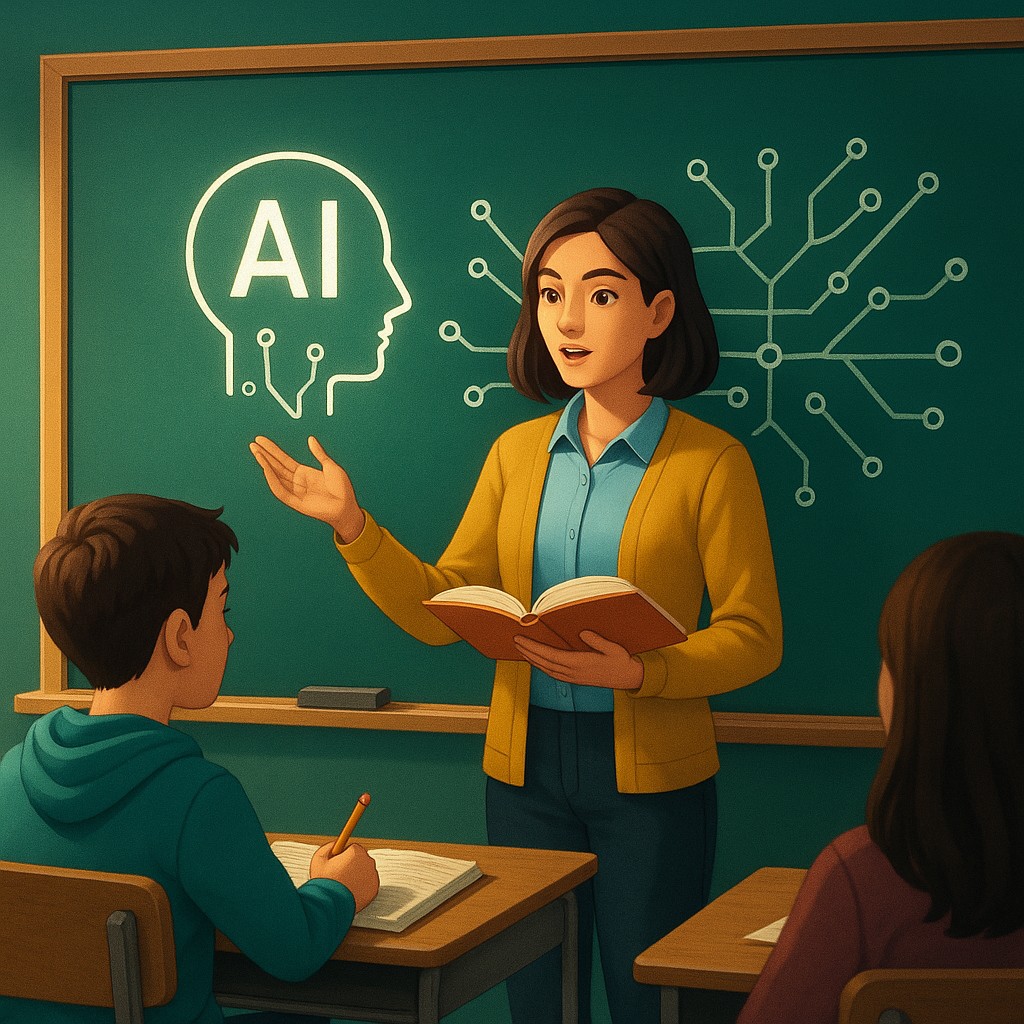
For decades, the struggle against technology in the classroom followed a set routine: first, we ban the distraction; then, we tolerate it; and finally, we realize it is the very tool students will use to build their future. We saw this cycle with pocket calculators in the seventies and the internet in the nineties. Today, the pattern is repeating with generative artificial intelligence, but with a fascinating twist. Instead of simply teaching kids how to "use" a tool, school districts are reframing how we interact with large language models as a foundational language skill. They are treating the "prompt" (the instruction given to the AI) not as a casual question, but as a high-stakes structure of intent. This task requires more logic than a traditional essay and more precision than a standard conversation.
This shift in education marks a transition. We are moving from viewing AI as an automated "answer machine" to seeing it as a "statistical processor" that requires specific, structured communication. When a student learns to prompt effectively, they are doing much more than taking a shortcut on their homework. They are engaging in a rigorous exercise, breaking down complex goals into clear, logical rules. This is the birth of AI literacy, a curriculum that prioritizes human clarity over machine magic. By moving away from "chatting" and toward "engineering," students are discovering that the quality of what the machine produces is a direct reflection of their own ability to think through a problem with absolute verbal precision.
The Ghost in the Statistical Machine
To understand why prompt engineering has become a core classroom skill, we must first push aside the common myth that AI "thinks" like a human. When a student types a query into a chatbot, they aren't talking to a conscious being that understands their feelings or the context they haven't mentioned. Instead, they are interacting with an incredibly sophisticated prediction engine. These models work by calculating the mathematical probability of the next word in a sequence based on massive amounts of data. This means that if a prompt is vague, the model has to guess what the user wants. This guessing often leads to "hallucinations" (confident but false statements) or generic, boring responses.
Educators are now teaching students to see this interaction as a technical challenge in reducing "information entropy." In this context, entropy refers to the amount of uncertainty or randomness in a message. If a student asks an AI to "write a story about a dog," the entropy is high because the AI could choose a thousand different breeds, settings, and tones. However, if the student specifies, "write a 300-word suspenseful story about a retired search-and-rescue Beagle in the Alps who finds a lost hiker," the entropy drops significantly. By narrowing the field of possibilities with specific keywords, the student guides the statistical processor toward a precise target.
Moving Beyond the Chat Interface
The most common mistake beginners make is treating an AI like a person sitting across a dinner table. In human conversation, we rely on "social shortcuts." We finish each other's sentences, read body language, and assume a shared cultural background that doesn't need to be explained. A large language model has none of that. It doesn't know you are a tenth-grader in Ohio unless you tell it. Treating the AI as a "colleague" rather than a "calculator" leads to frustration. Schools are now teaching a "mechanics-first" approach where students learn to provide the five essential parts of a professional prompt to ensure the machine has the right boundaries.
The following table illustrates the difference between a low-literacy "chat" approach and a high-literacy "engineering" approach.
| Element |
Low-Literacy Approach (The "Chat") |
High-Literacy Approach (The "Engineering") |
| Role Assignment |
Assumes the AI knows its purpose. |
Explicitly tells AI to "Act as a NASA scientist." |
| Context |
Provides a single sentence of intent. |
Provides background data, audience, and goal. |
| Constraints |
Uses vague words like "short" or "good." |
Uses metrics like "under 200 words" or "no jargon." |
| Step-by-Step |
Asks for the final result immediately. |
Requests a "Chain of Thought" or bulleted outline first. |
| Formatting |
Accepts whatever the AI generates. |
Demands specific output like a table, code, or poem. |
By mastering these distinctions, students move from being passive users of technology to being active architects of information. They realize that the AI is effectively a "genius without common sense," a powerful engine that will drive off a cliff if the directions aren't perfect. This realization forces a level of self-reflection that traditional writing assignments often miss. To give a good instruction, a student must first have a crystal-clear understanding of their own goal, which is the very definition of high-level thinking.
The New Art of Precise Language
In a traditional education, students studied rhetoric to learn how to persuade and inform human audiences. In the age of AI, we are seeing the rise of a "digital rhetoric" centered on semantic precision, or the art of choosing keywords that carry heavy statistical weight. Since AI models give more "attention" to certain parts of a prompt than others, students are learning to prioritize their instructions. They are taught that words like "summarize" are less effective than "distill into three actionable takeaways," because the latter provides a structural skeleton for the machine to fill.
This process mirrors the way a programmer writes code, but it uses the flexibility of everyday language. When a student breaks down a prompt, they are essentially organizing their thoughts into modules. They learn to separate the "Goal" (the what) from the "Style" (the how) and the "Knowledge" (the data). Separating these concerns is a sophisticated mental skill. It prevents "muddled thinking," where a person tries to say too many things at once. In a classroom, a teacher might ask a student to explain why a certain prompt failed, forcing the student to find the "logical leak" where the instructions became confusing.
Iteration as a Scientific Method
One of the most profound shifts in AI-integrated classrooms is the move from "one-and-done" assignments to a model of "iterative refinement." Traditional homework often focuses on the final product, but AI literacy focuses on the process of troubleshooting. If the AI produces an essay that is too formal or misses a key point, the student doesn't just give up. They analyze the output to see where their instructions were misunderstood. This creates a feedback loop that resembles the scientific method: form a hypothesis (the prompt), run the experiment (the generation), observe the results (the output), and refine the variables (the follow-up prompt).
This repeating process helps students get past "blank page" syndrome while simultaneously raising the bar for what "good work" looks like. Since the AI can handle the mechanical labor of drafting, the student's job becomes that of an editor and a strategist. They must verify facts, check for logical errors, and ensure the tone is right for the audience. This moves the student from "writer" to "director." Just as a movie director doesn't act in every scene but is responsible for the overall vision, the modern student uses AI to execute pieces of a project while maintaining total intellectual control.
Critical Thinking in a World of Instant Answers
The ultimate goal of teaching AI literacy isn't just to make students better at using software; it is to protect them against the risks of a world flooded with AI-generated media. When students understand "how the sausage is made," they become more skeptical of the information they consume. They learn that an AI can be "nudged" or "primed" to give biased answers if the prompt is loaded with leading questions. This understanding of "priming" (setting the AI's stage with specific context) is a vital lesson in media literacy. If a student sees how easy it is to make an AI sound like a radical or a cynic through a few clever instructions, they are more likely to recognize when a human author is doing the same thing.
By treating prompt engineering as a core language skill, we are preparing students for a workforce where "human-AI collaboration" will be the standard. Whether they become doctors, lawyers, or artists, they will need to communicate their specialized knowledge into systems that can help them do more. The ability to speak "machine" without losing one's "humanity" is the superpower of the 21st century. It requires a blend of the poet's love for the right word and the engineer's demand for the right result.
As you step into this new landscape, remember that the AI is not your replacement, but a vast, dark library where you are the only one holding a flashlight. The narrower and brighter your beam of light, the more effectively you can find exactly what you are looking for. Embrace the challenge of being precise, the joy of being clear, and the discipline of being logical. You are no longer just a student of subjects; you are a master of intent, learning to command the most complex tools ever built by simply speaking your mind with purpose.