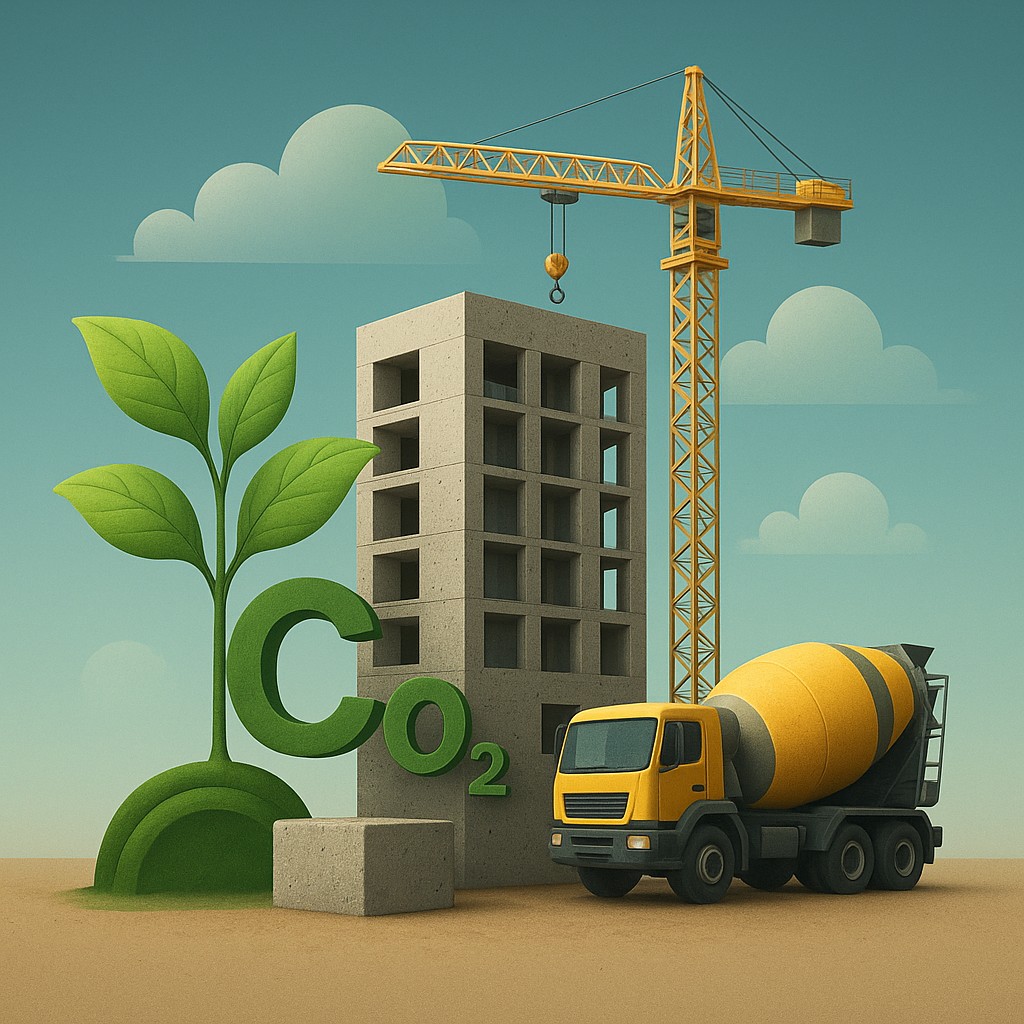
If you were to look around you right now, chances are you are within arm’s reach of the most consumed man-made material on earth. Concrete is the physical foundation of modern life, forming our bridges, skyscrapers, sidewalks, and sewers. We use roughly thirty billion tons of it every year, a volume so massive it is hard to wrap your head around. To put it simply, if the concrete industry were a country, it would be the third-largest carbon dioxide emitter in the world, trailing only China and the United States. This is because making cement, the "glue" that holds concrete together, is a double-whammy for global warming.
For decades, concrete has been seen as an environmental villain, a gray necessity that we could neither live without nor make "green." However, a fascinating shift is happening in materials science. Instead of viewing concrete merely as a source of pollution, engineers are beginning to treat it as a massive, spread-out sponge. By tweaking the chemistry of how concrete sets, we are entering an era of "carbon-negative" materials. We are no longer just trying to emit less; we are finding ways to use our infrastructure as a giant, permanent vault to lock away the very gases that are heating the atmosphere.
The Chemistry of a Climate Villain
To understand how we can turn concrete into a carbon sink, we first have to recognize why it was such a problem to begin with. The primary culprit is "Portland cement," the fine powder that acts as the binding agent in a concrete mix. Making cement requires limestone, which is mostly calcium carbonate. To turn that limestone into the reactive lime needed for cement, it must be heated in a kiln to more than 2,500 degrees Fahrenheit. This process releases carbon dioxide in two distinct ways. First, you have to burn a tremendous amount of fuel just to reach those extreme temperatures. Second, and more importantly, the chemical reaction itself releases CO2 as the limestone breaks down.
This chemical release is known as "calcination," and it accounts for about sixty percent of the emissions from cement production. Even if we ran every cement kiln on renewable electricity or hydrogen, we would still be left with the massive puff of CO2 that the rocks themselves give off when heated. This has long been the "hard-to-fix" wall that the industry hit. Because the emissions are baked into the chemistry of the material, simply using fuel more efficiently wasn't going to solve the problem. We needed a way to put the genie back in the bottle, or more accurately, put the carbon back into the stone.
Turning Gas into Granite
The breakthrough technology currently being used involves a process called carbon mineralization. When concrete is mixed, it is essentially a slurry of water, cement, and aggregates like sand and gravel. In a standard mix, the cement reacts with water to form a hard, crystal-like structure. The new "carbon-negative" approach adds a third ingredient: recycled carbon dioxide. Specialized machines at the concrete plant inject precise doses of liquid CO2 into the wet mix. As soon as the gas hits the slurry, it doesn't just bubble away like a soda; it undergoes a rapid chemical transformation.
The CO2 reacts with the calcium ions in the cement to form calcium carbonate nano-crystals. In simpler terms, the gas turns back into solid stone inside the wet concrete. These tiny minerals become permanently trapped in the concrete’s grid-like structure. They are not just "stored" the way a balloon holds air; they are chemically changed into a stable solid that will not leak out for centuries, even if the building is eventually torn down. This turns every sidewalk and support pillar into a permanent storage unit for captured industrial pollution, effectively canceling out a portion of the damage done when the cement was created.
Stronger Bones Through Mineralization
If you had told a construction foreman twenty years ago that you wanted to pump gas into his concrete, he likely would have kicked you off the job site. Traditionally, we avoid bubbles in concrete because they create "voids," or weak spots where the material can crack. However, the CO2 injection process is different because it isn't creating gas pockets; it is creating solid mineral mass. In a lucky twist of science, these tiny calcium carbonate crystals actually act as reinforcing fillers. They fill in the microscopic gaps in the cement paste, often resulting in a finished product that is five to ten percent stronger than traditional concrete.
This increased strength creates a "virtuous cycle" for engineers. If the concrete is naturally stronger because of the injected carbon, you can actually use less cement in the overall mix to reach the same structural rating. Since cement is the most expensive and most carbon-heavy part of the mix, using less of it saves money and further reduces the carbon footprint. It is a rare "win-win-win" for industrial engineering: you get rid of a waste gas, you create a tougher building material, and you lower the total amount of raw materials needed for construction.
Comparing the Old and the New
To get a clear picture of how this technology changes things, it helps to look at the differences in how these materials interact with the environment and the construction site. While the "new" concrete looks and feels identical to the old stuff, the internal mechanics are very different.
| Feature |
Traditional Concrete |
Carbon-Injected Concrete |
| Primary Role of CO2 |
Waste byproduct of production |
Functional mineral additive |
| Storage Mechanism |
None (Carbon is released) |
Chemical mineralization (Permanent) |
| Strength |
Baseline standard |
Often 5-10% higher compressive strength |
| Cement Requirement |
Standard volume |
Reduced (due to strength gains) |
| Climate Impact |
Roughly 1 ton CO2 per ton cement |
Significant reduction or potential neutrality |
The Limits of the Quick Fix
While catching carbon in a concrete trap is a massive leap forward, we have to stay grounded in reality. Carbon injection currently offsets about five to seven percent of the total carbon footprint of a batch of concrete. While that might sound small, when you multiply it by thirty billion tons of concrete worldwide, it represents a staggering amount of carbon being kept out of the sky. However, it is not a "silver bullet" that makes the industry green overnight. We still have to deal with those massive, roaring kilns and the intense heat required to start the whole process.
The ultimate goal is to combine several different technologies at once. Imagine a future where the kilns are powered by green hydrogen, the CO2 released during heating is captured directly from the chimney, and then that same captured CO2 is trucked to a mixing plant and injected back into the concrete slurry. This "closed loop" is the finish line. We also have to consider the logistics: getting liquid CO2 to every construction site or mixing plant requires a whole new network of pipes and trucks. It is a massive engineering challenge that goes far beyond just "making better rocks."
Reimagining the Human Footprint
Despite the hurdles, the mental shift this represents is huge. For the last century, human progress has meant environmental damage. We built our world by taking things from the earth and puffing waste into the sky. Technologies like carbon-negative concrete prove that we can flip that script. We are beginning to learn how to build by taking waste out of the sky and putting it back into the ground in a way that actually makes our structures safer and more durable.
This is the heart of "circular" engineering. It requires us to stop looking at CO2 as a poison and start looking at it as a building block. As these specialized machines become standard equipment at concrete plants from New York to Shanghai, the very definition of a "concrete jungle" might change. Instead of being a symbol of urban heat and pollution, the cities of the future could serve as the world’s largest man-made carbon sinks, quietly cleaning the atmosphere while we walk on their sidewalks and sleep within their walls.
The road to a sustainable world is paved with many different materials, but it is increasingly clear that carbon-trapping concrete will be the bedrock of that path. As you walk outside today and see a construction crew pouring a new foundation, take a moment to look at the gray slurry. It may look like the same heavy, dull material we’ve used for a hundred years, but beneath the surface, a high-tech chemical dance is happening. We are finally learning how to build for the future by literally solidifying the problems of the past.