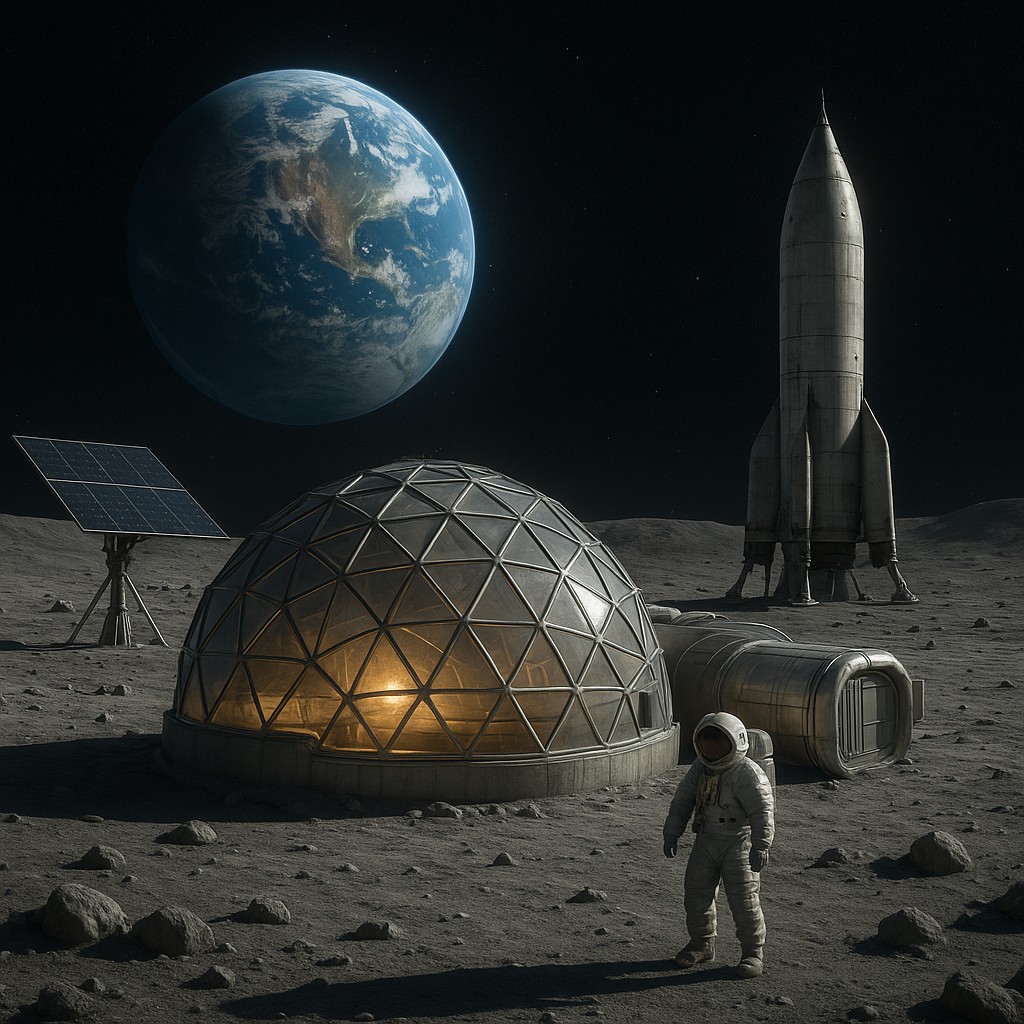
For as long as humans have gazed at the night sky, the Moon has been our silent, glowing companion. It serves as a constant reminder of a vast frontier sitting just a three-day journey away. While we have visited before, our previous trips were essentially the space-age version of a quick weekend camping trip. We brought our own snacks, slept in a cramped tent, and headed home as soon as our batteries started to run low. Today, we are no longer interested in just visiting. We are looking at the Moon as a piece of celestial real estate where we might actually set up shop, unpack our bags, and stay for a while.
The idea of a lunar base is moving out of the realm of science fiction and onto the blueprints of space agencies around the world. It is a monumental task that requires us to solve problems we have never faced before. We have to learn how to breathe in a vacuum, how to hide from solar radiation, and how to build a house out of nothing but gray, powdery moondust. This journey isn't just about planting flags or taking selfies with Earth in the background. It is about turning humanity into a multi-world species and using the Moon as the ultimate laboratory and launchpad for the rest of the solar system.
The Ultimate Pit Stop on the Road to the Stars
The primary reason we want to build a base on the Moon is because leaving Earth is so difficult. Our planet is wonderful, but it has a very thick atmosphere and a powerful gravitational pull that makes launching rockets incredibly expensive and fuel-intensive. We have to fight Earth's gravity for every kilogram of water, oxygen, or fuel we want to take to Mars. The Moon, however, has only one-sixth of Earth's gravity and no atmosphere to speak of, making it the perfect gas station in the sky. If we can learn to harvest resources on the lunar surface, we can launch missions much deeper into space with far less effort.
Beyond logistics, the Moon is a scientific goldmine that has preserved the history of our solar system for billions of years. Because the Moon has no wind, rain, or shifting tectonic plates, its surface is a pristine record of every comet and asteroid that has zipped through our neighborhood since the Earth was a molten ball of rock. Studying these craters is like reading the diary of the inner solar system. Furthermore, the far side of the Moon is the quietest place in our vicinity, shielded from the constant "noise" of Earth's radio and television signals. This makes it the perfect spot for giant radio telescopes that could peer back to the dawn of time without any static interference.
Mining the Moon for Cosmic Survival
To live on the Moon, we have to stop thinking like tourists and start thinking like pioneers. On Earth, we take for granted that the air is breathable and the ground is mostly harmless, but the Moon is a much harsher environment. However, it contains the raw ingredients we need to survive if we are clever enough to extract them. The most important resource is water ice, which scientists have discovered hiding in the permanently shadowed craters at the lunar poles. This ice is more than just a refreshing drink; it can be chemically split into hydrogen and oxygen. The oxygen keeps us breathing, and the hydrogen, when combined with oxygen, creates some of the most powerful rocket fuel known to man.
Then there is the soil itself, known as regolith. While it looks like soft sand, lunar regolith is actually made of tiny, sharp shards of volcanic glass and mineral fragments. While it is a nuisance for machinery, it is a treasure for construction. We can heat this soil with concentrated sunlight or microwaves to create solid bricks, or even use it as the "ink" for massive 3D printers that can crawl across the surface building walls. By using the Moon's own dirt as building material, we avoid the impossible cost of hauling bags of concrete from Earth.
Comparing Earthly Comforts to Lunar Realities
Moving to the Moon requires a massive shift in how we manage our daily needs. The following table highlights the radical differences between staying alive on our home planet and maintaining a presence on the lunar surface.
| Resource |
Source on Earth |
Source on the Moon |
Main Challenge |
| Oxygen |
Produced by plants and trees |
Extracted from regolith or ice |
Requires high energy input |
| Water |
Rain, rivers, and lakes |
Mined from polar ice craters |
Extremely cold working conditions |
| Radiation Shielding |
Earth's magnetic field |
Thick layers of lunar soil |
Soil is abrasive and dusty |
| Power |
Fossil fuels, solar, wind |
Constant solar or nuclear |
14-day long lunar nights |
| Communication |
Near-instant via satellites |
Direct line-of-sight to Earth |
The "Far Side" requires satellites |
Building a Home Without Home Depot
Once we decide what to build, the question becomes how to actually put the pieces together. We cannot simply send a crew of construction workers in hard hats to spend eight hours a day hammering nails in a vacuum. Instead, the first phase of lunar construction will likely be almost entirely robotic. Small, self-driving rovers will be sent ahead of humans to scout locations and begin the "pre-work." These robots will need to be incredibly durable, as lunar dust is one of the most annoying substances in the universe. It sticks to everything via static electricity and can grind metal joints into uselessness within days.
One of the most promising methods for building a base is a technique called contour crafting, which is essentially large-scale 3D printing. A rocket would land with a foldable printer arm and a "microwave head." The printer would scoop up the local moondust, melt it into a liquid ceramic, and lay it down layer by layer to create domes or hallways. These structures would then be covered in a thick layer of loose regolith to protect the people inside from cosmic rays and tiny space rocks called micro-meteorites. It is a bit like building a highly advanced sandcastle that is tough enough to withstand the vacuum of space.
Another fascinating idea is the use of inflatable habitats. Imagine a high-tech balloon made of layers of Kevlar and other strong fabrics. These can be packed into a small, light bundle for the rocket ride and then inflated once they reach the Moon. Once they are blown up, robots can pile several meters of dirt on top of them. This combination provides a pressurized living space that is lightweight to transport but sturdy enough to survive the lunar environment. It is a clever blend of Earthly materials and lunar muscle.
Dealing with the Deadly Beauty of the Lunar Night
Living on the Moon presents a rhythmic challenge that we don't often think about: the length of a day. On Earth, we have a comfortable 24-hour cycle, but the Moon rotates much more slowly. A single "day" on the Moon lasts about 29 Earth days. This means you get roughly two weeks of blindingly bright, hot sunshine followed by two weeks of pitch-black, freezing night. During the lunar night, temperatures can plummet to -170 degrees Celsius. This is a massive problem for solar-powered equipment, which needs a way to store enough energy to survive 14 days of darkness without the batteries freezing solid.
To solve this, scientists are looking at "Peaks of Eternal Light." These are specific locations at the lunar North and South poles, usually on the rims of craters, where the sun almost never sets because of the Moon's tilt. By placing solar panels on these high points, a base could have nearly continuous power. For everything else, we might need small, portable nuclear reactors. These "kilopower" units could provide a steady stream of electricity whether the sun is shining or not, ensuring that the life-support systems keep humming and the heaters keep the astronauts from freezing.
Correcting the Myth of the Silent Gray Rock
Many people assume the Moon is a dead, boring place where nothing happens, but that is a major misconception. While it lacks an atmosphere, it is a place of constant activity. It is showered by solar winds, hit by microscopic dust particles traveling at tens of thousands of miles per hour, and it even experiences "moonquakes." These quakes are caused by Earth’s gravity tugging on the Moon's interior, causing it to vibrate like a bell. Understanding these quakes is vital; if we build a rigid stone base on a fault line, our beautiful 3D-printed dome might crack like an eggshell.
Another common myth is that we can just walk around on the Moon like we do on Earth, only with more bouncing. In reality, the lack of an atmosphere means there is no air pressure to hold your body together. Without a pressurized suit, the gases in your blood would turn into bubbles, which is a very unpleasant way to spend an afternoon. Furthermore, the light on the Moon is incredibly harsh. Without air to scatter the sunlight, shadows are pitch black and the sunlit areas are blindingly bright. Astronauts have reported that it is very difficult to judge distances because there is no haze to tell your brain that a mountain is far away. Everything looks sharp and close, which makes driving a lunar rover a very tricky business.
The Moon as the Gateway to the Solar System
The ultimate goal of a lunar base is not to turn the Moon into a giant suburb, but to use it as a training ground for the rest of the universe. If we can figure out how to live sustainably on the Moon, where help is only three days away, we will have the skills and technology needed to go to Mars, where help is at least six months away. The Moon is the "shallow end" of the cosmic swimming pool. It is where we learn to grow food in closed-loop systems, where we test new spacesuit designs, and where we perfect the art of recycling every single drop of moisture and every breath of air.
As we look toward this future, it is helpful to remember that every great exploration in human history started with a small, precarious outpost. Whether it was the first Polynesian explorers crossing the Pacific or the early research stations in Antarctica, we have a long history of moving into "unlivable" places and making them home. The Moon is simply the next logical step in that journey. By turning the dusty plains of the Sea of Tranquility into a hub of human ingenuity, we are ensuring that the flicker of human consciousness continues to expand toward the stars.
The transition from being a planet-bound species to a spacefaring one is perhaps the greatest challenge we will ever take on. It requires us to be at our best, combining our most advanced physics with our most creative engineering and a healthy dose of old-fashioned bravery. When we finally see the golden glow of a pressurized habitat reflecting off the lunar surface, it won't just be a triumph of technology. It will be a testament to the fact that humans are, by nature, explorers. The Moon is no longer just a light in the sky; it is a destination, a laboratory, and the front porch of our future home in the cosmos.