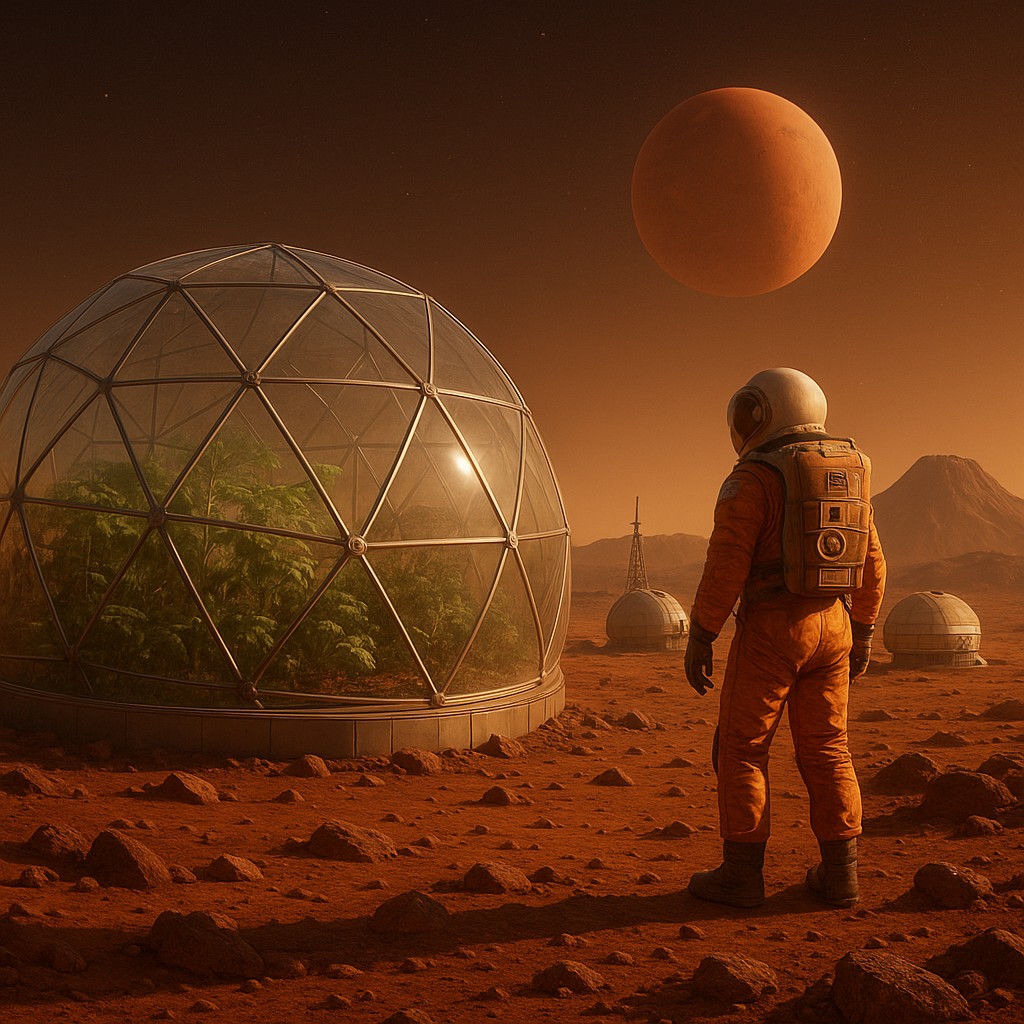
Imagine looking up at the night sky and spotting a tiny, reddish dot that has captivated the human imagination for thousands of years. For our ancestors, it was a god of war; for modern astronomers, it is a frozen desert world of rust and ancient volcanoes. But for the pioneers of the next century, Mars represents something much more personal: a potential second home. Moving to Mars is not just about building a faster rocket or packing enough snacks for a long road trip. It is the ultimate renovation project. It requires us to take a planet that is fundamentally hostile to life as we know it and persuade it to cooperate with our biological needs.
The challenges are undeniably massive. Mars is a place where the air will kill you, the soil is toxic, the sun shoots invisible radiation at your DNA, and the temperature makes an Antarctic winter look like a tropical vacation. Yet, despite these obstacles, the laws of physics and chemistry give us a roadmap. To make Mars habitable, we have to become master environmental engineers, learning how to manufacture air, trap heat, and shield ourselves from the vacuum of space. It is a journey that begins with surviving in high-tech bubbles and ends with the ambitious dream of transforming an entire world into a lush, green paradise.
The Invisible Shield and the Air We Need
The first thing any aspiring Martian colonist will notice - or rather, the thing they will desperately miss - is the atmosphere. On Earth, we live at the bottom of a heavy ocean of air that provides the pressure necessary to keep our liquid interiors from boiling away. Mars, unfortunately, has an atmosphere only about one percent as thick as Earth’s. Even if that thin air were made of pure oxygen, you would still need a pressurized suit just to keep your blood from vaporizing. To make Mars livable, we have to address both the lack of pressure and the fact that 95 percent of Martian "air" is carbon dioxide. This is great for plants, but deadly for humans.
In the early stages of colonization, we won't be breathing the Martian atmosphere directly. Instead, we will use machines like MOXIE, a small device already tested by NASA’s Perseverance rover. This device pulls in carbon dioxide and uses heat and electricity to strip away the oxygen atoms. It is essentially an electronic tree. For a permanent settlement, these systems would need to be scaled up a thousand times over. We would also need to create "buffer gas." Breathing pure oxygen is actually dangerous over long periods, so we would need to mine nitrogen from the Martian soil to dilute the oxygen. This would create a mix that mimics the air in your living room right now.
The lack of a magnetic field is another invisible hurdle. Earth has a molten metal core that spins like a giant generator, creating a magnetic shield that deflects the sun’s harshest radiation. Mars lost its internal generator billions of years ago. This left its surface exposed to solar winds that strip away the atmosphere and cosmic rays that can cause cellular damage. To live there long-term, we might need to get creative, perhaps by placing a giant magnetic dipole in orbit to act as a "windbreaker" for the entire planet. Until then, our homes will likely be buried under meters of Martian soil, using the ground itself as a shield against the silent rain of radiation from the stars.
Building Homes Out of Dust and Ice
Shipping bricks and bags of cement from Earth to Mars would be the most expensive logistics nightmare in history. Every kilogram of cargo costs a fortune to launch, so the first rule of Martian architecture is to live off the land. This concept, known as In-Situ Resource Utilization (ISRU), is the key to staying on Mars permanently. The Martian surface is covered in regolith, a fine, volcanic dust rich in iron oxide. By mixing this dust with specific binding agents or using high-powered lasers to melt it into solid glass, we can 3D print our houses directly onto the Martian plains.
One of the most promising designs is the "Mars Ice House." We know there are vast amounts of water ice locked away in the Martian poles and just beneath the soil in many regions. By using robots to harvest this ice, we could create a double-walled structure where a thick layer of ice is sandwiched between layers of pressurized plastic. This is brilliant for two reasons: ice is an incredible shield against radiation, and it allows natural sunlight to filter through. Living in a translucent ice palace sounds much more pleasant than living in a dark, windowless metal tin. It would also provide the psychological boost of seeing the Martian sun, even if it does look a bit smaller and bluer than the one on Earth.
| Resource Needed |
Martian Source |
Extraction Method |
| Oxygen |
Carbon Dioxide in Atmosphere |
Electrolysis (Splitting CO2) |
| Water |
Subsurface Ice and Polar Caps |
Thermal Mining (Heating the Soil) |
| Building Material |
Regolith (Surface Dust) |
3D Printing and Melting |
| Rocket Fuel |
Methane and Oxygen |
Sabatier Reaction (Mixing CO2 and Hydrogen) |
| Power |
Solar and Geothermal |
Solar Arrays and Deep Drilling |
The table above illustrates how we can turn a "dead" planet into a supply depot. Take rocket fuel, for example. By combining Martian carbon dioxide with hydrogen brought from Earth (or harvested from Martian ice), we can trigger the Sabatier reaction. This chemical process creates methane and water. The methane can be used to refuel rockets for a return trip or to power backup generators during long, dark Martian dust storms. By treating the planet as a giant chemistry set, we stop being visitors and start being residents.
The Martian Garden and the Chemistry of Food
Once we have a pressurized, shielded room filled with breathable air, we face the next big problem: lunch. You cannot simply sprinkle seeds into Martian dirt and wait for a salad. Martian soil is technically "regolith," meaning it lacks the organic matter and helpful bacteria that make Earth's soil productive. Worse yet, it contains chemicals called perchlorates, which are salts that are toxic to humans. Before we can plant anything, we have to "wash" the soil to remove these toxins. We must then jump-start its biology by adding compost brought from Earth or created from our own recycled waste.
Growing food on Mars will likely start with hydroponics and aquaponics. In these systems, plants grow in nutrient-rich water rather than soil. This allows for total control over the environment, ensuring every drop of water is recycled and every leaf of kale provides maximum nutrition. However, for a truly sustainable colony, we will need to transition to indoor greenhouses that use the Martian regolith as a base. We would introduce earthworms and nitrogen-fixing bacteria to create a living ecosystem. These greenhouses would act as the "lungs" of the colony, scrubbing carbon dioxide from our breath and replacing it with fresh oxygen.
Dietary variety would be a luxury in the early days. You might become very well-acquainted with different ways to prepare potatoes, soy beans, and algae. Scientists are particularly excited about spirulina, a type of blue-green bacteria that grows incredibly fast, is packed with protein, and thrives in controlled vats. It might not sound delicious, but when flavored with lab-grown seasonings, it could be the superfood that keeps the first Martians healthy. Over time, as the colony grows, we might even see labs for cultivated meat, allowing for a Martian burger without ever needing to fly a cow across the solar system.
The Long Game of Planetary Engineering
The ultimate dream for any Mars enthusiast is a process called terraforming. This is the radical idea of changing an entire planet’s climate to make it look and feel like Earth. Currently, Mars is a "cold trap," meaning it is so cold that any water on its surface freezes or evaporates immediately. To fix this, we need to thicken the atmosphere to create a greenhouse effect. We would essentially be trying to induce "global warming" on Mars, which is the one place in the universe where we actually want more heat.
The plan involves pumping powerful greenhouse gases, like perfluorocarbons, into the atmosphere. While these are pollutants on Earth, on Mars they would act like a giant thermal blanket, trapping the sun’s energy and slowly raising the temperature. As the planet warms, the frozen carbon dioxide at the poles would turn into gas, further thickening the atmosphere and creating a feedback loop. Eventually, the temperature could rise enough for water to flow on the surface again. We would see the return of Martian rivers and ancient lakebeds filling with blue water for the first time in three billion years.
This process would take centuries, if not millennia. After the planet warms and the pressure rises, we would introduce "pioneer species." These would be hardy lichens and mosses that can survive in extreme conditions. These organisms would slowly break down Martian rocks and release oxygen. It would be a slow, biological march toward a world where humans might eventually walk outside without a spacesuit, perhaps only needing a small oxygen mask. It is the height of human ambition, a testament to our desire to not just survive in the universe, but to thrive and expand the reach of life itself.
Gravity and the Human Machine
While we are busy fixing the planet, we also have to worry about fixing ourselves. Mars has about 38 percent of Earth’s gravity. This might sound fun at first - you could dunk a basketball like a pro or carry heavy crates with ease - but the human body is designed for the crushing weight of Earth. In low gravity, our bones lose density, our muscles waste away because they don't have to work as hard, and even the shape of our eyes can change as fluids shift upward toward the head.
To live on Mars, humans will have to become obsessive gym rats. Daily exercise for several hours on resistance machines would be mandatory to keep our skeletons from turning into sponges. There is also the unanswered question of whether humans can safely have children in low gravity. If a baby grows up in 38 percent gravity, would their bones ever be strong enough to visit Earth? Or would they be "trapped" on Mars forever, finding the home world's gravity too punishing to endure? These are the biological frontiers we must explore.
Future Martians might eventually adapt to their new home through a combination of technology and evolution. We might see the development of "gravity suits" that use tight elastics to simulate the load of Earth's gravity on the bones. Or, further down the line, genetic engineering could help us tweak our biology to be more resistant to radiation and bone loss. The people of Mars would eventually become a distinct branch of humanity, shaped by the environment of a world that they themselves helped to build.
The Psychology of the Red Frontier
The most difficult part of living on Mars might not be the radiation or the lack of air, but the feeling of being incredibly far from home. On Mars, Earth is just a tiny blue speck in the sky, a distant memory that is at least six to nine months away by rocket. You are living in a confined space with a small group of people, eating the same food, and looking at the same red rocks day after day. This isolation could lead to profound feelings of homesickness.
To combat this, the design of Martian habitats must prioritize mental health. This means including "green spaces" full of Earthly plants to provide the smells and sights of nature. It means high-speed communication arrays that - while still suffering from a time delay of 3 to 22 minutes - allow for a constant stream of messages, movies, and data from Earth. We would need to create a new Martian culture, with its own holidays, its own sports played in low gravity, and its own sense of identity. A Martian colony cannot just be a laboratory; it has to be a community.
Ultimately, we would be building a new society from scratch. This gives us the chance to rethink how we live, how we use resources, and how we govern ourselves. The pioneers on Mars would be forced to be the ultimate recyclers and the ultimate cooperators. On a planet where everything is trying to kill you, your neighbor is your most important life-support system. This shared struggle would likely forge a bond stronger than any found on Earth, creating a civilization that is resilient, inventive, and profoundly aware of the fragility of life.
The journey to Mars is the most audacious task we have ever considered. It is a multi-generational relay race that challenges every branch of science and the limits of our endurance. This quest forces us to better understand our own planet as we try to recreate its life-sustaining systems on a dead world. By reaching for the red plains of Mars, we are doing more than just finding a backup plan for humanity; we are proving that the spirit of exploration is an unstoppable force. Whether it takes fifty years or five hundred, the day will come when a human child looks up at a blue sunset on Mars and calls that dusty, beautiful world "home.