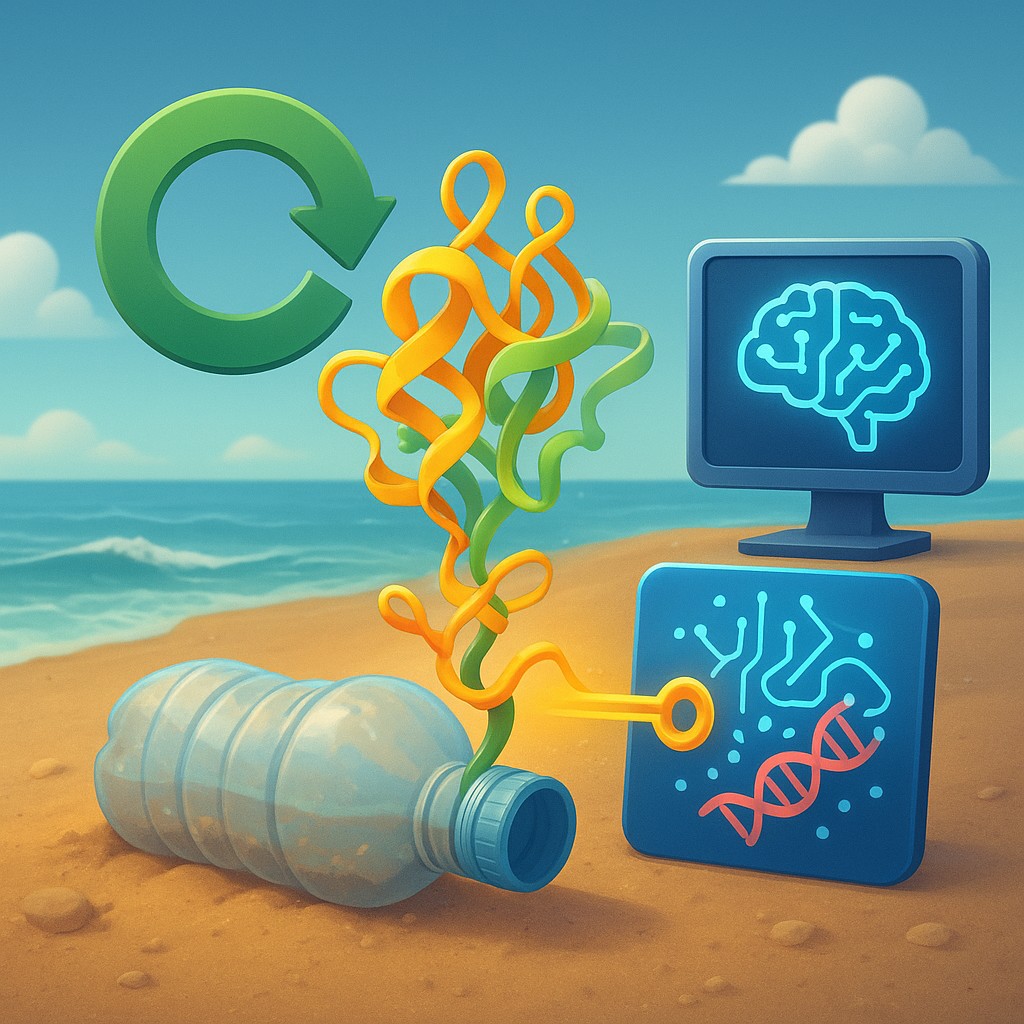
Imagine walking along a coastline and spotting a plastic bottle half-buried in the sand. Normally, that bottle is a geological artifact. It is built to survive the elements for hundreds, if not thousands, of years. Instead of vanishing, it slowly breaks down into microplastics that work their way into the food chain. For decades, our best solution was to melt these bottles into lower-quality products or bury them in the earth, hoping future generations would find an answer. We were essentially waiting for nature to evolve a way to eat our trash, a process that usually takes millions of years of trial and error.
However, silicon has just hijacked the evolutionary timeline. Scientists are no longer searching the remote corners of the Amazon or the depths of the ocean for a "miracle microbe" with a taste for soda bottles. Instead, they are sitting at computer terminals, using generative artificial intelligence to dream up biological machines that never existed in nature. These custom-designed proteins, known as synthetic enzymes, can shred the chemical bonds of industrial plastics in a matter of hours. By treating protein design as a language or a geometric puzzle, we have moved from being observers of biology to being its primary architects.
The Molecular Lock and the AI Key
To understand how AI is rewriting the rules of recycling, we have to look at what an enzyme actually is. At its core, an enzyme is a biological catalyst, a specialized protein that speeds up chemical reactions. Think of a plastic bottle as a long, stubborn chain of molecular "beads" called polymers. To recycle this plastic effectively, you need to break the "string" between the beads so they can be reused to make brand-new, high-quality plastic. In nature, most enzymes are far too weak or slow to manage this, primarily because plastic is a modern invention that biology hasn't had time to adapt to.
This is where the "active site" comes in. Every enzyme has a specific physical pocket, a tiny nook where the chemical reaction actually happens. If the plastic molecule doesn't fit into this pocket like a key in a lock, nothing happens. Generative AI models, such as those that grew out of the AlphaFold project, allow scientists to work backward. Instead of looking at an enzyme and wondering what it does, researchers can look at a piece of plastic and ask the AI to design a "lock" that fits it perfectly. The AI calculates the exact sequence of amino acids needed to fold into a shape that grips the plastic molecule and applies chemical pressure to its weakest points.
The precision of these AI-designed enzymes is staggering. By simulating millions of possible protein folds in a virtual environment, researchers can identify "super-enzymes" that are vastly more efficient than anything found in a bog or a landfill. These synthetic proteins are designed to be thermostable, meaning they don't fall apart when they get warm, and they are tuned to operate at high speeds. While a natural microbe might nibble on a plastic bag over several months, these AI-generated proteins can reduce a pile of plastic waste to its original liquid components in the time it takes to watch a few movies.
From Natural Discovery to Computational Engineering
Historically, the search for plastic-eating tools was a game of biological treasure hunting. In 2016, Japanese scientists famously discovered Ideonella sakaiensis, a bacterium at a recycling site that had evolved a mild appetite for PET (polyethylene terephthalate) plastic. It was a breakthrough, but the organism was slow and finicky, requiring very specific conditions to work. The shift we are seeing today is the move from "discovery-based" science to "design-based" engineering. We are no longer limited by what evolution happened to produce; we are limited only by our ability to model molecular physics.
Generative AI short-circuits the evolutionary process by using "Protein Language Models." Much like a chatbot predicts the next word in a sentence, these models predict the next amino acid in a protein chain to ensure it folds into a stable, functional shape. This allows for the creation of "de novo" proteins, proteins designed from scratch that have no ancestors in the natural world. This engineering approach lets us solve the "efficiency gap" that has long plagued green technology.
| Feature |
Natural Enzymes (e.g., PETase) |
AI-Designed Synthetic Enzymes |
| Origin |
Found in rare bacteria or fungi |
Designed from scratch on a computer |
| Speed |
Days to months to break down bonds |
Hours for near-total degradation |
| Temperature |
Often require very specific, mild heat |
Engineered to thrive in industrial heat |
| Precision |
"Accidental" fit for plastic |
Perfectly sculpted "active site" |
| Scalability |
Hard to maintain in industrial tanks |
Optimized for high-volume chemical plants |
Breaking the Heat Barrier and the Energy Cost
One of the biggest hurdles in recycling plastic is its physical toughness. To get enzymes to work efficiently, the plastic usually needs to be heated until it starts to soften, a state known as its glass transition temperature. The problem is that most natural proteins are fragile; if you heat them up too much, they "denature" or unravel, much like an egg hardening when you fry it. If your enzyme dies at the temperature where the plastic becomes "edible," you have a major engineering stalemate.
Generative AI models have solved this by focusing on thermostability. By reinforcing the "scaffold" or framework of the protein, AI can design enzymes that remain rigid and functional even as the temperature rises. This allows the recycling process to happen at temperatures that make the plastic easier to pull apart without destroying the biological tool doing the work. This synergy between heat and enzymatic speed is what allows new models, like "TurboPETase," to achieve nearly complete breakdown of plastic bottles in a single shift.
Furthermore, these AI-designed tools are becoming more robust against the "impurities" of the real world. In a laboratory, plastic is clean. In a recycling bin, plastic is covered in soda residue, labels, glue, and dirt. Traditional chemical recycling often requires intense cleaning and high-pressure tanks to deal with this "noise." Synthetic enzymes, however, can be engineered to be highly "selective." They are like molecular snipers that only target the plastic bonds, ignoring strawberry jam or paper labels, which simplifies the cleaning process and saves huge amounts of energy.
Addressing the Common Myths of "Plastic-Eating" Bio-Tech
When people hear about "plastic-eating proteins," their minds often jump to sci-fi scenarios of escaped lab experiments devouring whole cities. This is a common misconception rooted in a misunderstanding of how enzymes work. Unlike a living bacterium, an enzyme is just a specialized chemical. It is not "alive." It cannot reproduce, it cannot spread like a virus, and it definitely cannot "eat" anything it wasn't specifically designed to fit. Once the reaction is over or the environment changes, the enzyme simply breaks down into harmless amino acids, essentially becoming fertilizer.
Another myth is that this technology will immediately replace all other forms of recycling. While AI enzymes are a massive leap forward, we have to stay grounded in the reality of industrial economics. Currently, making "virgin" plastic from oil is still incredibly cheap. Even though we can now break down plastic into its raw building blocks with enzymes, building the massive "bioreactors" (giant stainless steel tanks) required to do this at a global scale is expensive. We aren't just fighting a scientific battle; we are fighting a price war against the fossil fuel industry.
The final misconception is that this technology gives us a "free pass" to keep using single-use plastics without guilt. While bio-recycling is a powerful tool, it is not a magic wand. Every time we process plastic, even with perfect enzymes, there is some energy loss and cost involved in transporting and sorting that waste. The goal of synthetic biology isn't to justify more waste, but to create a "circular economy" where the plastic we already have becomes a permanent resource rather than a permanent pollutant.
The Road to the Super-Factory and the Price of Progress
The most exciting frontier in this field isn't occurring in the test tube, but in the "scale-up." Several startups and research institutions are currently moving from the "milligram" phase to the "ton" phase. To make this technology viable, scientists are using AI not just to design the enzyme itself, but to optimize the entire factory process. This includes using AI to manage the flow of fluids in the tanks, the cooling cycles, and the "harvesting" of the broken-down plastic components.
Recent breakthroughs in "VenusMine" pipelines and other protein-language models have significantly lowered the cost of finding these enzymes. Instead of spending years on trial and error, a single research team can now screen tens of thousands of potential enzyme candidates in a few days. This "acceleration of discovery" is the real superpower of AI. It turns a decade-long research cycle into a few months of intense computing. The goal is to reach a "tipping point" where the cost of recycled plastic pellets produced by enzymes is lower than the cost of plastic made from oil.
As the price of computing continues to drop and our understanding of protein geometry grows, we are entering an era of "bespoke biology." We won't just have one enzyme for all plastic; we will have a toolkit of specialized proteins. There will be one for the PET in your water bottle, another for the nylon in your carpet, and a third for the polyester in your clothing. This level of specialization was unthinkable ten years ago, but it is fast becoming the standard in modern biochemistry.
A Future Written in Amino Acids
We are witnessing a fundamental shift in how humanity interacts with the material world. For most of history, we were at the mercy of the materials nature provided, or the messy, high-heat chemical processes we invented to force those materials into new shapes. Today, we are learning to speak the language of the cell to solve the problems we created with the heavy industry of the past. The ability to design a microscopic machine that can undo a century of environmental damage is one of the most hopeful developments of our time.
The journey from a digital model of a protein to a cleaner ocean is a long one, but the path is now clearly illuminated. As you look at the challenges facing our planet, remember that we are no longer just waiting for a miracle to happen in some distant tide pool. We are building those miracles ourselves, one amino acid at a time, guided by the immense processing power of artificial intelligence. The future of our planet may very well be folded into the shape of a synthetic protein, ready to get to work.