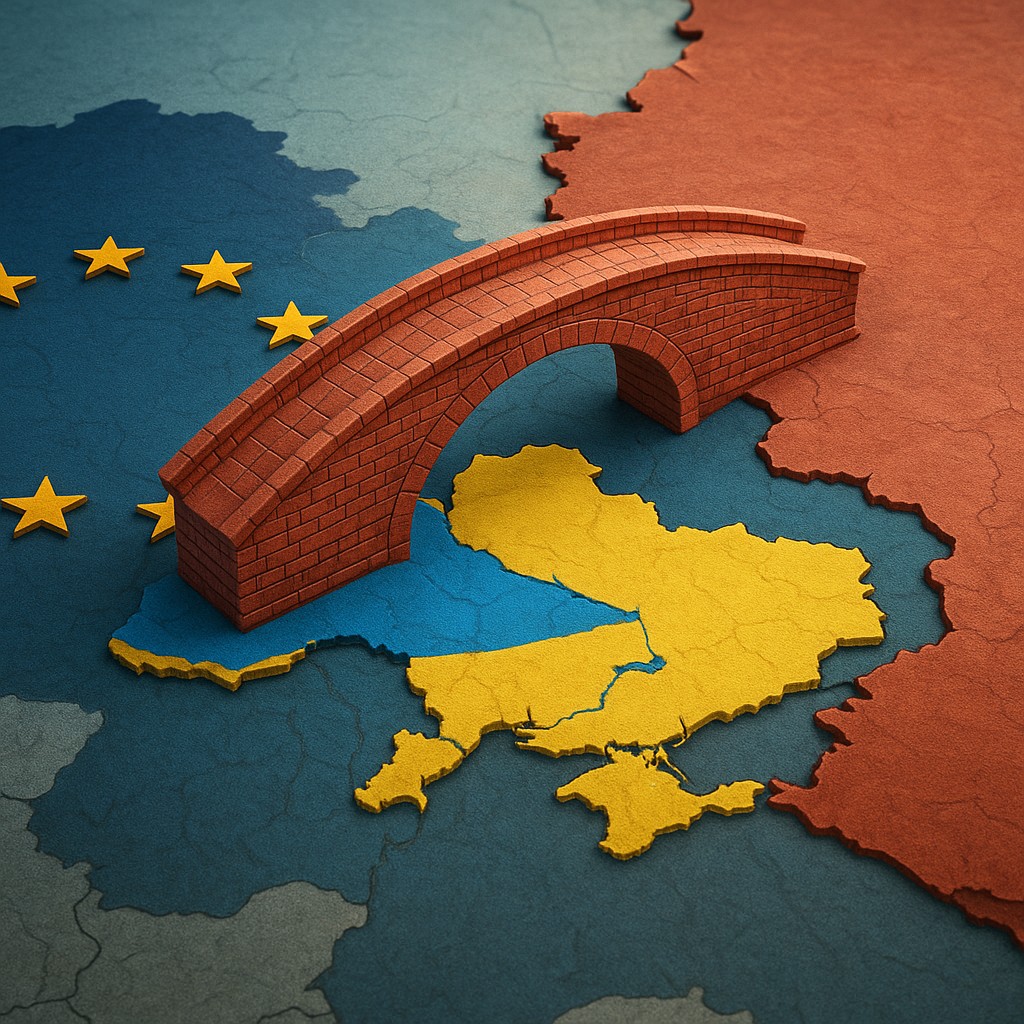
When you look at a map of Europe, Ukraine looks like a sturdy bridge connecting the vast plains of Russia to the heart of the European Union. For centuries, this geography has been both a blessing and a curse. It has placed the country at the center of a tug-of-war between two very different visions of the world. To understand why Russia launched a full-scale invasion of Ukraine, we have to look past the daily headlines. We must dive into a complex mix of deep history, bruised imperial pride, and a massive disagreement over who gets to decide the future of Eastern Europe. This is not just a story of soldiers and tanks; it is a story of a nation trying to define itself while its powerful neighbor refuses to let go of the past.
Imagine having a neighbor who insists your house actually belongs to their family estate because your great-grandparents once shared a kitchen. This is essentially how the Kremlin views Ukraine. When Vladimir Putin speaks about the conflict, he often relies on a version of history suggesting that Russians and Ukrainians are one people. He claims they are bound by a common origin in the medieval state of Kyivan Rus. While they do share a heritage, the two nations drifted apart over hundreds of years. They developed distinct languages, cultures, and political goals. The tragedy of the current moment is that while many Ukrainians see themselves as a sovereign, European democracy, the Russian leadership sees them as a lost province that must be brought back into the fold at any cost.
The Long Shadow of the Soviet Collapse
The roots of the current crisis go back to 1991, a year that changed the world forever. When the Soviet Union crumbled, 15 new countries emerged. Ukraine was one of the largest and most important. For many in the West, this was a moment of liberation and the birth of a new era of freedom. However, Vladimir Putin and many in the Russian security services saw it as the greatest geopolitical disaster of the century. They did not just lose territory; they lost the "buffer zone" that had protected the Russian heartland from Western influence for generations.
In the years after the collapse, Russia struggled through economic chaos. At the same time, NATO-the Western military alliance formed to counter the Soviet Union-began to expand eastward. Countries like Poland, Hungary, and the Baltic states had once been under Russian control. They rushed to join NATO and the European Union to ensure Moscow would never dominate them again. Russia watched this with growing resentment. They viewed every new NATO member as a Western "tank" moving closer to their front door. To Moscow, Ukraine was the ultimate red line. It was the one neighbor they could never allow to join the Western side.
Meanwhile, Ukraine was undergoing its own transformation. The country was caught between a pro-Russian east and a pro-Western west, a divide that often stalled its politics. However, as the 21st century moved forward, a younger generation of Ukrainians began to look toward Paris, Berlin, and Warsaw for their future rather than Moscow. They wanted a life defined by European living standards and the rule of law, rather than the system of powerful billionaires-known as oligarchs-that defined much of the post-Soviet world. This shift in public opinion was exactly what the Kremlin feared most. A successful, democratic Ukraine would provide a "dangerous" example to the Russian people.
From Protests to Prohibited Territory
The tension finally boiled over in late 2013 and early 2014 during what became known as the Maidan Revolution. The Ukrainian President at the time, Viktor Yanukovych, was under intense pressure from Russia to scrap a trade deal with the European Union. Russia wanted him to join a Russian economic union instead. When he suddenly chose Moscow over Europe, thousands of Ukrainians took to the streets of Kyiv in protest. These demonstrations were about more than just a trade deal; they were about the soul of the country. After months of protests and a violent government crackdown, Yanukovych fled to Russia. A new pro-Western government took charge in Kyiv.
Russia’s reaction was swift and aggressive. They viewed the revolution as a Western-backed coup designed to pull Ukraine into NATO’s orbit. Within weeks, Russian "little green men"-soldiers in unmarked uniforms-appeared in Crimea, a strategically vital peninsula on the Black Sea. Russia soon annexed Crimea, an act that most of the world condemned as illegal. Shortly after, Russia began supporting separatist rebels in eastern Ukraine, specifically in the Donbas region. This created a low-level war that simmered for eight years. It claimed thousands of lives and kept Ukraine in a state of constant instability, which Moscow hoped would prevent it from ever joining the West.
| Key Turning Point |
Year |
Impact on the Conflict |
| Dissolution of the USSR |
1991 |
Ukraine becomes independent, creating a sense of "lost territory" in Moscow. |
| Orange Revolution |
2004 |
Mass protests against election fraud signal a shift toward democracy. |
| Maidan Revolution |
2014 |
Pro-Russian president ousted; Russia responds by seizing Crimea. |
| Minsk Agreements |
2015 |
Ceasefire deals that failed to resolve the underlying political disputes. |
| Full-Scale Invasion |
2022 |
Russia moves from proxy warfare to a direct attempt to conquer Ukraine. |
The Security Argument and the NATO Question
One of the most frequent reasons Russia gives for its actions is the expansion of NATO. According to the Kremlin, they were promised in the 1990s that NATO would not move "one inch" to the east. While historians debate the specifics of these verbal promises, Russian leaders have used this story to frame their invasion as a defensive move. They argue that if Ukraine joined NATO, the alliance would place missiles right on Russia's border. In their view, attacking Ukraine was a preemptive strike to stop the West from turning Ukraine into a "bridgehead" for an eventual attack on Russia itself.
However, many observers point out that this security argument has several holes. For one, NATO is a defensive alliance that requires a unanimous vote to admit new members. Before 2022, there was no clear path or timeline for Ukraine to join. Furthermore, by invading Ukraine, Russia actually achieved the opposite of its goal. The war pushed previously neutral countries like Finland and Sweden to join NATO. It also convinced the alliance to move even more troops into Eastern Europe. This suggests that while NATO expansion is a genuine grievance for Moscow, it may also be a convenient excuse for a war that is really about identity and power.
There is also the matter of "demilitarization" and "denazification," terms used by Putin at the start of the 2022 invasion. Experts largely dismiss the "denazification" claim as propaganda. They note that Ukraine’s president, Volodymyr Zelenskyy, is Jewish and lost family members in the Holocaust. Furthermore, far-right parties have very little support in Ukrainian elections. Instead, these terms are seen as code for "regime change." Russia’s goal was likely to remove the elected government and replace it with a puppet administration loyal to Moscow, similar to the government in neighboring Belarus.
A Vision of a New Russian Empire
Beyond the military and political details lies a much deeper motivation: Vladimir Putin’s desire to restore Russia’s status as a great power. He has often written about the "historical unity" of Russians and Ukrainians, arguing that Ukraine is not a real country with a right to its own independence. In this worldview, the world is divided into powerful empires and "vassal states," or small countries that follow the orders of a larger one. To Putin, Russia can only be a great power if it controls its neighbors. Allowing Ukraine to become a thriving, independent democracy is seen as a threat to the current Russian political system.
The invasion that began in February 2022 was an escalation of this philosophy. By attempting to take Kyiv in a matter of days, Russia hoped to prove that the post-Cold War order was over. In that old order, borders were respected and big countries could not simply swallow small ones. They wanted to show that Russia was back as a global force that could dictate terms to the world. However, they drastically underestimated the strength of Ukrainian identity and the willingness of the people to fight for their home. Instead of a quick victory, Russia found itself in a long, grinding conflict that has reshaped global politics.
This war is also about the internal stability of the Russian government. For a long-standing leader, an external enemy can be a powerful tool to unite the people at home. By framing the war as a struggle against a "hostile" West that is using Ukraine as a puppet, the Kremlin can justify economic hardships and the crackdown on protesters at home. In the eyes of the Russian public, it turns a war of choice into a war of survival. This narrative helps keep the current leadership in power by claiming that only they can protect Russia from surrounding threats.
The Global Stakes of the Conflict
The reasons Russia is attacking Ukraine are also tied to a global shift toward "multipolarity." Russia and China have frequently argued that the era of American dominance is over. They believe the world should be run by a few major powers, each with its own "sphere of influence." By invading Ukraine, Russia is trying to claim its sphere by force. If they succeed, it sends a message that the international rules established after World War II no longer apply. This is why so many countries are watching closely; the outcome could determine whether the 21st century is defined by international law or by the principle that "might makes right."
On a practical level, Ukraine is a global breadbasket and a hub for energy. Controlling Ukrainian territory means controlling a large portion of the world's grain supply and the pipelines that carry natural gas to Europe. While these are likely secondary goals, they provide a powerful financial incentive. A Russia that controls Ukraine is a Russia that holds massive leverage over the global economy, especially over food security in the Middle East and Africa.
As we look at the conflict today, it is clear that neither side is willing to back down because both see the stakes as a matter of survival. For Ukraine, losing means the end of their independence and the erasing of their national identity. For the Russian leadership, losing means a blow to their vision of Russia as an empire and a potential threat to their grip on power. The war has moved past a simple border dispute. It is now a clash of fundamental beliefs about how the world should be organized and who gets to decide the fate of a free people.
The story of the Ukraine-Russia conflict is a sobering reminder that history is never truly settled. It teaches us that the way leaders interpret the past can have devastating consequences for the present. Yet, the resilience of the Ukrainian people has shown the world that a sense of purpose and a desire for freedom are forces that can withstand even the most powerful armies. By understanding these deep-seated reasons for the war, you are better equipped to navigate the news and appreciate the profound value of sovereignty. Keep asking questions and looking for the "why" behind the headlines; that is how we truly learn to understand our world.