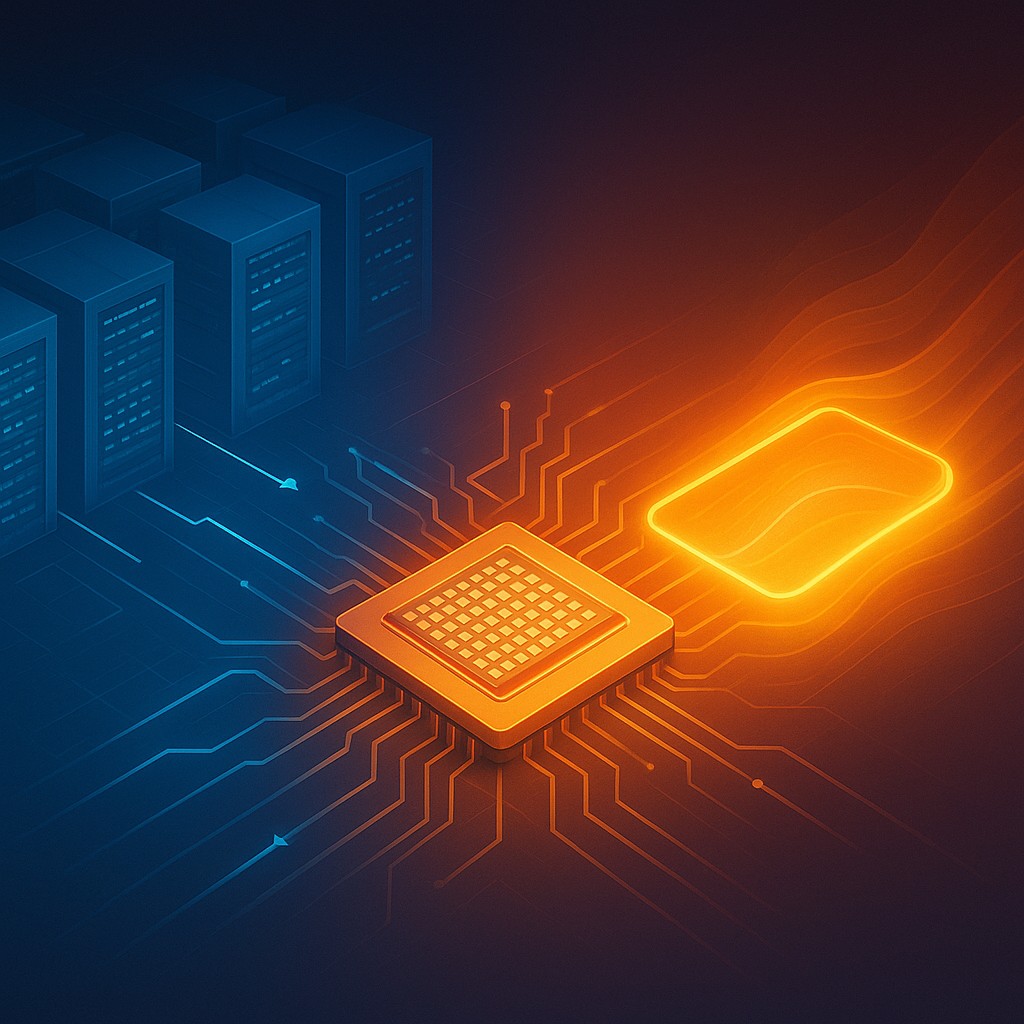
Think of a high-performance data center as a sprawling city that never sleeps. Inside these digital metropolises, billions of tiny messengers called electrons are constantly sprinting through copper wires. They carry the instructions that power everything from your morning weather app to the most advanced artificial intelligence. But a feverish problem sits at the heart of this city. As electrons push through the narrow metal corridors of a computer chip, they hit resistance, much like a crowd of people shoving through a cramped hallway. This friction creates heat. In a massive AI server farm, that heat is so intense it would melt the hardware if it weren't for some of the world's most powerful air conditioning units.
We are reaching a breaking point where we spend almost as much energy cooling our computers as we do running them. It is as if we are trying to build faster and faster sports cars while the engines get so hot they threaten to ignite the pavement. To solve this, engineers are looking toward a fundamental shift in how we move and process information. Instead of relying on the frantic, friction-heavy movement of electrons, they are turning to photons, which are the basic particles of light. By swapping electricity for light, we aren't just making computers a little faster; we are attempting to build a system that can think at the speed of light while remaining as cool as a shadow.
The Friction of Modern Computing
To understand why light is the future, we first have to recognize why electricity is becoming a burden. In a standard copper wire, electrons "bump" into the atoms of the metal as they travel. This resistance turns electrical energy into heat. This is why your laptop gets uncomfortably warm during a high-end game and why your phone heats up during a long video call. In a massive data center housing thousands of server racks, this heat is a multi-billion dollar headache. It limits how tightly we can pack chips together; if they are too close, they will simply cook one another.
This "heat ceiling" is a major roadblock for artificial intelligence. AI models rely on massive amounts of data flowing between processors at incredible speeds. When we use traditional electrical wires to move this data, we hit a wall. Increasing the speed requires so much power and creates so much heat that further growth becomes physically impossible. We are effectively trying to drink from a firehose that is slowly turning into a blowtorch. Optical computing offers a way to bypass this resistance entirely. Because photons do not have mass or an electric charge like electrons do, they can zip through specialized glass or silicon pathways without generating friction-based heat.
Trading Copper for Glass
The transition to optical computing begins with silicon photonics. This technology uses the same manufacturing techniques used for traditional computer chips, but instead of etching paths for electricity, engineers etch "waveguides" for light. Think of these as microscopic fiber-optic cables carved directly onto a chip. When data needs to move from one part of a system to another, a tiny laser converts the electrical signal into pulses of light. These photons then race through the chip, carrying information with virtually zero energy loss.
This isn't just a minor upgrade; it is a fundamental change in how data moves. Normally, the further you move data across a circuit board, the more "juice" you need to push the signal through. With light, the energy required to send a signal ten millimeters is almost the same as sending it ten centimeters. This allows engineers to design data centers where processors are spread out or interconnected in ways that used to be impossible. By removing the "tax" of electrical resistance, we can create connections that are thousands of times more efficient than the copper wires we have relied on since the era of the telegraph.
The Quest for the Light Transistor
While moving data with light is a skill we are beginning to master, the "holy grail" of this field is the optical transistor. In a standard computer, a transistor acts like a tiny gate that opens or closes to represent the ones and zeros of computer code. These gates are controlled by electricity. To create a truly optical computer, we need a way for light to control light, a "photonic switch" that can turn on and off without needing to convert the signal back into electricity. This is where physics gets tricky. Unlike electrons, photons don't naturally run into one another. If you shine two flashlights at each other, the beams simply pass through one another rather than bouncing off or blocking the path.
To make an optical transistor, scientists use "non-linear" materials that change their properties when hit by light. For instance, a certain material might stay transparent until it reaches a specific brightness, at which point it suddenly becomes opaque. This creates a functional "gate" for data. The challenge is making these switches as small and fast as their electronic cousins. While we have working prototypes, manufacturing billions of them on a single chip with the reliability needed for a high-end server is the final frontier of computer engineering.
| Feature |
Electronic Computing |
Optical Computing |
| Primary Carrier |
Electrons moving through copper |
Photons moving through waveguides |
| Internal Heat |
High (due to electrical resistance) |
Almost zero (no friction) |
| Data Speed |
Limited by metal conductivity |
Speed of light |
| Power Scaling |
Increases rapidly with speed |
Remains relatively stable |
| Reliability |
Extremely high and proven |
Emerging (manufacturing hurdles) |
Scaling AI Beyond Human Limits
If we can solve the manufacturing hurdles of optical computing, the impact on artificial intelligence will be staggering. Right now, the size of an AI model is often limited by how many GPUs (graphics chips) you can link together before the power bill and the heat become unmanageable. If we swap copper for light, we could theoretically link ten times as many chips together without increasing the power draw of the facility. This is known as "scaling without the thermal tax," and it is the reason companies like NVIDIA, Intel, and startups like Lightmatter are pouring billions into this research.
Beyond just making systems larger, optical computing could make AI feel instantaneous. Because light travels so quickly and can carry multiple signals at different wavelengths at once (a trick called wavelength division multiplexing), the delay in a computer's thinking process could drop to nearly zero. Imagine a self-driving car that could process its entire 360-degree surroundings and make a decision in the time it takes a photon to cross a fingernail. This isn't just about efficiency; it is about unlocking a level of real-time intelligence that electricity simply cannot support.
Navigating the Light Barrier
Despite the excitement, we aren't going to wake up tomorrow to find our laptops replaced by boxes of mirrors and lasers. The transition will happen in stages, starting with "co-packaged optics." In this phase, the "brain" of the computer remains electronic, but the "veins and arteries" that move data between those brains are optical. We are already seeing this in high-end data centers where fiber-optic cables plug directly into the processor units. This hybrid approach allows us to keep the reliable logic of electronic transistors while reaping the heat-saving benefits of light.
The ultimate goal remains a fully "photonic" processor where even the math is done with light. This would require a total overhaul of how we build computers, shifting from a design used since the 1940s to a system that looks more like a high-tech light show. While building reliable, microscopic light-gates is a major hurdle, the "heat wall" means we have no choice but to try. As we reach the physical limits of silicon and copper, light represents the only path forward into the next era of supercomputing.
The journey toward optical computing reminds us that human progress is often a story of switching mediums to escape the friction of the past. We moved from stone tablets to paper to communicate faster, and from steam to electricity to power our cities. Now, as our digital world threatens to overheat under the weight of its own intelligence, we are turning to the fastest and cleanest thing in the universe. By harnessing the photon, we are ensuring that the future of discovery isn't limited by how much heat a copper wire can handle, but by how far we can imagine light can go.