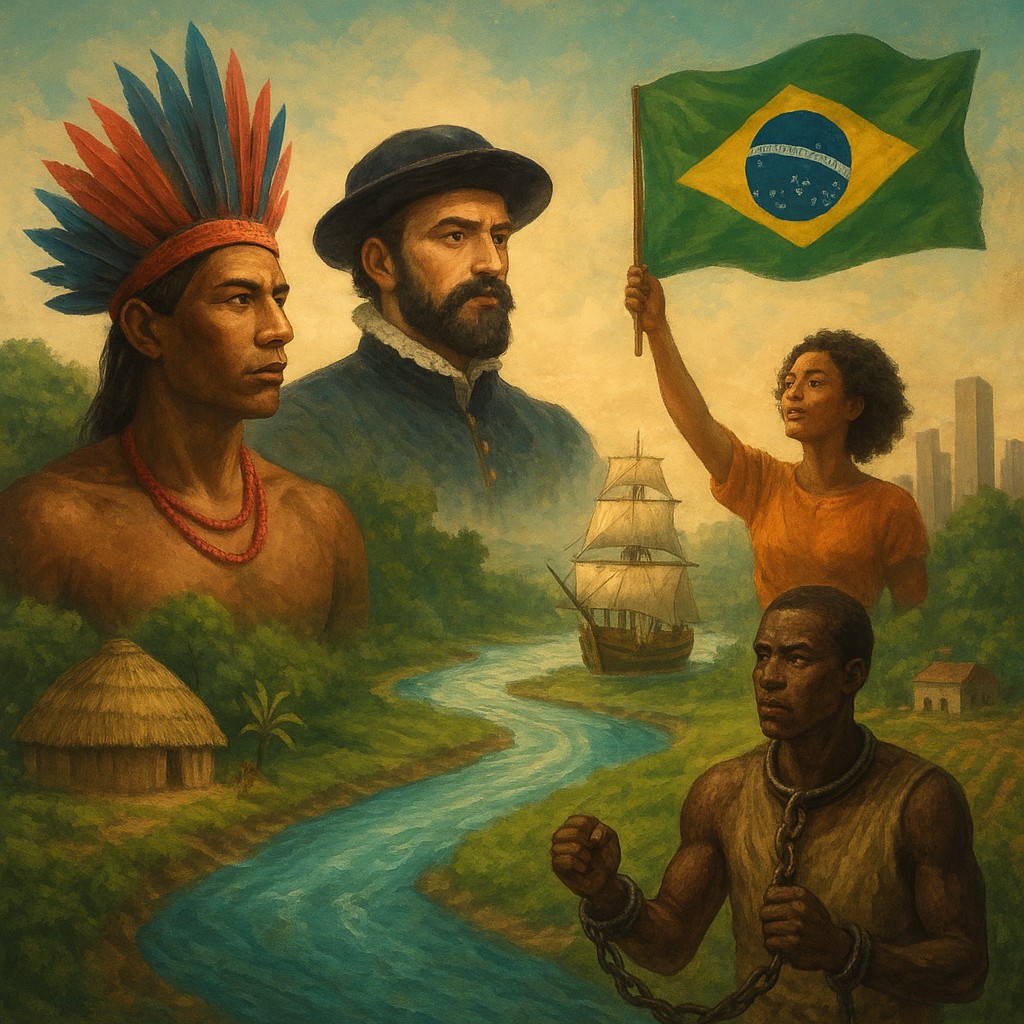
Brazil’s history is like a river: it began long before anyone drew borders, it gathers streams from many peoples and places, and it keeps changing course even when others try to hold it in place. If your summary runs, "Portugal arrived, sugar happened, slavery happened, then samba," you miss the fuller, more interesting story: a continent-sized society built through negotiation, violence, imagination, faith, resistance, ambition, and a stubborn ability to reinvent itself.
Studying Brazil’s past also teaches how history works. Myths grow when we simplify. Saying "Brazil was peacefully mixed from the start" feels comforting but leaves out a lot. Saying "Brazil has always been one nation" sounds neat but ignores how fragile unity once was. And treating colonization as a finished chapter does not explain why land ownership, inequality, and race still shape daily life. Brazil is a good teacher because it refuses to fit one easy story.
So let’s move from the Indigenous worlds that existed for thousands of years, through colonization and slavery, through empire and republic, to dictatorship and democracy, and into the messy present. Along the way we will correct a few popular misunderstandings and watch for the repeating themes that make the story stick.
Before Brazil had a name: Indigenous worlds and deep time
Long before Europeans arrived with flags, crosses, and paperwork, the land that became Brazil was home to a huge variety of Indigenous peoples. They did not form a single "Indigenous culture," just as Europe is not one culture. Hundreds of languages and societies existed, from groups on the Atlantic coast to communities deep in the Amazon, each adapted to different environments and seasons. Some moved often, some built larger villages, some depended on rivers, and many practiced sophisticated farming, growing manioc (cassava), maize, and fruit.
One common mistake is to picture Indigenous societies as "untouched nature" or frozen in time. In reality, people shaped landscapes for centuries, using controlled burns and creating highly fertile terra preta soils (nutrient-rich dark earth) in parts of the Amazon. Long before any European ship arrived, trade networks, alliances, and conflicts linked many communities. Another myth is that Brazil was "empty," a convenient idea for colonizers because empty land is easier to claim. It was not empty, and the arrival of outsiders brought a demographic catastrophe as diseases like smallpox spread through people with no prior exposure.
Indigenous history did not end in 1500. Indigenous peoples resisted, adapted, negotiated, retreated, fought, and survived, and they still do. Modern Brazil includes many Indigenous nations that continue to defend land, language, and culture, often under intense pressure from mining, logging, and expanding farms.
1500 and the long negotiation called colonization
In 1500, the Portuguese navigator Pedro Álvares Cabral reached the Brazilian coast, part of a wider European rush for trade routes and territory. At first, Portugal did not aim to "build a new country," but to extract value. Early trade focused on brazilwood, prized for its red dye, which led to coastal exploitation and trade that often used coercion and shifting alliances with Indigenous groups. The Portuguese crown claimed the land, but turning a claim into control took time, money, and people.
Colonization was not a smooth march inland. It was a long negotiation, often violent, among colonial officials, settlers, missionaries, enslaved people, Indigenous groups, and rival European powers. The French tried to establish footholds, and the Dutch later seized parts of the northeast in the 1600s, especially during the sugar boom. Those Dutch years in places like Pernambuco left cultural and urban traces, but Portugal eventually retook control.
Missionaries, especially Jesuits, played a mixed role. They sometimes defended Indigenous people against outright enslavement by settlers, but they also pushed forced conversion and reshaped Indigenous life in mission settlements. If you take one lesson from this period, it is this: colonization was not a single event done by one group at one moment. It was a shifting system, and different people experienced it very differently, often at the same time.
Sugar, slavery, and the making of a colonial society
Sugar turned colonial Brazil from a risky outpost into a profitable part of the Atlantic economy. Sugar plantations required major capital, land, equipment, and, above all, labor. Indigenous enslavement happened early, but it proved hard to sustain on a large scale because of resistance, escape, legal limits on paper, and the devastation of disease. The Portuguese then expanded the transatlantic slave trade, and Brazil became the largest destination for enslaved Africans in the Americas.
This is a central fact: for centuries, Brazil’s economy and society were built on slavery. Enslaved Africans brought knowledge, skills, religions, languages, music, foodways, and tactics of resistance, even as they suffered brutal dehumanization. Afro-Brazilian culture is not a "spice" added later to a Portuguese base. It is foundational.
Resistance took many forms. Some people negotiated small freedoms inside a system meant to deny them. Others rebelled. Some fled and formed quilombos, communities of runaway enslaved people, the most famous being Palmares, which lasted for decades in the 1600s. The popular myth that Brazil’s slavery was "milder" than elsewhere does not hold up. The scale was immense, punishments were severe, and the legacy of racial inequality did not disappear when slavery ended.
Gold, inland expansion, and a colony that started looking like a country
In the late 1600s and 1700s, gold and diamonds were found inland, especially in what is now Minas Gerais. This set off a rush that pulled people away from the coast, created boom towns, and pushed colonial control deeper into the interior. Cities like Ouro Preto grew, and the Portuguese crown raised taxes and tightened oversight to collect its share. The wealth fueled baroque art and architecture, and it also sharpened social divisions and tensions.
This period also produced a more complex colonial society. A local elite formed, linked to Portuguese authority but increasingly aware of its own interests. When the crown tightened control, conspiracies and revolts appeared, like the Inconfidência Mineira in 1789, associated with figures such as Tiradentes. It failed, but it showed that revolutionary ideas, including those that spread after the American and French Revolutions, were reaching Brazil.
At the same time, Brazil’s borders were not just "the Portuguese line on a map." They were made through expeditions, settlements, treaties, and conflict, including the work of bandeirantes, inland explorers and raiders who also enslaved Indigenous people and expanded Portuguese influence. The result was a vast territory, but not yet a united nation in the modern sense.
Independence without a revolution: an empire is born
Brazil’s path to independence is unusually peaceful. Instead of a long anti-colonial war led by local revolutionaries, independence came through a monarchy. The key twist was Napoleon. When Napoleon invaded Portugal in 1807, the Portuguese royal court fled to Rio de Janeiro, making the colony the seat of the empire. Rio became a political and cultural center with new institutions, printing presses, and more trade, all of which made it hard to return to the old colonial order.
In 1822, Brazil declared independence under Dom Pedro I, the Portuguese prince who became Brazil’s first emperor. This was dramatic, but it kept many power structures in place. Large landowners and elites stayed in charge, slavery continued, and political participation remained limited. Independence was real, but it was not a social revolution.
Brazil then spent decades trying to hold itself together. Regional revolts and disputes tested unity, and the monarchy worked, sometimes clumsily, to keep a huge territory under one government. Dom Pedro II, who ruled for much of the 1800s, presided over a period of relative stability and modernization, including railways and growing coffee production. But state stability did not mean justice for everyone.
Coffee, abolition, and the fall of the monarchy
By the 1800s, coffee replaced sugar as the main export, especially in southeastern regions like São Paulo and Rio de Janeiro. Coffee wealth reshaped politics and infrastructure, and it increased the demand for labor. Slavery remained central even as abolitionist movements grew and international pressure rose. Brazil was among the last countries in the Americas to abolish slavery, doing so in 1888 with the Lei Áurea (Golden Law).
A common misconception is that abolition was a generous "gift" from Princess Isabel. The law mattered, but it came after decades of resistance by enslaved people, organizing by abolitionists, and changing economic calculations. More painfully, abolition happened without land reform, compensation, or serious state support for formerly enslaved people. Freedom arrived, but many had to navigate a society still shaped by old hierarchies.
One year later, in 1889, the monarchy fell and a republic replaced it. The change was driven by the military and elite political interests, not by a mass democratic uprising. Brazil entered a new era with old inequalities still firmly in place.
From "Old Republic" to Vargas: modernization, coups, and new identities
The early republic, often called the Old Republic (1889 to 1930), was dominated by regional oligarchies, especially coffee interests. Voting was limited and often controlled through patronage and intimidation, a system sometimes called coronelismo. At the same time, Brazil encouraged immigration, especially to the south and southeast, bringing Italians, Germans, Japanese, and others into a changing labor market. These communities helped shape Brazilian culture, food, and industry, but they also joined a society marked by deep racial and class divides.
In 1930, Getúlio Vargas came to power and began a period of major change. Vargas pushed industrialization, centralized authority, and built a stronger federal state. He also created labor laws and institutions that gave protections to some workers while keeping unions under state control. In the late 1930s, he ruled as a dictator under the Estado Novo, showing how "modernization" can arrive wearing democratic or authoritarian clothes.
This era also helped form ideas of Brazilian national identity, including the celebration of samba and Carnival as national symbols. That cultural embrace was real, but it could also hide uncomfortable truths, like ongoing racism and unequal access to power. Think of Vargas as a leader who expanded the role of the state in daily life, sometimes improving conditions, sometimes suppressing dissent, often doing both.
A fast-changing mid-century: democracy, development, and a military dictatorship
After Vargas fell in 1945, Brazil went through a period of democratic politics mixed with instability. Industrialization sped up, cities grew, and debates sharpened over land reform, labor rights, and how to manage inflation and inequality. In 1960, Brazil inaugurated Brasília, a futuristic new capital built in the interior. It was meant to signal modernity and national integration, and it did, but it also highlighted the gap between grand plans and everyday life for many Brazilians.
In 1964, a military coup overthrew the government and began a dictatorship that lasted until 1985. The regime said it acted to protect the nation from communism and chaos, a familiar line in Cold War Latin America. It used censorship, political persecution, torture, and the suppression of opposition. At the same time, it pushed major projects and oversaw periods of fast economic growth, sometimes called the "Brazilian Miracle," though the benefits were uneven and the debt and social costs were high.
A common mistake is to equate dictatorship with neat "order and prosperity," period. In reality, authoritarian stability often depends on silencing people who would question the cost. Brazil’s dictatorship left a deep legacy in policing, public trust, and debates about accountability that still resonate today.
Democracy’s return and today’s Brazil: progress, friction, and unfinished business
Brazil’s return to civilian rule culminated in the 1988 Constitution, often called the "Citizen Constitution" because it expanded rights and democratic institutions. This period saw new protections for Indigenous lands on paper, the growth of social movements, and a revival of civil society. Yet democracy came with hard economic challenges, including hyperinflation, which was brought under control in the 1990s through reforms and a new currency, the real.
In the 2000s, Brazil gained global attention with economic growth and social programs that reduced poverty for many, even as inequality stayed high. Political scandals, corruption investigations, and polarized elections have repeatedly tested institutions. Recent years have featured intense disputes over the Amazon, public security, and the limits of political speech and protest. Brazil is neither a simple success story nor a simple crisis story. It is a democracy with real achievements and real weaknesses.
Look at Brazil today through long historical threads rather than isolated headlines. Land concentration traces back to colonial plantations. Racial inequality links to centuries of slavery followed by abolition without repair. Regional differences reflect patterns of settlement, commodity booms, and where the state invested over time. History is not a chain around Brazil’s ankle, but it does map how Brazil arrived here.
A quick timeline you can actually remember
The dates matter less than the pattern: Indigenous diversity, colonial extraction, slavery and resistance, a monarchy that held unity, a republic with elite control, modernization mixed with authoritarian turns, and a democracy still being built.
| Era / Turning Point |
Rough Dates |
What Changed |
What Stayed Stubbornly the Same |
| Indigenous societies across the territory |
Before 1500 |
Complex networks, agriculture, environmental management |
Diversity, local autonomy, ongoing intergroup politics |
| Portuguese arrival and early colonization |
1500s |
Coastal footholds, resource extraction, missions |
Conflict over land and labor |
| Sugar economy and Atlantic slavery |
1500s-1700s |
Plantation system, massive forced migration from Africa |
Violent inequality, resistance from below |
| Gold and inland expansion |
1700s |
Urban growth inland, tighter crown control |
Exploitation, social stratification |
| Independence and empire |
1822-1889 |
New nation-state, political unity under monarchy |
Slavery until 1888, elite dominance |
| Republic, Vargas, and industrialization |
1889-1945 |
Centralized state, labor laws, industry |
Unequal political voice, periodic authoritarianism |
| Military dictatorship |
1964-1985 |
Repression plus major development projects |
Inequality, limits on rights, institutional trauma |
| Democratic era |
1985-present |
Expanded rights, competitive elections, social programs |
Polarization, inequality, struggles over land and environment |
Myths worth retiring (so you can see Brazil clearly)
One myth is that Brazil’s colonization was "less violent" because the country became culturally mixed. Mixing happened, yes, but it took place inside a system that ranked people by race, status, and freedom, and it involved force as well as consent. Another myth is that independence and abolition "solved" the colonial past. Independence kept slavery, and abolition ended legal slavery without building a fair starting line, so the aftershocks continued.
A third myth is that Brazil is "naturally" united and peaceful compared to its neighbors. Brazil did avoid some fragmentation after independence, but unity was built through political bargaining, military force, and the interests of elites who wanted one big market. And peace is relative: the country has long faced conflict, from colonial wars to modern fights over land, policing, and political power. Understanding these myths does not make Brazil worse, it makes Brazil more real.
Leaving with the big picture, and a reason to keep going
If you remember one idea, make it this: Brazil is not a finished product. It is a work in progress, shaped by people arguing over what the country should be, who counts as a full citizen, who controls land and labor, and how to balance freedom with authority. Those arguments have run for five centuries, and they still run today, now with better microphones and worse comment sections.
The best part about learning Brazil’s history is that it rewards curiosity. Every era links to music, food, architecture, migration, and the stories families tell at the dinner table. Follow the threads—Indigenous survival and leadership, Afro-Brazilian resistance and creativity, regional identities, democratic struggles—and you will do more than memorize events. You will start to see how a nation learns, slips, and tries again, which is a useful skill for understanding the world and imagining what Brazil might become next.