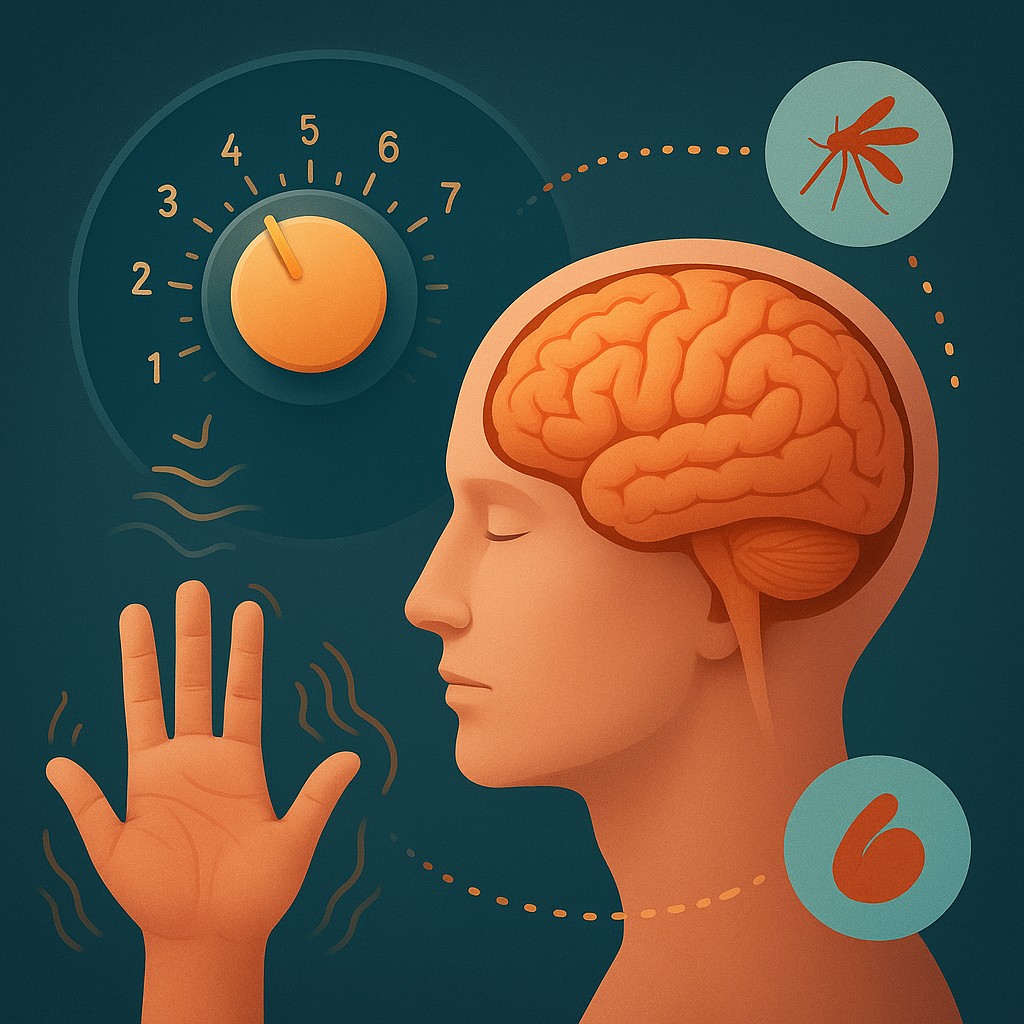
Right now, you are likely wearing several layers of clothing, a watch, or perhaps a pair of glasses resting on your nose. Unless you are consciously thinking about them, you probably cannot feel the fabric of your shirt against your back or the weight of your socks. However, the moment I mentioned them, those sensations "switched on" in your mind. Your skin did not suddenly grow new nerves, and your clothes did not change. Instead, your brain simply decided to stop ignoring a signal that has been buzzing in the background all day.
This mental vanishing act is a clever survival strategy known as inhibitory control, fueled by a process called neural adaptation. If your brain were a radio, it would be constantly bombarded by thousands of stations playing at the same volume. To make sense of the world, your internal DJ has to turn down the "boring" stations, like the feel of your chair, so you can hear the "important" ones, like a door closing or a mosquito landing on your arm. Without this ability to mute the mundane, the sheer volume of sensory data would make it impossible to think, move, or survive.
The Body's Silent Sentinels
To understand how we ignore the world, we first have to understand how we feel it. Your skin is packed with receptors, each specialized for a different job. Some detect heat, some feel pain, and others sense physical pressure. Among these pressure receptors, there is a fascinating split between "slowly adapting" and "rapidly adapting" cells. When you first put on a sweater in the morning, these receptors fire off an enthusiastic burst of electricity. This signal travels up your nerves and into your spinal cord, announcing that something soft and woolly is touching your skin.
However, many of these receptors act as "change detectors" rather than "state detectors." They are highly sensitive to the initial contact, but if the feeling stays the same, they simply stop sending signals. Think of them like a security guard who sounds an alarm when someone enters a room but does not keep screaming for the three hours the person stays seated. This adaptation happens right at the source, in the skin itself. It ensures your nervous system does not waste energy transmitting information your brain already knows.
The Thalamus: The Ultimate Bouncer
While the nerves in your skin do some of the heavy lifting, the real magic happens deep inside the brain in a small, walnut-sized structure called the thalamus. Often described as the "gateway to the cortex," the thalamus acts as a high-level personal assistant for your conscious mind. Almost every piece of sensory information, with the notable exception of smell, must pass through this relay station before it is allowed to enter the cerebral cortex, the area where you actually become aware of it.
The thalamus uses inhibitory control to filter out predictable data. When you sit in a chair, your thalamus receives the signal that there is pressure on your thighs. Since that pressure is constant and offers no new threat or information, the thalamus "gates" the signal. It releases chemical messengers that tell the next neurons in the chain to pipe down. By the time the signal reaches your conscious mind, it has been muffled so thoroughly that it becomes invisible. This is why you can "lose" your glasses while they are sitting on top of your head; your thalamus has decided that the "glasses on head" signal is no longer news.
A Comparison of Sensory Filtering Mechanisms
To visualize how the brain manages this massive workload, it helps to look at the different stages where information is filtered. Each step has a specific goal, moving from the physical hardware of your nerves to the complex software of your attention.
| Level of Filtering |
Physiological Process |
Primary Function |
Everyday Example |
| Receptor Level |
Neural Adaptation |
Prevents nerve fatigue by slowing down firing rates. |
The initial cold "bite" of a swimming pool fading after a minute. |
| Thalamic Level |
Sensory Gating |
Filters out predictable background noise from the cortex. |
Not noticing the humming sound of a refrigerator in the room. |
| Cortical Level |
Selective Attention |
Focuses limited mental energy on specific tasks. |
Reading a book while someone is talking nearby. |
| Motor Level |
Efference Copy |
Blocks sensations caused by our own movements. |
The reason you cannot tickle yourself. |
Why Novelty Wins the Battle for Attention
The brain's primary goal is not to give you a perfect map of reality; it is to keep you alive. In nature, things that stay the same are rarely dangerous. The rock you sit on is unlikely to bite you, but a tiny rustle in the grass or a sudden change in wind temperature could signal a predator. Therefore, our nervous system is hard-wired to prioritize change. This is known as the "mismatch" principle.
When a stimulus changes, your neurons experience a "rebound" effect. If a light breeze blows through the window and moves your shirt, the pattern of pressure on your skin shifts. This new pattern is unfamiliar to the thalamus, which immediately flings open the gates. The sensory information rushes into the part of the brain that processes touch, and you "feel" your shirt again. This system is so efficient that it allows us to live in noisy, high-stress environments without losing our minds, while remaining hyper-sensitive to a single tap on the shoulder.
Misconceptions About the "Off" Switch
A common myth is that our nerves simply shut down when we aren't paying attention. In reality, your body is still "feeling" your clothes. If we hooked up a sensor to the nerves in your arm, we would still see electrical activity. Your body is constantly collecting data; it is just your conscious mind that is being protected from it. Inhibitory control is an active process, not a passive one. Your brain spends energy to suppress those signals, which is why sensory overload can be so exhausting for people whose filtering systems work differently, such as those on the autism spectrum.
This filtering applies to almost every sense. It is why you stop noticing the "house smell" of your own home within minutes of walking through the door, a process called olfactory adaptation. It is also why your brain filters out the sound of your own heartbeat or the sight of your nose, which is always in your field of vision but edited out by your brain. Your brain is essentially an expert editor, cutting the boring scenes out of your life's movie so you can focus on the plot.
The Cost of Awareness and the Power of Focus
There is a biological price to pay for every bit of information we process. The human brain makes up only about two percent of our body weight, but it consumes twenty percent of our daily energy. If we had to consciously process the weight of every thread in our clothes, the position of every toe, and the hum of every outlet, our brains would need more calories than we could possibly eat. Inhibitory control is an energy-saving feature. It allows the most "expensive" part of our brain, the prefrontal cortex, to stay fresh for solving problems and making decisions.
By understanding how your brain silences the world, you can appreciate your own biology. You are walking around in a biological filtering machine that constantly decides what is worth your time. This means that even when the world is chaotic and loud, your brain is designed to find the signal in the noise, ensuring you stay focused on what truly matters.
As you go about your day, take a moment to "check in" with those hidden sensations. Feel the weight of your shoes, the texture of your hair, or the air against your face. For a few seconds, you have overridden one of the most powerful filters in nature. Then, let go. Trust your thalamus to take back the reins, silencing the mundane so you can return your focus to the opportunities around you. Your brain has been handling the background noise for years, and it is more than happy to keep doing the job while you do yours.