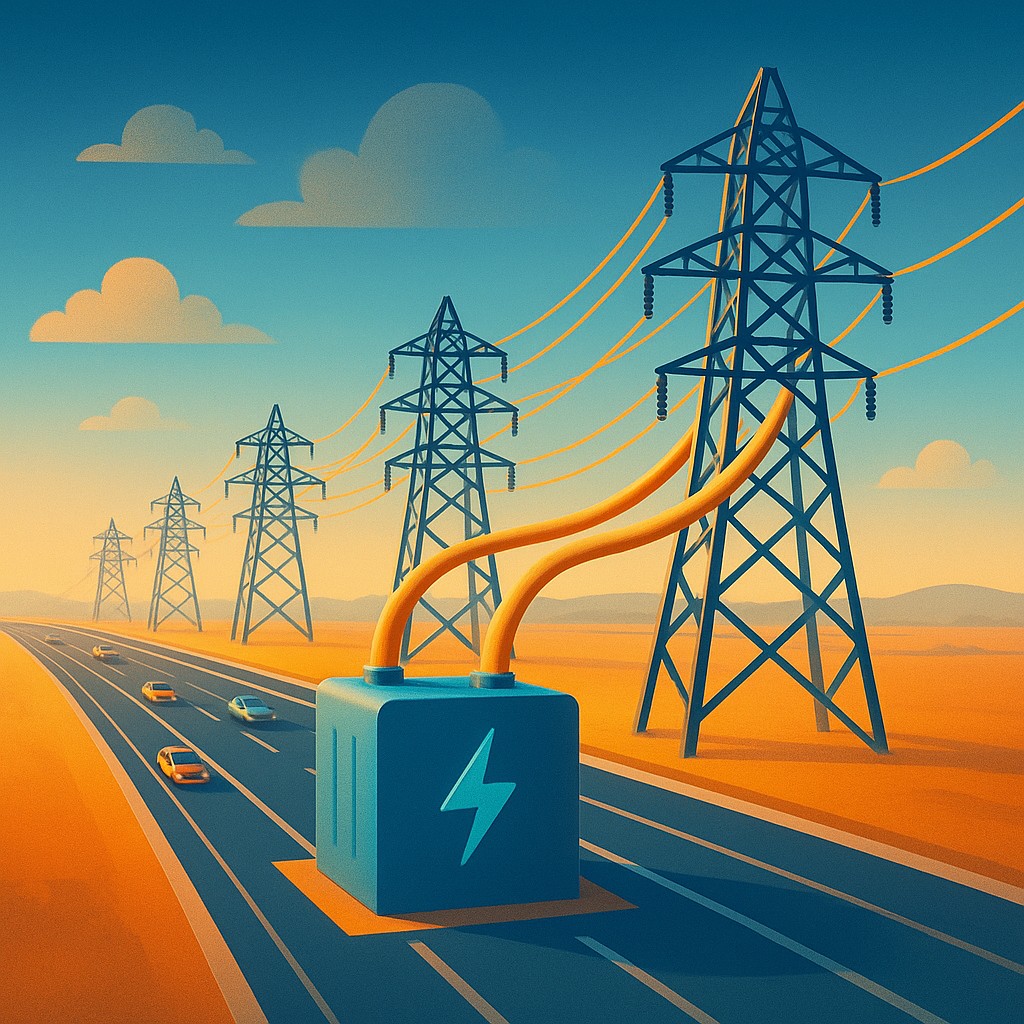
Imagine the global power grid as a massive highway system spanning the continent, where every car is an electron and every road is a high-voltage copper wire. For decades, these roads have been governed by a rigid speed limit based on a worst-case scenario: the hottest, most listless day of the year. This cautious approach was a necessity because, unlike asphalt, power lines physically warp when they are overworked. As electricity flows through a wire, natural resistance creates heat, which causes the metal to expand. If a line gets too hot, it stretches and sags dangerously close to the ground or nearby trees. This "thermal sag" can cause catastrophic short circuits or even spark massive wildfires.
To prevent this, engineers set a fixed limit on how much power a line can carry. They usually assume a brutal environment of 90-degree heat and zero wind. This means that even on a crisp, blustery autumn day when wind turbines are spinning at full speed, the grid might still be restricted by rules designed for a sweltering summer afternoon. This creates a major bottleneck for clean energy. Thousands of megawatts of solar and wind power are often "curtailed" - wasted - because the wires are legally considered full, even though a cool breeze is actually chilling the metal and allowing it to safely carry much more electricity than the rulebooks allow.
The Physical Constraints of a Copper Backbone
To understand why we cannot simply pump more electricity through existing wires, we have to look at the physics of heat. Most transmission lines are made of aluminum or copper reinforced with steel. These metals are excellent conductors, but they are not perfect. As electrons bounce through the metal atoms, they lose a bit of energy to friction, which turns into heat. This heat is the main enemy of power transmission. When a wire gets hot, it grows longer. Since a power line is hung between two fixed towers, that extra length has nowhere to go but down.
A sagging line is a major hazard. If it dips too low, electricity can "arc," jumping through the air to a nearby object like a pine tree or a fence. This is why utility companies spend millions of dollars every year trimming trees along their "rights-of-way," the corridors where the lines run. However, even with perfectly cleared land, there is a limit. If the metal gets too hot, it can lose its structural strength and become permanently weakened through a process called annealing. To prevent this, grid operators have traditionally used "Static Line Ratings," which are essentially conservative guesses about how much heat a wire can release into the air.
This static approach is incredibly inefficient because it treats the weather as if it never changes. In reality, the environment is the biggest factor in how much power a line can handle. A light breeze of just five miles per hour can carry away enough heat to let a line safely carry 20 to 30 percent more electricity. By ignoring this cooling effect, we have been leaving a massive amount of "hidden" capacity on the table. In a world racing to go green, we can no longer afford to let that capacity go to waste while we wait decades to build new towers.
Shifting From Static Guesses to Real-Time Data
This is where Grid-Enhancing Technologies, or GETs, come in. The most impactful of these tools is known as Dynamic Line Rating (DLR). Instead of relying on a fixed guess, DLR uses a network of advanced sensors clamped directly onto high-voltage lines. These sensors act like a fitness tracker for the grid, constantly measuring the wire's temperature, the angle of its sag, and local weather conditions like wind speed and air temperature.
These sensors feed live data into software models that calculate the "true" capacity of the line every few minutes. On a windy day, the software might tell the grid operator that a specific 100-mile stretch of wire can safely handle 40 percent more power than its official rating. This allows the operator to uncork the bottleneck, letting a surge of wind power from a distant farm flow through to a city without needing to build a single new tower or string a new inch of wire. It effectively turns physical hardware into a flexible, digital system.
The beauty of this technology is how fast it can be deployed. Building a new high-voltage line in the United States or Europe can take fifteen years due to permits, land disputes, and massive construction costs. In contrast, a crew can install DLR sensors on an existing line in just a few weeks. By digitizing the physical state of the wires, we move from a system governed by "just in case" margins to one governed by "just in time" data. It is a fundamental shift in how we manage the limits of the physical world.
Managing the Flow with Digital Traffic Cops
While Dynamic Line Rating tells us how much power a wire can carry, other technologies help us decide where that power should go. Power grids are inherently stubborn; electricity follows the path of least resistance, much like water flowing through pipes. Sometimes, one line becomes overloaded while a parallel line just a few miles away is sitting half empty. In the past, operators could do very little about this unbalanced flow without using expensive, heavy hardware.
Modern grid tools now include Advanced Power Flow Control (APFC) devices. Think of these as digital valves or traffic cops for electrons. Installed at substations, these devices use power electronics to "push" electricity away from crowded lines and "pull" it toward empty ones. By dynamically changing the "impedance" - the electrical version of resistance - of specific paths, these tools ensure every scrap of copper is used as efficiently as possible.
When you combine DLR sensors with Flow Control devices, you get a "Smart Grid" in the truest sense. The grid becomes aware of its own physical limits in real time and can automatically reroute power to stay within those limits. This is vital for renewable energy, which is famously unpredictable. Weather patterns can shift in minutes, causing wind production to spike in one county and drop in another. A static grid struggles to keep up, but a GETs-enabled grid can adapt on the fly, ensuring green energy isn't turned off just because the "traffic" is poorly distributed.
Comparing the Old Guard and the New Wave
To see why engineers are so excited about these upgrades, it helps to compare traditional grid expansion with these newer, digital-first approaches. The table below shows the trade-offs between the "Big Iron" approach of building new lines and the "Digital Squeeze" of grid-enhancing technologies.
| Feature |
Traditional Grid Expansion |
Grid-Enhancing Technologies (GETs) |
| Time to Deploy |
10 to 15 Years |
6 to 12 Months |
| Primary Cost |
Billions in steel, land, and labor |
Millions in sensors and software |
| Environmental Impact |
Large (requires new land) |
Negligible (uses existing structures) |
| Capacity Gain |
Massive (doubles or triples capacity) |
Moderate (increases of 10-40%) |
| Risk Factor |
High (long-term investment uncertainty) |
Low (modular and easy to move) |
| Data Usage |
Static, based on worst-case models |
Dynamic, based on real-time sensors |
As the table shows, GETs are not necessarily a permanent replacement for new lines. If we want to move massive amounts of power from the windy Great Plains to coastal cities, we will eventually need more physical "highway" lanes. However, GETs provide a vital bridge. They let us maximize what we have right now, buying us time and ensuring our transition to clean energy doesn't stall while we wait for the slow gears of bureaucracy and heavy construction to turn.
Beyond Sag: Detecting Invisible Dangers
Reliability isn't just about moving power; it is also about knowing when something is about to break. Beyond tracking sag and temperature, modern grid sensors are becoming increasingly "perceptive." Some systems use fiber-optic cables or microphones to listen to the lines. These sensors can detect the specific hum of a failing insulator or the tiny vibrations of a tree branch brushing against a wire miles away in a remote forest. This allows utilities to perform "predictive maintenance," fixing a problem before it causes a blackout.
There is also the concept of "Topology Optimization." This is a technical term for using software to find the best way to open and close the thousands of switches across a grid network. Traditionally, grids were designed with one fixed shape. But if a storm knocks out a major line, the resulting traffic jam can ripple across an entire state. Optimization software can run thousands of simulations per second to find a "workaround" that reroutes power through healthy lines, often finding hidden pathways that a human operator might never see during an emergency.
By linking these technologies, we are giving the power grid a nervous system. In the 20th century, the grid was a "dumb" machine, built with huge safety buffers because we had no way of knowing what was happening on a remote hilltop. By adding sensors and software, we bring transparency to the invisible world of electricity. We can finally see the heat, feel the wind, and hear the vibrations of the wires, allowing us to run the world’s largest machine with surgical precision.
Building the Nervous System of the Future
The shift toward grid-enhancing technologies marks a profound change in our relationship with infrastructure. We are moving away from an era of "over-building" and into an era of "over-thinking." Instead of solving every problem with more steel and concrete, we are solving them with intelligence and better data. This transition is a moral necessity as much as a technical one. Every megawatt of clean energy we cannot move through the grid is often replaced by a megawatt of fossil fuel power generated closer to the city. By "squeezing" more out of the grid, we directly speed up the race to save our planet.
The next time you see those giant steel towers along the highway, remember they are no longer just passive chunks of metal. They are becoming part of a living, breathing digital network. The secret to our energy future isn't just in massive wind turbines or vast solar fields; it is hidden in the gaps between the "static limits" of the past and the "dynamic reality" of today. By embracing these flexible technologies, we can build a world that is not only more sustainable, but more resilient and prepared for the challenges of the next century.