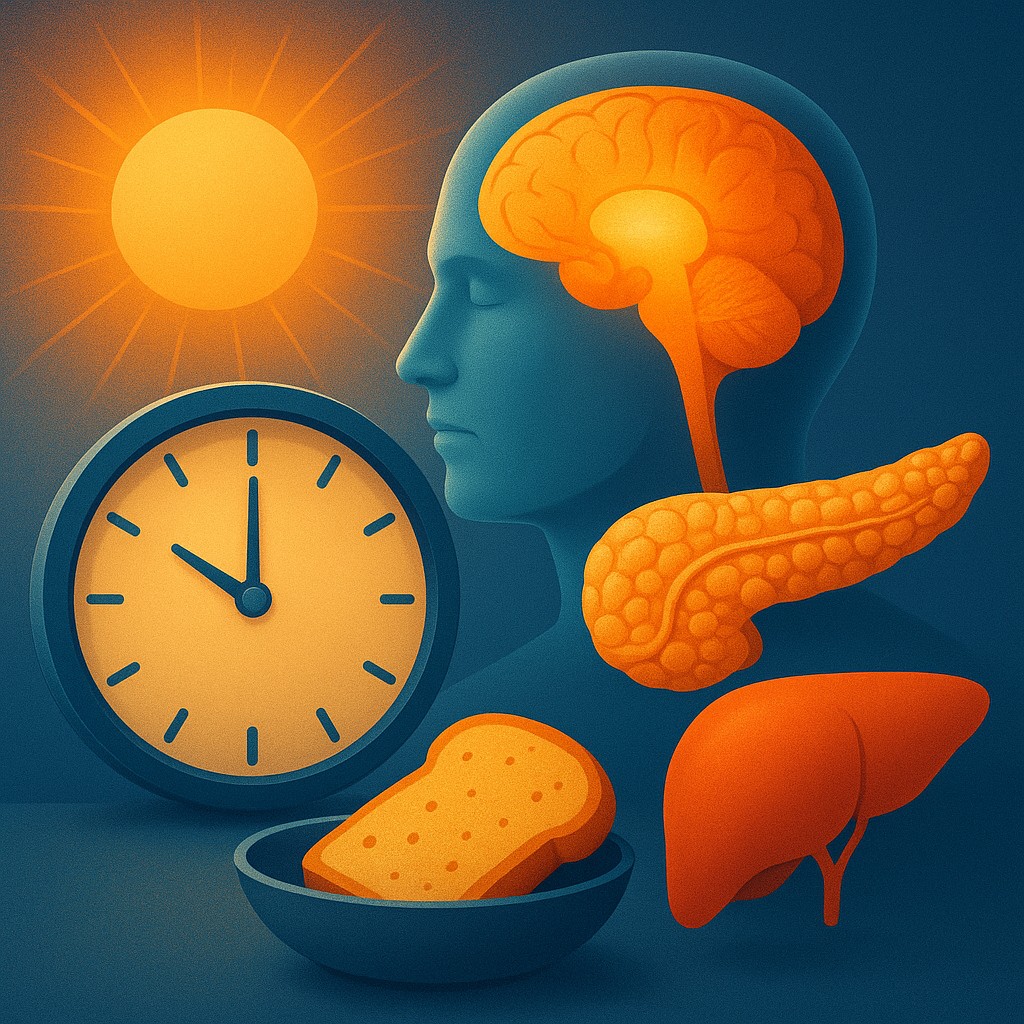
Imagine your body is not a single entity, but a massive, high-speed corporate headquarters where every department depends on a shared schedule to run smoothly. For a long time, scientists believed there was only one CEO: a tiny cluster of cells in the brain called the suprachiasmatic nucleus, which acted as the master clock. We assumed this central commander shouted orders through the hallways, telling every organ exactly when to wake up and when to go to sleep. However, modern biology has revealed a much more decentralized and fascinating reality. Every single organ, from your liver to your skin and your pancreas, has its own internal "peripheral oscillator." Think of this as a departmental clock that keeps its own time while trying its best to stay in sync with the main office.
The primary signal that keeps this complex corporate machine running is light, specifically the high-energy blue light found in the morning sun. When those light particles hit specialized receptors in your eyes, they do more than just help you see; they send a high-speed memo to your brain that the workday has officially begun. This "morning bell" sets off a cascade of biological prep work. Long before you have even bitten into your first piece of toast, your brain has already signaled your pancreas to get ready for incoming fuel. This intricate choreography ensures that your metabolism is at peak performance exactly when you need it most, creating a window of opportunity that we often overlook in our modern, 24-hour lifestyle.
The Morning Light Handshake and Metabolic Priming
When you step outside or sit near a bright window in the morning, your eyes capture specific wavelengths of light that trigger a neural pathway directly to the hypothalamus, the brain’s control center. This is the "Morning Handshake," a moment where your environment tells your biology exactly where you are in time. This signal doesn't just wake you up mentally; it acts as a starter pistol for your digestive system. Your pancreas, which produces insulin to manage blood sugar, receives this signal and begins to prime itself. It enters a state of high sensitivity, meaning it becomes incredibly efficient at monitoring sugar and releasing just the right amount of insulin to keep your energy levels stable.
This anticipatory behavior is a survival mechanism honed over millions of years. For the vast majority of human history, food was most likely to be found and eaten during daylight hours. By linking insulin sensitivity to the presence of blue light, the body ensures it is ready to process calories when they are most likely to show up. In the morning, your cells are "hungry" for glucose, and your pancreas is ready to help move it. This creates a state of high metabolic flexibility, where your body can easily switch from burning fat during your overnight fast to efficiently using carbohydrates from your breakfast with minimal stress on the system.
Interestingly, this process isn't just about the brain's master clock. Research into those departmental oscillators suggests that the pancreas has its own genetic "gears" that tick away independently. If you were to keep pancreatic cells in a dark lab dish, they would still show rhythmic pulses of insulin production. However, without the morning light signal through the eyes to "wind" the clock, these smaller clocks can easily drift out of sync. When your brain thinks it is 9:00 AM but your pancreas thinks it is still midnight, you experience a form of internal jet lag that makes processing even a healthy meal much more difficult.
The Evening Fade and the Rise of Insulin Resistance
As the sun sets and the blue light fades from the sky, your body begins a process often described as "closing up shop." The high insulin sensitivity you enjoyed at 8:00 AM begins to decline steadily as the evening progresses. This isn't a flaw; it is a deliberate transition into a fasting state. During the night, your body shifts its focus from digestion and absorption to repair and cellular cleanup. To help with this, the pancreas reduces its "on-call" staff. It becomes less responsive to spikes in blood sugar because, biologically speaking, it doesn't expect you to be eating a three-course meal in the middle of a dark forest.
When we override this system by eating late at night, especially under the artificial glow of LED lights and screens, we create a metabolic conflict. Our eyes might be receiving enough fake "blue light" from a tablet to keep our brain awake, but our internal clocks know it is late. If you eat a heavy, sugar-rich meal at 10:00 PM, your pancreas is essentially caught napping. It takes longer to recognize the rise in blood sugar, and when it finally does react, it has to pump out significantly more insulin than it would have needed in the morning to get the same result. This leads to short-term "insulin resistance," where your blood sugar spikes higher than normal and stays high for far too long.
Over time, consistently asking a tired pancreas to handle high workloads at night can lead to permanent metabolic burnout. This is why shift workers or people with chronic late-night eating habits often face higher risks of metabolic disorders. It isn't just about the calories; it is about the context. The body is an economy of scale, and trying to run the "digestion factory" during the "maintenance shift" is an expensive and inefficient way to operate. Understanding this decline helps us see why that late-night bowl of cereal feels so different to our biology than the exact same bowl eaten shortly after sunrise.
Mapping the Circadian Metabolic Calendar
To better understand how your body prioritizes tasks based on the time of day, it helps to look at the specific functions that dominate different windows of the 24-hour cycle. Your biology isn't just reacting to what you do; it is predicting what you will do. The following table summarizes how the body’s metabolic focus shifts from the stimulating light of dawn to the restorative darkness of midnight.
| Time Window |
Primary Signal |
Pancreatic State |
Metabolic Goal |
| Dawn (6 AM - 9 AM) |
High Blue Light |
Peak Sensitivity |
Efficiently store and use fuel for the day. |
| Mid-Day (10 AM - 3 PM) |
Bright White Light |
Stable Operation |
Maintain steady energy and glucose levels. |
| Dusk (5 PM - 8 PM) |
Low/Red Light |
Sensitivity Declining |
Prepare for transition into fasting state. |
| Late Night (9 PM - 4 AM) |
Darkness |
Low Sensitivity |
Repair cells, burn stored fat, and detoxify. |
As you can see, the "window of efficiency" is relatively narrow. While modern society allows us to be active and eat at any hour, our ancient biological hardware remains strictly organized. The high-sensitivity phase at dawn is the "golden hour" for metabolic health. When you align your heaviest meals with this window, you are working with the wind at your back. Conversely, as you move toward the late-night phase, you are essentially swimming against a biological current that is trying to pull you toward rest and restoration.
Why the "What" Cannot Be Separated From the "When"
We are often taught to think of nutrition as simple math: calories in versus calories out. If a bagel has 300 calories, we assume it does 300 calories worth of "work" regardless of when it enters the system. However, the discovery of the pancreas's internal clock completely upends this logic. The biological "cost" of a bagel changes depending on the time of day. In the morning, that bagel is processed by a highly sensitive system that quickly moves the sugar into your muscles for energy. At midnight, that same bagel hits a sluggish system, leading to a massive insulin spike that tells the body to store those calories as fat instead of using them for fuel.
This realization has led to the rise of "chrononutrition," the study of how meal timing interacts with our circadian rhythms. It suggests that many modern health struggles are not just the result of eating the "wrong" things, but of eating them at the wrong time. If you eat a sugary dessert at noon, your body has the hormonal infrastructure to manage the fallout. If you eat it at midnight, you are essentially throwing a wrench into a delicate machine that was trying to perform a different task entirely.
Furthermore, this connection between light and the pancreas highlights why "light hygiene" is just as important as diet. If you spend your entire morning in a dark room and your entire evening under bright fluorescent lights, you are sending conflicting signals to your internal clocks. Your pancreas won't know whether to prime itself or to wind down. This "circadian misalignment" can lead to feeling foggy in the morning and restless at night because your hormonal gears are grinding against one another. By simply seeking out bright morning light, you are "zeroing" your metabolic scales for the day ahead.
Practical Strategies for Synchronizing Your Systems
Living in harmony with your internal clocks doesn't require moving to a cabin in the woods, but it does require some intention. The first and most impactful step is to seek out bright, natural light within 30 minutes of waking up. This resets the master clock and tells your pancreas to get to work. Even on a cloudy day, the light levels outside are significantly higher than anything your indoor bulbs can produce. This simple act coordinates your brain and your belly, ensuring that when you sit down for breakfast, your insulin response is as sharp as possible.
Another vital habit is the "metabolic sunset." Just as the sun goes down, our kitchens should ideally follow suit. Finishing your food three to four hours before bed gives your pancreas the chance to complete its work and enter its rest phase before you fall asleep. This prevents a late-night spike in blood sugar that disrupts sleep and contributes to long-term inflammation. If you must eat late, choosing protein or healthy fats over heavy carbohydrates can help minimize the burden on a pancreas that is already trying to log off for the night.
- Get 10 to 20 minutes of morning sunlight to "wind" your metabolic clocks.
- Eat your largest meals earlier in the day when insulin sensitivity is at its peak.
- Avoid bright screen light in the two hours before bed to prevent tricking your brain into thinking it is daytime.
- Keep your meal times consistent, as your internal clocks actually learn your routine and prepare in advance.
- If you are a night owl, be extra careful with sugar late at night, as your biology is naturally less equipped to handle it.
Ultimately, understanding the link between light, your rhythm, and your pancreas is about taking control of your health. You have a sophisticated, billion-year-old timing system built into every cell of your body, designed to keep you thriving. By learning to speak its language - the language of light and timing - you stop fighting against your own biology and start working with it. When you align your lifestyle with your internal clocks, you'll find that energy comes easier, digestion feels smoother, and your body finally operates on one single, harmonious schedule.