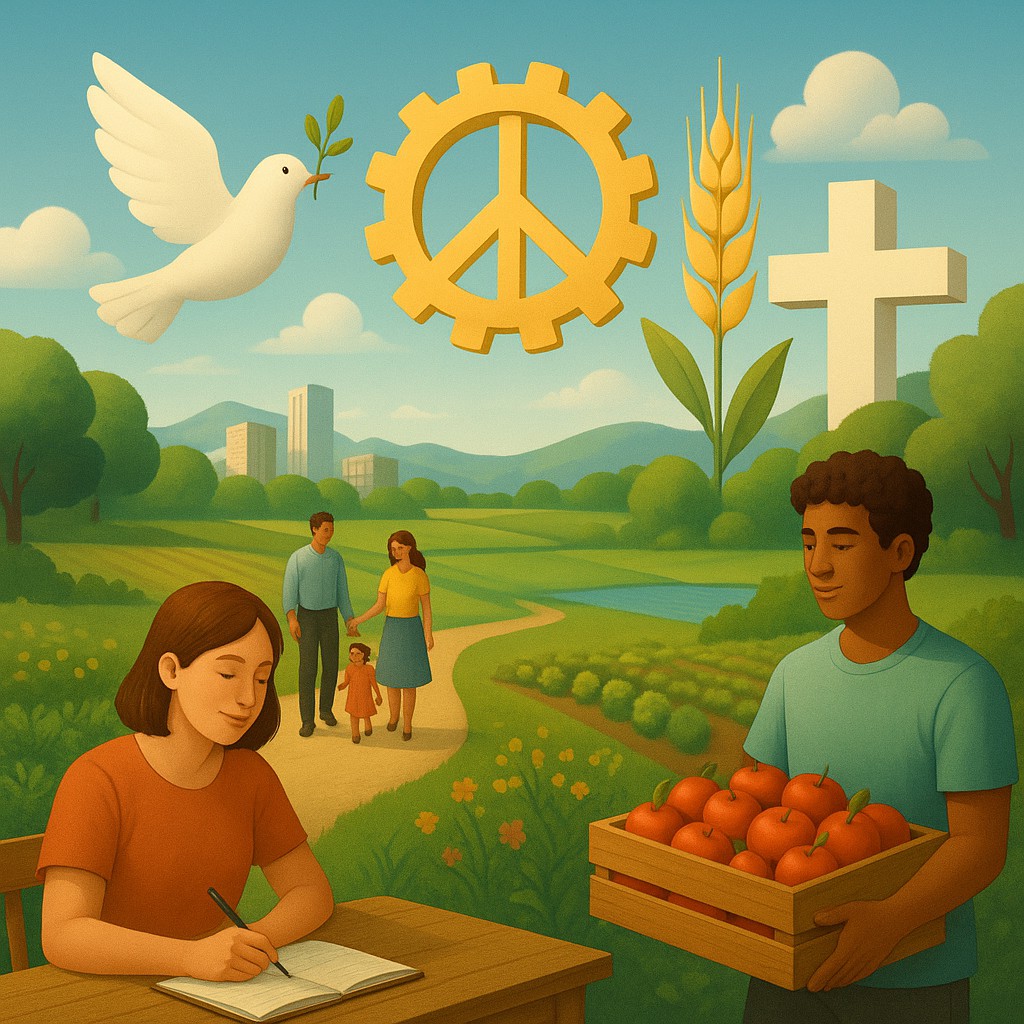
Most people run the same private thought experiment at least once: what if the world actually worked? Not “worked” like a buggy app that needs three updates and a restart, but worked like a place where violence is rare, hunger is a note in a history book, and getting sick is an inconvenience rather than a financial and existential cliff. In that world, people do not spend their best years bracing for disaster. They spend them becoming themselves.
The catch is that paradise is not one big invention. It is not a single hero, policy, or magic technology. It grows from many boring, practical systems lining up so reliably that peace and health feel normal, and self-discovery stops being a luxury for the lucky few.
So let us build this idea step by step, staying grounded in how people actually behave. We will borrow from psychology, economics, public health, and conflict studies, then add a dash of storytelling so it sticks. Think of it as designing a “default good life” for eight billion stubborn, lovable people.
Peace that lasts is built, not wished for
Worldwide peace is not the absence of disagreement. It is the presence of habits and institutions that keep disputes from turning violent. People will still argue in paradise. They will argue about art, land use, parenting, religion, sports, and whether pineapple belongs on pizza (it does, in moderation). The difference is that disputes reliably move into channels that do not involve guns, revenge, or public humiliation.
One big requirement is broad physical and economic security. When people feel trapped, they become easy recruits for extremists and easy to scare into backing harsh leaders. In the transition to paradise, the world invests heavily in early-warning systems for violence: local mediation groups, rapid-response diplomacy teams, and community trust builders like shared schools and civic projects. The aim is to spot rising tensions the way good public health spots outbreaks, early enough that a small fix beats a war.
Another requirement is legitimate governance, which is a simple way of saying, “Most people follow the rules even when they lose.” That trust comes from fair courts, low corruption, and predictable enforcement. It also comes from something less glamorous: paperwork that works. When property rights, identities, and contracts are clear, people do not have to fight to prove they exist or to protect what they own. Paradise has many skilled civil servants, and they are treated like society’s plumbers: not glamorous, but absolutely essential.
A third requirement is shrinking the payoff for violence. In the real world, war can pay off for warlords, smugglers, corrupt officials, and companies that thrive on chaos. In our scenario, global financial transparency improves dramatically. Shell companies are harder to hide behind, illicit trade is easier to trace, and selling weapons into unstable regions becomes politically and economically costly. Peace becomes the rational choice not because everyone turns saintly, but because violence stops being a good business model.
The misconception that trips people up: “Peace needs everyone to agree”
A common myth is that peace requires shared values around the world. It does not. Peace requires shared rules for handling disagreement, plus enough fairness that people do not feel the rules are a cover for exploitation. You can have deep cultural differences and still remain peaceful, the same way you can have wildly different musical tastes and share a playlist without throwing a chair.
Ending hunger is mostly logistics, fairness, and political will
Here is a shocking fact that kills the “we just need more food” story: the world already produces enough calories to feed everyone. Hunger persists because of poverty, conflict, weak infrastructure, food waste, and policies that sometimes treat food as a weapon. In the transition to paradise, hunger ends not with one miracle crop, but by making access reliable.
First, the world prioritizes conflict reduction because war and hunger feed each other. You cannot farm when you are fleeing. You cannot distribute food when roads are bombed. Peace-building and ending hunger are not separate projects; they are interlocking gears.
Second, the world guarantees a basic floor of purchasing power. People need more than food being available somewhere; they need a way to get it. That looks like cash transfers, child benefits, pensions, or guaranteed work programs. Cash sounds almost too simple, which is why some people distrust it, but time and again it proves a powerful anti-hunger tool where markets exist and supply can respond.
Third, infrastructure becomes a heroic character in this story. Roads, bridges, grain storage, refrigeration, and ports make the difference between “a good harvest” and “a good year.” In paradise, countries invest in resilient regional food networks so a drought in one area does not become a famine in another. Storage is upgraded to cut spoilage, and farmers get insurance and climate-adapted practices so one bad season does not wipe out a family for generations.
Fourth, the world takes food waste personally. A large share of food is lost between farm and plate. That is not only wasteful, it is ethically strange in a hungry world. Better packaging, storage, and supply-chain coordination become standard, and “ugly produce” stops being rejected like it has committed a fashion crime.
If you want a clear image, picture hunger as a leaky bucket. We keep pouring resources in, but the bucket leaks through conflict, corruption, waste, and poverty. Paradise is what happens when we fix the leaks.
A few practical shifts that matter more than they sound
- Reliable cash or food assistance that reaches people fast in crises, without humiliating hoops.
- Local and regional grain reserves to buffer price spikes and supply shocks.
- Farmer support for soil health, water efficiency, and climate resilience.
- Transparent procurement and anti-corruption systems so food aid does not “vanish.”
Health becomes common when prevention becomes boring and universal
In a healthy paradise-world, hospitals are important, but they are not the main event. The main event is prevention: clean water, sanitation, vaccines, nutritious food, safe housing, and air that does not slowly punish your lungs. These are not glamorous achievements, which is exactly why they work. They operate quietly in the background, like good streetlights.
Universal health coverage is a core requirement, because medical bills are one of the fastest ways to turn a steady family into a desperate one. Universal coverage does not mean everyone gets every experimental treatment instantly. It means everyone can get essential care without financial ruin, and care is organized around outcomes rather than billing tricks. Strong primary care catches problems early, reduces expensive emergencies, and builds trust between communities and the medical system.
Public health infrastructure also grows up and gets proper funding. That means disease surveillance, rapid testing capacity, stockpiles of key supplies, and clear communication channels. During outbreaks, the paradise-world does not act like “panic is the problem.” It treats uncertainty as normal, shares data quickly, and coordinates globally. Misinformation is tackled not by scolding people, but by building trusted messengers and making truthful information easier to find than conspiracy theories.
Health in paradise includes mental health by default, not as an afterthought. Loneliness, addiction, depression, and trauma are public health priorities. Communities are designed to cut isolation: third places - everyday public spots like parks and community centers - return, walkable neighborhoods increase casual contact, and work cultures stop treating burnout as a personality trait.
Another misconception: “Health is mostly personal responsibility”
Personal choices matter, but choices are shaped by environments. If your neighborhood has unsafe sidewalks, polluted air, and only ultra-processed food nearby, “just be healthier” is not advice, it is a shrug. In the transition to paradise, the healthy choice becomes the easy choice through policy, urban design, education, and economic support.
Education and self-realization: turning survival time into living time
Now for the part people want most, and often define least: self-realization. In paradise, people are not only alive and fed, they are growing. They have time to learn, create, love, and contribute. This is not about everyone becoming a poet. It is about people having the freedom to discover who they are without constant threat.
The first ingredient is early childhood support. Brains develop fast, and stress in early years can echo across a lifetime. In our scenario, prenatal care, parental leave, early childhood education, and nutrition are universal. This is not only compassionate, it is strategic. A society that protects childhood reduces future crime, improves health, and increases learning capacity.
Next comes education that is truly for life, not just for tests. Literacy, numeracy, and scientific thinking are essential, but so are emotional skills: conflict resolution, media literacy, and basic psychology. People learn how to argue without dehumanizing, how to spot manipulation, and how to cooperate across differences. Adults also get easy access to retraining as technology changes jobs, so progress feels like opportunity rather than a trapdoor.
Work changes too. In the transition to paradise, societies deliberately reduce the share of life spent in meaningless drudgery. Part of that happens through automation, but the key is fair distribution. If automation only boosts wealth for a small group, it breeds resentment. If it expands leisure, security, and creative time for most people, it becomes a peace technology.
Self-realization also needs cultural permission. Many people are taught to shrink themselves to survive, to fit narrow roles, or to chase endless status games. Paradise cultures celebrate contribution, craft, caregiving, and creativity, not just wealth signals. People still achieve and compete, but the competition shifts from “Who can hoard the most?” to “Who can build the most useful, beautiful, or kind thing?”
Economic rules that make “doing good” the profitable option
To keep paradise stable, incentives must line up with human nature. You do not design a system that needs everyone to be perfectly wise and selfless. You design one where ordinary self-interest, along with social norms, tends to produce decent results.
A key change is how success is measured. If a society worships GDP alone, it can grow richer while people get sicker, lonelier, and more stressed. In the transition to paradise, governments and businesses use dashboard metrics that track health, education, inequality, ecological stability, life satisfaction, and trust. These are not feel-good numbers. They are steering wheels.
Another change is reducing extreme inequality, because extreme gaps corrode trust. When people think the game is rigged, they disengage or revolt. Paradise does not require perfect equality. It requires a believable social contract: if you contribute, you can live with dignity, and no one can buy a private universe while others cannot afford insulin.
That means progressive taxation that is enforced, not optional. It also means closing loopholes, cracking down on corruption, and reducing the political power of concentrated wealth. At the same time, it means rewarding entrepreneurship that actually solves problems: clean energy, medical innovation, affordable housing, and tools that improve learning.
Here is a compact way to remember the economic redesign:
| Lever in the system |
What changes in daily life |
Why it supports “paradise” outcomes |
Typical time to see impact |
| Universal basic services (health, education, basic housing support) |
Fewer survival emergencies, more stability |
Reduces fear-based politics and improves productivity |
2-10 years |
| Cash supports or negative income tax |
Hunger drops, families plan ahead |
Converts economic growth into real access |
1-5 years |
| Progressive taxation plus anti-corruption enforcement |
Less extraction, more public investment |
Builds trust and funds long-term systems |
3-15 years |
| Well-being metrics alongside GDP |
Policy targets real outcomes |
Prevents “rich but miserable” development |
2-8 years |
| Carbon pricing and clean energy investment |
Cleaner air, fewer climate shocks |
Protects health and food systems, reduces conflict drivers |
5-25 years |
| Labor protections and lifelong learning |
Less burnout, smoother job transitions |
Keeps social cohesion during tech change |
2-10 years |
A myth worth busting is that helping everyone kills innovation. In practice, innovation thrives when people have education, security, and the ability to risk failure without ruin. A society that prevents ruin is often more dynamic, not less, because more people can afford to try.
Global cooperation that works even when trust is imperfect
A paradise-world still has nations, interests, and disagreements. The difference is that global cooperation is treated as infrastructure, not a hobby for idealists.
The first requirement is robust international law and credible enforcement. War crimes, corruption, and human rights abuses cannot be handled with a “strongly worded statement.” In the scenario, international courts gain teeth through treaty commitments, coordinated sanctions that target leaders instead of civilians, and financial systems that can freeze illicit assets quickly. This reduces the sense that powerful actors can do anything without consequences.
The second requirement is shared management of existential risks: pandemics, climate change, and runaway technologies. Climate stability is especially central because climate stress multiplies conflict and hunger. In the transition to paradise, clean energy becomes cheaper than fossil fuels everywhere, and grids modernize fast. Adaptation is funded like insurance for civilization: water systems, heat-resilient cities, drought-resistant agriculture, and disaster response.
Technology governance also matures. AI and social media are treated like powerful infrastructure, not toys. Platforms must be transparent about recommendation systems, and independent auditors can inspect for manipulation and harm. Deepfakes and misinformation are countered with authentication standards and public education, not only censorship. The goal is to preserve free expression while making mass deception harder to scale.
Finally, cooperation becomes local too. Cities and regions share best practices across borders, universities exchange knowledge openly, and scientific research is funded with the expectation of broad benefit. Paradise is not a single world government. It is a network of systems that keep each other honest and functional.
A small but crucial human ingredient: dignity
Many global efforts fail because they treat people as problems to fix rather than partners to respect. In our scenario, aid is less paternalistic. Communities co-design programs, local leaders are empowered, and cultural context matters. People protect what they help build.
The “secret recipe” is feedback loops, not perfection
If one concept holds this whole paradise idea together, it is feedback loops. Good systems notice when they are failing, then adapt. Bad systems deny reality until reality returns with a battering ram.
In a functioning transition, societies invest in data people trust: transparent budgets, public dashboards of health outcomes, independent journalism, and scientific institutions protected from political punishment. When a policy backfires, leaders can admit it without career suicide because the culture rewards learning, not performative certainty. That may sound unrealistic, but it is how high-reliability organizations work - think airlines and well-run hospitals.
This is also where everyday citizens matter. Paradise is not a gift delivered from above. It is co-produced by norms: how people treat neighbors, how employers treat workers, how communities welcome outsiders, how families teach conflict skills, and how consumers reward ethical behavior. Big structures matter, but so does the daily choice to be a little less cruel than your worst impulse.
A closing thought you can actually use
In this scenario, the world becomes more like paradise when it stops betting everything on exceptional heroes and starts building exceptional systems. Peace grows when safety and fairness make violence a bad deal. Hunger ends when access is treated as a right backed by logistics, cash support, and stability. Health becomes common when prevention is universal and ordinary, and when mental health is treated like health. Self-realization takes off when survival no longer fills the calendar and education becomes a lifelong companion.
The good part is that none of these changes require new human nature. They require arranging incentives, institutions, and culture so that ordinary people, on ordinary days, can reliably do decent things and recover from mistakes. Paradise is not a sparkling finish line, it is a direction of travel, and the map is drawn in practical steps. If enough of us learn how these systems fit together, we stop asking “Is a better world possible?” and start asking the more useful question: “Which lever do we pull first?”