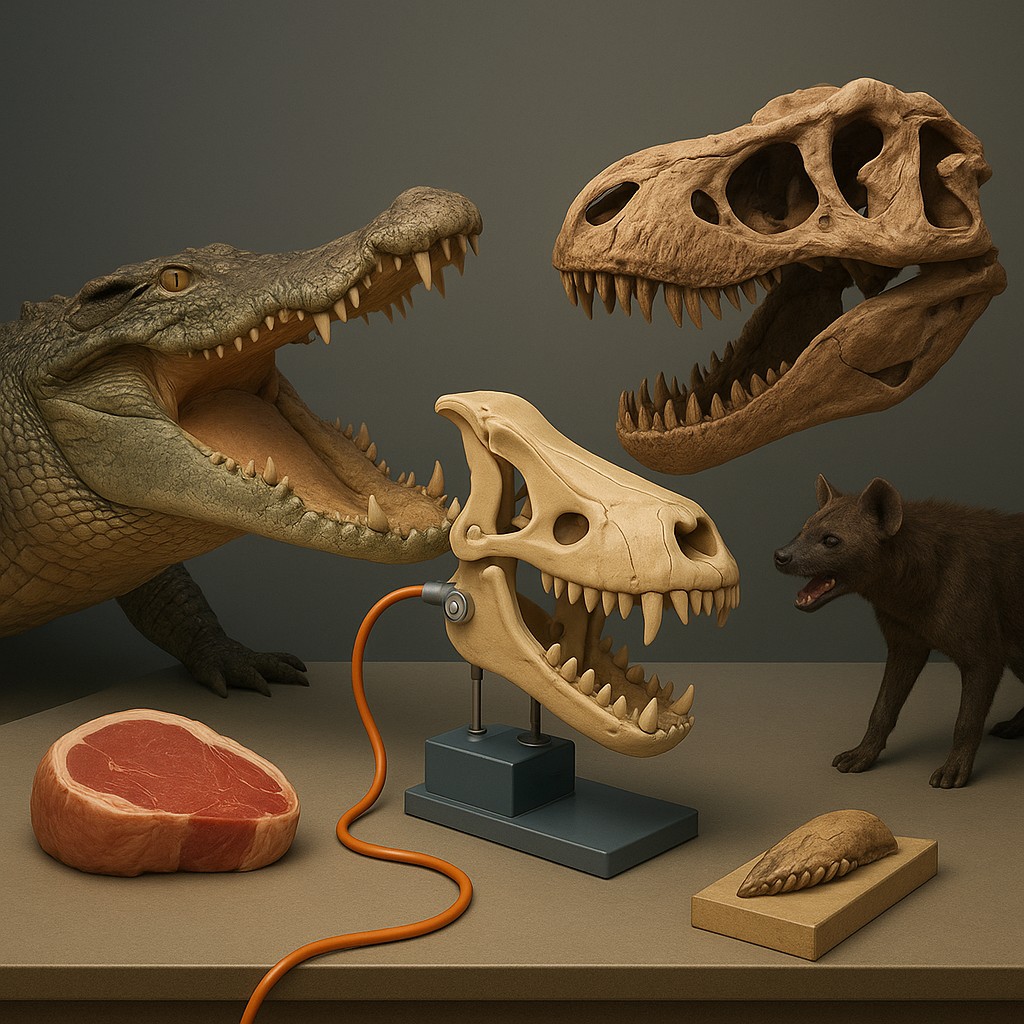
Think of a bite as nature's handshake - sudden, revealing, and sometimes terrifying. Whether you picture a crocodile's death roll, a Tyrannosaurus tearing into bone, or a shark ripping through blubber, bite strength is one of those dramatic traits that tells a big story about ecology, evolution, and survival. People are fascinated because bite force mixes brute physics with biological design - muscle, bone, tooth, and behavior all coming together in a single explosive moment.
This question - which living creature now or in the past had the strongest bite in Earth's history - is a delicious puzzle because it forces us to compare apples and oranges. Do we mean the greatest raw force, the most pressure at a tooth tip, the most force relative to body size, or the animal best adapted to crush bone? As you unpack those angles, the winners change. Below, we walk through how scientists measure and estimate bites, who the modern champions are, which extinct giants might top the list, and why the answer depends on how you define "strongest."
How researchers measure bite power - units, tools, and why numbers vary
Measuring bite force sounds simple - record the force of a jaw closing. In practice it is not. Scientists use two basic strategies, each with pros and cons. For living animals, researchers sometimes use bite force transducers - sturdy devices placed between the teeth that record force directly when the animal bites. This gives a real-world measure but can stress the animal and depends on whether the animal will bite the device. For extinct species, or living species too dangerous to test, scientists build biomechanical models that reconstruct jaw muscles, attachment points, and skull lever mechanics, then estimate plausible muscle sizes and force output. Modeling is powerful but depends heavily on assumptions.
Units matter, so let us keep them straight. Force is measured in newtons (N) or pounds-force (lbf). Pressure is force over area and is measured in pascals (Pa) or pounds per square inch (psi). Two animals could exert the same force but produce very different pressures if one has a tiny, needle-like tooth while the other has a broad, flat tooth. That difference matters for what the bite accomplishes - slicing, piercing, or crushing. Finally, bite capability is shaped by more than raw muscle - skull shape, jaw lever mechanics, tooth geometry, gape angle, and behaviors such as shaking or twisting are all part of the equation.
Because of these factors, you will see wide ranges for many species. Researchers are not trying to trick you; they are responsibly reporting uncertainty. For living animals with direct measurements, numbers are tighter. For extinct creatures, ranges reflect different modeling choices - for example, how big the jaw muscles could plausibly have been.
Modern day champs: who bites hardest right now
If you want the current world record for measured bite force, the saltwater crocodile is the obvious candidate. Researchers have recorded bites from very large individuals that exceed 16,000 newtons, or roughly 3,700 pounds-force. That is jaw-closing power enough to crush prey and bite into bone. Crocodiles achieve this with huge jaw adductor muscles anchored to a robust skull, and a lever system that favors raw force over speed. The saltwater crocodile's ambush lifestyle - long holds on large prey - favors crushing power.
Hippos are another modern powerhouse. They are not carnivores, but their very large canines and massive jaw muscles generate enormous forces. Estimates for hippo bite force are less consistent than for crocodiles because direct data are scarcer, but typical figures put them in the multiple thousands to low tens of thousands of newtons. Hippos use that strength in jaw-based fights and to intimidate rivals; their teeth and jaw mechanics are designed for slicing and clashing, not long-term chewing cycles.
Among mammals specialized for bone-crushing, spotted hyenas deserve mention. Their skulls and jaw mechanics are adapted to deliver sustained pressures capable of cracking large bones, and measured bite forces for big hyenas reach around several thousand newtons. Jaguars merit a special shout-out among big cats for something different: the strongest bite relative to body size. Jaguars have shorter, more robust skulls that concentrate force into a powerful, skull-puncturing bite. That lets them pierce reptile skulls or deliver a killing bite through the skull of prey, a hunting strategy unique among the big cats.
Sharks present a special challenge because measuring bite force in large living sharks is difficult. Great white sharks are powerful biters and models suggest large great whites could exert forces comparable to big terrestrial predators, but the cartilaginous skull and the way sharks feed - multiple bites, head shakes, and tearing - make direct comparisons tricky. For modern animals with reliable direct measurements, the saltwater crocodile stands out in raw force.
Giants from the deep past: extinct contenders and how they are estimated
When we turn to prehistoric animals, the playing field gets both more exciting and more speculative. Fossil bones preserve skulls, teeth, and bite traces, but not muscle. To estimate bite force for extinct species, paleontologists combine skeletal mechanics, attachment site size, comparative anatomy with living relatives, and computer modeling. These techniques have produced headline-grabbing numbers for several extinct giants.
Tyrannosaurus rex is perhaps the best-known example. Multiple biomechanical studies have modeled T. rex skulls and muscle attachments and estimated bite forces in the tens of thousands of newtons. Conservative models put T. rex bite force near 35,000 newtons, while other models that assume exceptionally large muscles push estimates toward 50,000 newtons or more. T. rex teeth were thick and robust - built for bone-crushing and shearing flesh - and its short, deep skull optimized for delivering crushing force rather than rapid snapping.
Megalodon, the gigantic prehistoric shark, is a different kind of problem. Some modeling studies that scale up modern great white data to a shark many times larger have produced monstrous bite force estimates - sometimes over 100,000 newtons. Those numbers make sense if you accept simple geometric scaling from a very large body and tooth sizes designed to slice through thick marine mammal flesh. But estimating muscle size and jaw kinematics in a cartilaginous skull as big as Megalodon's introduces large uncertainties, and not every researcher accepts the highest estimates.
Other extinct giants like Sarcosuchus and Deinosuchus - enormous fossil crocodyliforms - likely rival modern crocodiles in bite force, and could have exceeded them simply because of larger size. Purussaurus, a giant caiman from South America, is another candidate for a massive bite. Dunkleosteus, a placoderm fish with steel-like jaw plates from the Devonian, did not have teeth but had slicing bony plates. Modeling suggests Dunkleosteus could generate bite forces strong enough to shear through armored prey, though direct force estimates are lower than those for large crocodylians or dinosaurs when judged by raw newton values.
The takeaway is that extinct creatures can plausibly exceed anything living today, but the magnitude depends on modeling choices. T. rex and Megalodon are popular contenders for the title of "strongest bite ever" because their body plans combine large mass with skulls and teeth adapted for strong forces. Whether they top every other extinct contender depends on how skeptically you treat each model's assumptions.
Force, pressure, and the difference that teeth make
A crucial concept that changes the narrative is pressure. A bite that focuses force onto a very small tip can produce tremendous cutting or piercing pressure without the absolute force being record-breaking. For example, sharks and sabertooth cats used tooth shapes and angles to maximize cutting performance. Conversely, animals that crush bone - such as hyenas or bone-crushing dinosaurs and crocs - need large contact areas and sustained compressive strength.
Consider this analogy: pushing with a hand on a door generates force but not much pressure on the door surface. Pushing with the point of a nail yields very high pressure even if the force is the same. In bites, narrow conical teeth excel at puncturing, and broad blunt teeth excel at crushing. So "strongest bite" can mean the greatest force, the greatest pressure at a tooth tip, or the greatest bone-crushing ability. Each definition highlights different evolutionary solutions and produces different winners.
Lever mechanics also matter. The length of the jaw relative to where muscles attach creates mechanical advantage. Short jaws that concentrate muscle force near the bite point are better for crushing. Long, narrow jaws are excellent for seizing prey or achieving a wide gape but sacrifice peak closing force. Skull reinforcement - such as buttressing struts and fused bones - lets animals handle the stresses of super-strong bites without their skulls shattering.
Quick comparison table of top contenders and what they mean
| Animal (example) |
Estimated bite force range (newtons) |
Extant or extinct |
Why it matters and caveats |
| Saltwater crocodile |
~10,000 - 16,000+ N (measured) |
Extant |
Highest reliably measured bite force among living animals, built for crushing and holding; direct measurements exist |
| Hippopotamus |
~8,000 - 12,000 N (estimates) |
Extant |
Massive jaws and canines, used in fighting; estimates vary because direct standardized measures are rare |
| Spotted hyena |
~4,000 - 5,000 N (measured) |
Extant |
Specialized for bone-cracking; excellent example of force applied to fracture bones |
| Jaguar (relative strength) |
~1,000 - 3,000 N (measured) |
Extant |
Not the highest absolute force, but exceptionally strong bite for its body size; adapted to pierce skulls |
| Tyrannosaurus rex |
~35,000 - 57,000+ N (models) |
Extinct |
Bone-crushing dentition and skull architecture; estimates depend on assumed muscle size |
| Megalodon |
~100,000+ N (wide-ranging models) |
Extinct |
Very large jaws and teeth suggest enormous forces, but scaling models vary widely and assumptions are debated |
| Sarcosuchus / Deinosuchus |
tens of thousands of N (models) |
Extinct |
Giant crocodyliforms that likely had crushing bites beyond modern crocs, but exact numbers are model-dependent |
| Dunkleosteus |
several thousand to tens of thousands N (models) |
Extinct |
Massive slicing jaw plates; specialized for shearing armor rather than crushing like mammalian bone-crushers |
Numbers in this table are approximate and intentionally broad to reflect scientific uncertainty. For extinct taxa, estimates come from biomechanical reconstructions and comparative scaling, not direct measurement.
Common myths and the reality behind them
Myth 1: Tyrannosaurus rex had the single strongest bite in history. Reality: T. rex probably had one of the strongest bites among terrestrial animals and was built for bone-crushing, but some marine giants such as Megalodon may have matched or exceeded it depending on modeling assumptions. Declaring a single "strongest ever" requires choosing metrics and trusting models.
Myth 2: The biggest animal always has the strongest bite. Reality: Bite force generally scales with size, but skull shape, muscle arrangement, and leverage can let smaller animals deliver higher forces relative to their mass. Jaguars and hyenas show how specialization beats simple size scaling.
Myth 3: Sharks bite harder than crocodiles. Reality: Some shark models produce high numbers, but directly measured bite forces in giant sharks are rare. Measured values for crocodiles are among the most reliable for absolute force, giving them the modern record.
Myth 4: Teeth alone determine bite strength. Reality: Teeth shape the effect of a bite, but skull reinforcement, muscle size, leverage, and behaviors such as head-shaking or twisting are all part of the bite story.
How this changes the way you see animals and their evolution
Bite force is a great window into evolutionary trade-offs. Predators balance speed, force, and tooth design against the prey they target. Bone-crushers evolve reinforced skulls and blunt teeth, while piscivores and slicers evolve speed and sharp edges. Herbivores evolve grinding surfaces and strong jaw muscles for long chewing cycles rather than explosive closing power.
This line of inquiry also teaches something about scientific reasoning. Direct measurement gives hard data for living species, while models fill in the fossil record at the cost of assumptions. Good science makes uncertainty explicit and uses multiple lines of evidence - tooth wear, feeding traces, skull anatomy, and ecological context - to build a robust picture.
Whether you are captivated by T. rex or impressed by a croc, bite force reveals how life solves the same mechanical challenge in many creative ways.
Final bite - what to remember and why it is fascinating
If you want a short answer: among living animals, the saltwater crocodile holds the crown for the strongest reliably measured bite. In the broader sweep of history, several extinct giants - T. rex and possibly Megalodon among them - could have exceeded living champions, depending on how we estimate muscle size and jaw mechanics. But the richer lesson is that "strongest" is not a single trophy. It depends on whether you prize raw force, crushing power, pressure at a tooth, or force relative to body size.
Keep this curiosity alive. Next time you see a crocodile basking, a hyena feeding, or a museum mount of a dinosaur or shark, think about the engineering problem that animal solved. Evolution did not produce one best bite; it produced many brilliant solutions tuned to different jobs. That blend of physics, anatomy, and behavior is what makes the study of bites so fun, and it is a terrific example of how biology and mechanics mingle to create the natural world's most dramatic moments.
Go out and notice the small adaptations that add up to power - the stubby jaw of a jaguar, the wide gape of a croc, the serrated edge of a shark tooth. They tell the story of survival, competition, and creative engineering by evolution. You will see the world a bit more cleverly, and you will be ready to answer, with nuance and confidence, the question: who bites the hardest?