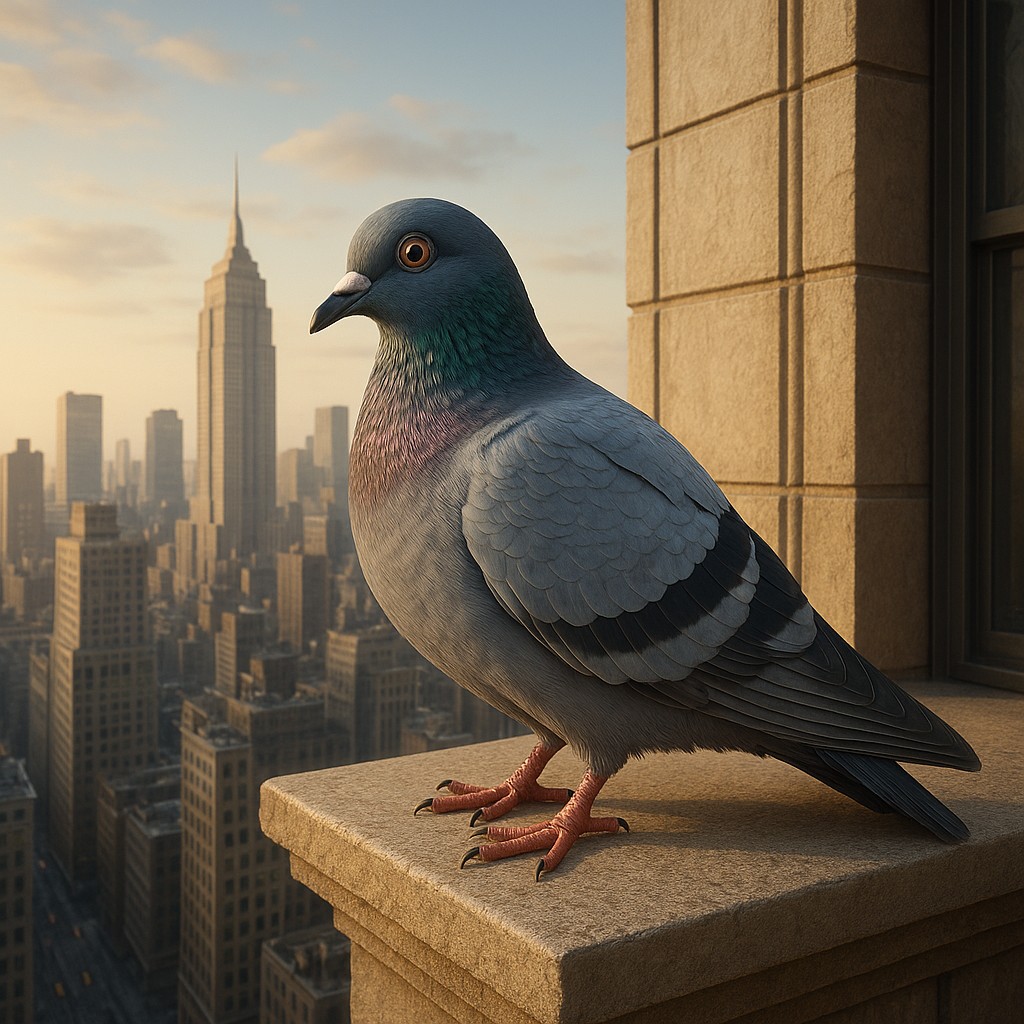
When you look out of a high-rise office window or stand in a crowded public square, you are almost certain to lock eyes with a creature that most city dwellers dismiss as a nuisance. We often call them pigeons, usually adding a nasty nickname like "rats with wings," yet we fail to notice that these birds are perhaps the most successful immigrants in animal history. They do not just survive in our jungles of steel and glass; they thrive with a level of comfort that suggests they were designed for the modern city long before the first skyscraper was ever built.
The secret to their success is a biological fluke called "pre-adaptation." While we see a bustling metropolis of concrete and asphalt, the pigeon sees a sprawling, infinite mountain range. To a bird whose ancestors spent millions of years clinging to the sheer limestone cliffs of the Mediterranean and North Africa, a window ledge in Manhattan or a bridge girder in London is not "man-made" infrastructure. It is a familiar, high-security fortress that offers perfect protection from predators on the ground. We did not just build cities for ourselves; we unintentionally created the world’s largest system of artificial cliffs and invited the world’s best cliff-dwellers to move in.
The Architectural Illusion of the Concrete Cliff
To understand the urban pigeon, we must first use its real name: the Rock Dove. This is the bird’s ancestral identity, and it explains everything about how they act. In the wild, Rock Doves (Columba livia) avoid trees and forest canopies. Instead, they seek out the craggiest, most vertical environments possible. Evolution sharpened their bodies to navigate three-dimensional, upright spaces. This is why you rarely see a pigeon standing on a thin tree branch, but you can see them perched comfortably on a one-inch wide neon sign. Their feet are designed for flat surfaces and rocky outcrops, naturally steadying them on the steep edges of the urban world.
Our skyscrapers are, for all intents and purposes, limestone cliffs on steroids. From a pigeon’s perspective, the "canyons" of Wall Street or the high-rise apartments of Hong Kong provide the exact same signals as a mountain gorge. The vertical walls create rising air currents that the birds use to save energy while flying, and the flat ledges provide nesting sites that are out of reach for most cats, rats, and even many larger hawks. When a pigeon chooses a crumbling stone ledge on an old Victorian building, it is not looking for "shelter" in the way humans do; it is finding a biological home that its species has occupied since the Ice Age.
Furthermore, our cities act as massive heaters. Concrete and asphalt soak up solar energy during the day and release it at night, a process known as the Urban Heat Island effect. For a bird that originally lived in the mild climates of the Mediterranean, this extra warmth is a huge advantage. It makes staying warm in the winter much easier on their bodies and creates a local climate that mimics the sun-warmed rocks of their ancestral home. While other birds have to fly south when the temperature drops, the pigeon stays put, enjoying the radiator-like warmth of our buildings.
Mastery of the Vertical Food Chain
One of the most common myths about pigeons is that they are natural "garbage eaters." In reality, their natural diet consists almost entirely of seeds, grains, and the occasional fruit. If you see a pigeon fighting over a discarded pizza crust or a soggy fry, you are not seeing its first choice; you are looking at a resourceful animal adapting to a concrete desert where its natural food sources have been paved over. They are survivalists who have learned to turn human waste into the fuel they need to maintain their high-speed, high-altitude lifestyle.
Pigeons have a specialized digestive system that allows them to process many types of food, but their true biological "superpower" is in their throat. Unlike almost any other bird, pigeons can drink water by using their beak like a straw. Most birds have to take a sip, tilt their head back, and let gravity do the work. Pigeons can keep their head down and suck up water continuously. In a city where water might only be found in a shallow puddle or a dripping pipe, this ability to hydrate quickly and move on is a major survival skill, reducing the time they spend in danger on the ground.
| Feature |
Ancestral Environment (Cliffs) |
Modern Environment (Cities) |
| Nesting Site |
Limestone crevices |
Window ledges, AC units, bridge beams |
| Defense from Predators |
Vertical height and steep drops |
Skyscrapers and high-rise balconies |
| Dietary Base |
Grains, seeds, and legumes |
Human scraps, birdseed, spilled grain |
| Water Access |
Mountain springs and runoff |
Puddles, fountains, and leaking pipes |
| Climate |
Sun-warmed rock faces |
Urban Heat Island effect (warm concrete) |
The Biology of Crop Milk
Perhaps the most fascinating biological "trick" that allows pigeons to dominate the city is their reproductive strategy. Most birds only breed during certain seasons because they rely on nature to provide high-protein insects or specific seeds to feed their chicks. If the food is not there, the chicks starve. Pigeons, however, have bypassed this problem through a process that looks a lot like nursing. Both male and female pigeons produce a substance called "crop milk."
This is not milk in the traditional sense, but a thick, nutrient-rich liquid produced in the lining of the bird’s crop, which is a storage pouch in the throat. It is incredibly high in protein and fat, even more so than cow’s milk, and it is full of antibodies that boost the chick’s immune system. Because the parents make this food from their own stored body fat and nutrients, they do not need to find specialized "baby food" in the environment. As long as the parents find enough calories to survive, even if those calories come from a discarded bagel, they can produce high-quality milk for their young.
This internal food production allows pigeons to breed nearly all year round. In cities where "artificial mountains" offer warmth and humans provide plenty of calories, pigeons can raise several groups of chicks annually. While other birds are waiting for the spring thaw to start nesting, a pair of pigeons on a sheltered parking garage ledge might already be on their third set of babies for the year. This intense breeding cycle is the main reason why pigeon populations can grow so quickly in city centers.
Navigating the Steel Maze
Living in a city requires more than just physical toughness; it requires a sophisticated mental map. Pigeons are famous for their homing abilities, but we often forget how this applies to their daily commute. To navigate the complex, multi-layered layout of a city, pigeons use several different systems at once. They are sensitive to the Earth’s magnetic field, which helps them keep their sense of direction even when they cannot see well. However, research suggests they also use visual landmarks, much like humans do.
Studies have shown that pigeons following a familiar route to a feeding spot will actually follow roads and turn at specific intersections. They treat the city as a series of hallways. They memorize the shapes of specific buildings and the location of reliable food, such as a particular park bench where someone sits every Tuesday afternoon. This mental mapping is what allows them to return to the same tiny ledge every night out of ten thousand identical-looking windows.
Their intelligence also shows in how they learn from each other. Pigeons are social animals that live in flocks for protection and to share information. If one pigeon finds a new source of grain near a shipping dock, the rest of the flock watches and learns. This "cultural sharing" of data makes the whole group more efficient at using the city to their advantage. They are not just mindless drones; they actively study human activity, timing their movements to match commute patterns, lunch hours, and market schedules.
Reimagining Our Feathered Neighbors
The next time you walk past a pigeon, try to see the "Rock Dove" hidden beneath the city grime. Look at the shimmering purple and green feathers on their necks, a reminder of the colorful minerals found in their ancestral mountains. Observe the way they bank and dive between buildings with the precision of an elite pilot. They are not "dirty" by choice; they are simply a wild species that stayed behind when we paved over their world, deciding that our architecture was a perfect replacement for the ancient cliffs.
Pigeons are a living bridge between the ancient natural world and our modern lives. They remind us that nature does not just exist in national parks or remote forests; it adapts, evolves, and finds a way to move into the heart of our civilizations. By seeing the pigeon as a specialized cliff dweller, we can move from being annoyed to being impressed. We are sharing our cities with a master of survival, a bird that looked at our concrete towers and saw a home. When we look at them with curiosity, we can see the boring parts of the city as a vibrant, living ecosystem, where every ledge is a sanctuary and every skyscraper is a mountain waiting to be explored.