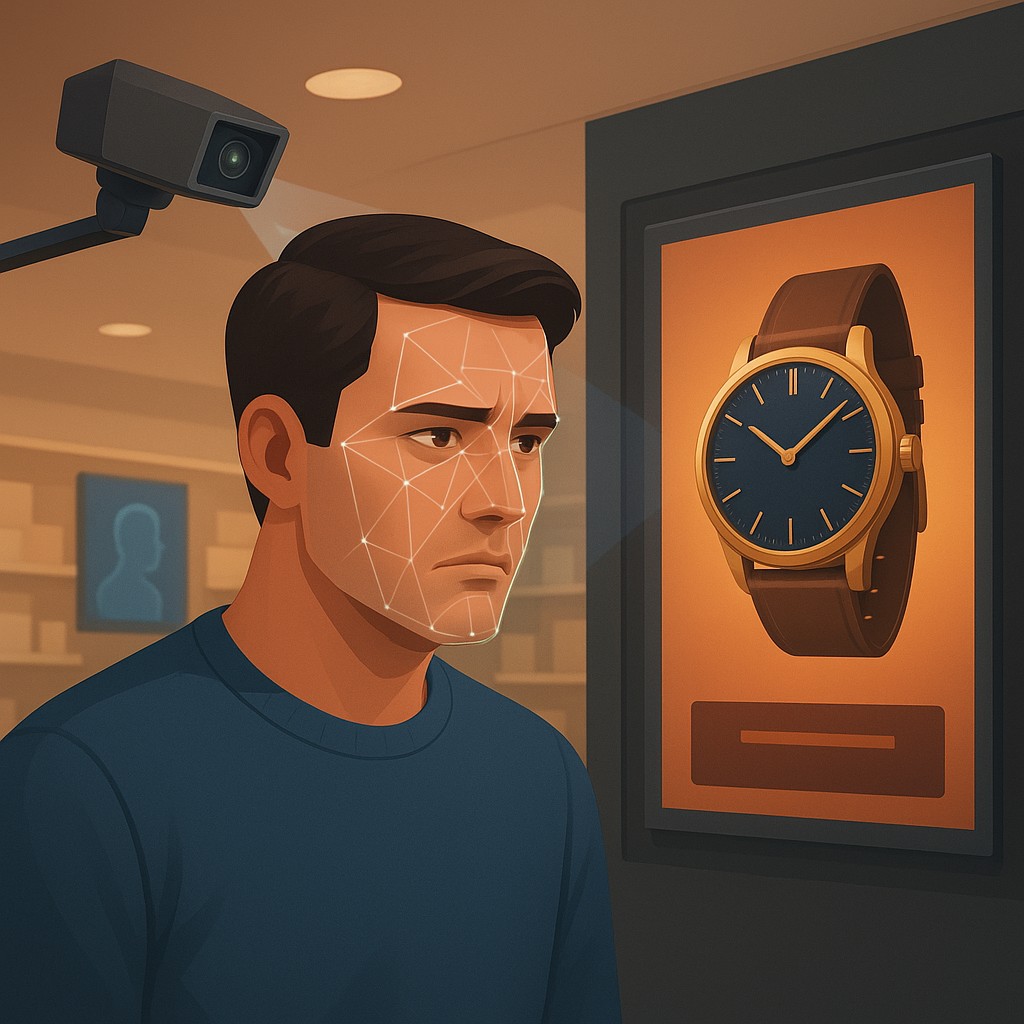
Imagine walking into a high-end clothing store where the mirrors do more than just show your reflection. As you browse, a hidden camera scans your face. It doesn't care about your name or your social security number. Instead, it is interested in the fact that you look like a man in his early thirties who seems a bit frustrated while lingering near the expensive watches. Within seconds, the digital screens around you change. They stop showing generic ads and switch to a targeted promotion for a luxury watch designed to reduce stress. All of this happens because an algorithm "read" your demographic profile and your current mood.
This scenario represents the new frontier of digital privacy. It goes far beyond old fears of hackers stealing passwords or bank details. We are entering an era where your physical appearance is harvested not just to identify you, but for what legal experts call "categorization." In this world, your face is no longer just a biological passport. It is a gold mine of data that companies use to predict your behavior, your spending habits, and even your political leanings. The legal battle is shifting from "Who are you?" to "What are you?" and "How do you feel?"
Beyond the Digital Fingerprint
For years, the conversation about biometric privacy focused on identity theft. The logic was simple: if a company stores a map of your thumbprint or a mathematical "faceprint" and that data is stolen, you cannot change your thumb or your face like you would a compromised credit card. This led to the first wave of laws, most notably the Illinois Biometric Information Privacy Act (BIPA). These laws fine companies for collecting this data without clear permission. Under these older rules, the primary "harm" was the creation of a unique ID that could be used to track you online or unlock your devices.
However, technology has moved faster than the law. We are now seeing a massive jump from identification to "inference." Modern AI does not just look for a match in a database. It uses deep learning to guess things about you that you never shared. It measures the distance between your eyes and the corners of your mouth to decide if you are happy, sad, or skeptical. It analyzes skin texture and bone structure to estimate your age and gender. To many tech firms, your face is a set of signals that can be sorted through "unauthorized categorization," a process that happens without you ever typing a word into a search bar.
The Legal Pivot from Theft to Taxonomy
The shift in the courtroom is subtle but important. Historically, to win a privacy lawsuit, a plaintiff often had to prove a specific "injury," such as money being stolen or a private record being leaked. But new legal views are starting to see the "mining" of human traits as an injury to personal dignity and independence. Under new frameworks, like the European Union's AI Act or updated state laws in the U.S., the harm is the act of being labeled and categorized without your consent.
Think of it as the difference between someone stealing your diary (data theft) and someone watching you from a distance to write a psychological profile about you (categorization). In the second case, they haven't "stolen" an object, but they have taken value from who you are without your agreement. This is why we are seeing more lawsuits against companies that use emotion-recognition software to monitor employees at work or to see if students are paying attention in class. The core of the complaint is that a person's inner feelings and identity are protected assets. They cannot be turned into data for profit without a specific, informed "opt-in" from the person.
| Feature |
Classic Biometric Identification |
Modern Biometric Categorization |
| Primary Goal |
To verify "who" you are (ID) |
To determine "what" or "how" you are |
| Data Output |
A unique mathematical template |
Labels (age, gender, mood, health) |
| Storage Need |
Usually kept in a database for matching |
Often processed instantly in real-time |
| Legal Focus |
Data security and preventing leaks |
Personal dignity and anti-discrimination |
| Example Use |
Unlocking a phone with a face scan |
Changing a billboard based on your mood |
The Edge Processing Loophole and Local Analysis
One of the most complex parts of this shift is where the "thinking" happens. In the past, privacy experts worried about "the cloud," which refers to distant servers where your data is sent and stored. To answer these concerns, many tech companies now focus on "on-device" or "edge" processing. They claim that because the analysis of your face happens locally on your smartphone or a smart camera and is never uploaded to a central server, no privacy violation has occurred. They argue that if the data is deleted a fraction of a second after the "classification" is made, there is no "record" to complain about.
Lawmakers and privacy advocates are increasingly rejecting this "loophole." They argue that the intrusion happens the moment you are analyzed, not the moment you are stored. If a system scans your face to decide you look "angry" and then uses that to show you an ad for a boxing gym, it has used your biological data to influence your behavior. The location of the computer chip doing the math is less important than the fact that your body was used as a source of commercial intelligence. New laws are starting to require very specific permissions: you might let a company recognize your face so you can log in, but that does not give them the right to guess your mood or your ethnicity for "research."
The Ghost in the Machine of Emotion Recognition
A major point of debate in "unauthorized categorization" is whether the science behind emotion recognition actually works. Most of these systems are based on a theory that there are universal facial expressions for basic human emotions. Critics call this "pseudo-science" because it ignores cultural differences, people whose brains process information differently (neurodiversity), or the fact that people often hide their true feelings. A person might have a naturally heavy brow that an AI reads as "anger," which could lead to unfair results in automated job interviews or security checks.
Because of these flaws, the legal pushback is about more than just privacy; it is about "accuracy and fairness." When a company categorizes you, they are forcing a label onto you that might be wrong. Being mislabeled as "aggressive" by a security program or "bored" by an online learning tool can have real-world consequences. This has led some places, such as the EU, to propose bans on emotion recognition in high-stakes areas like workplaces and schools. The logic is that the risk of being "profiled" based on your looks is too high to be fixed by a simple consent form.
Navigating a World of Constant Classification
As we move forward, the rules for being a person in public and digital spaces are being rewritten. We are moving toward a standard where "informed consent" must be very specific. In the near future, when you download an app or enter a "smart" building, you might see a checklist instead of a single "I Accept" button. You might agree to let the building identify you for security, but explicitly "opt-out" of having your walking style analyzed for health insights or your facial expressions mined for marketing.
This shift allows individuals to treat their physical presence as a form of personal property. It challenges the "wild west" era of data collection where anything a camera could see was considered free for the taking. By making categorization a legal hurdle, we are putting a price on the data of our daily lives. It forces companies to prove that their analysis is not just possible, but also ethically and legally invited by the person being watched.
The evolution of biometric privacy reflects a deeper understanding of what it means to be private today. It is no longer enough to keep our names and numbers secret. We are now fighting to keep our internal moods and physical traits from being turned into products. As these lawsuits move through the courts, we are drawing a line around our own bodies. We are declaring that our faces are not just data sets to be mined, but the most intimate parts of who we are. This journey from protecting "who we are" to "how we are seen" is the next great chapter for human rights in the digital age.