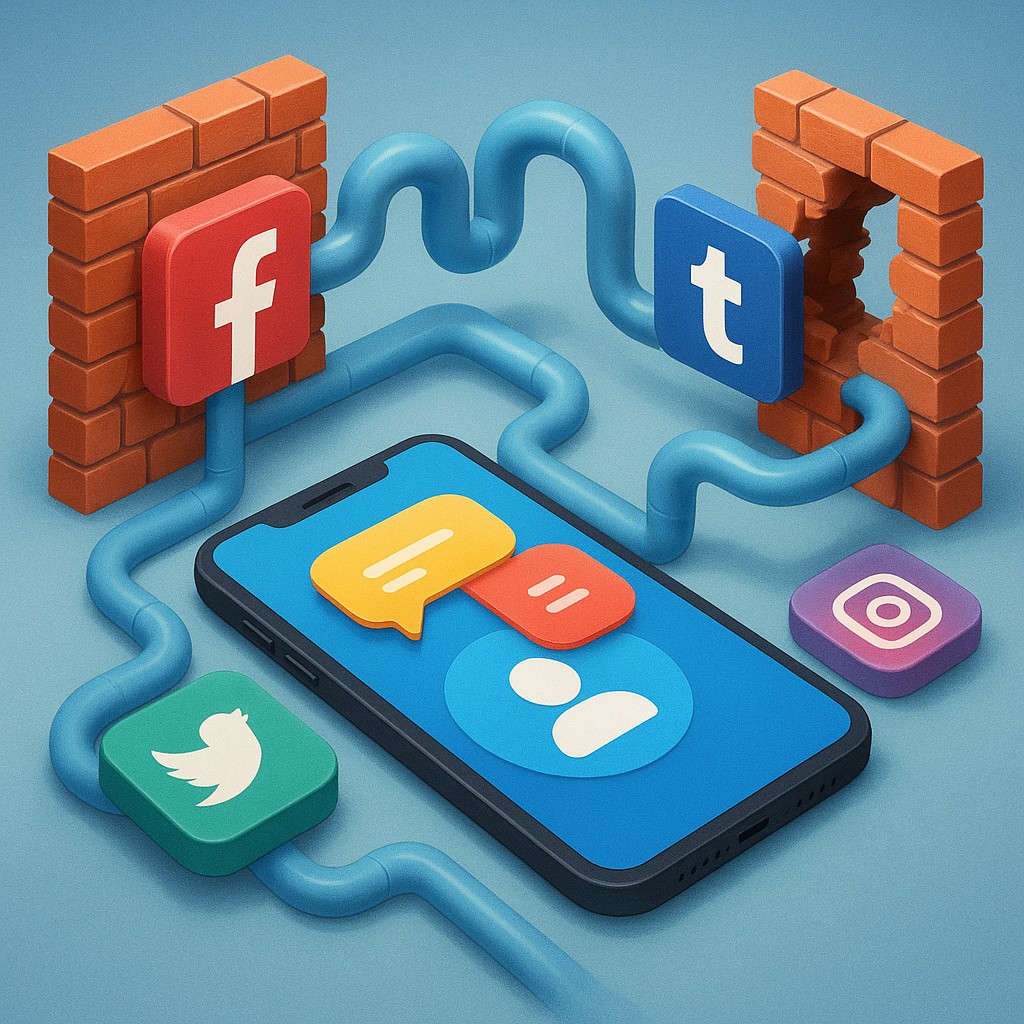
Imagine for a moment that your smartphone worked the same way social media does today. If you used a carrier like Verizon, you could only call or text other people on Verizon. To talk to a friend who used AT-T, you would have to buy a second phone, create a new ID, and manage a completely separate contact list. We would find this setup absurdly inefficient for phones, yet we have accepted it as the standard for our digital lives. Every time a new social app gets popular, we dutifully rebuild our networks from scratch, trapped within "walled gardens" built by companies that treat our list of friends as their private property.
Those walls are beginning to crumble thanks to a concept called interoperability. This shift is centered on the idea that social media should work more like email or the web itself, where the platform you choose is simply a doorway to a universal network rather than a closed-off room. Ongoing trials across the internet are now using a technology called ActivityPub to prove that your profile, your posts, and your followers can exist independently of any single corporation. It is a fundamental shift in how power is shared online, moving the focus away from platform owners who want to keep you locked in and toward the individuals who actually create the value in those networks.
The Invisible Plumbing of the Decentralized Web
To understand how different social platforms can suddenly start talking to one another, we need to look at the concept of a protocol. In the world of technology, a protocol is simply a shared set of rules that allows different systems to exchange information. Think of it as a universal language. When you send an email from a Gmail account to someone using Outlook, you are using a protocol called SMTP. The two companies might be fierce competitors, but because they both speak the SMTP language, your message arrives exactly where it should.
ActivityPub is the social media version of that email language. It was established as a standard by the World Wide Web Consortium (W3C), the same organization that oversees the basic rules for how websites are built. This protocol works using two main parts: a "client-to-server" rule and a "server-to-server" rule. The first part allows you to use an app on your phone to post a photo or a status update. The second part is where the magic happens; it allows the server hosting your account to broadcast that photo to your friends' servers, regardless of whether they use the same app as you.
This collection of connected servers is often called the "Fediverse," a name made by joining the words "federated" and "universe." In a federated system, there is no central headquarters. Instead, thousands of independent servers talk to one another using ActivityPub. If one server goes offline or changes its rules in a way you dislike, you can simply pack your digital bags and move to a different server without losing your connections. This creates a competitive environment where platforms must earn your loyalty through good service rather than the threat of losing your social life.
Comparing the Old Guard and the New Wave
The move from closed platforms to an open network represents a massive shift in how data is managed. In the traditional model, the platform acts as the guardian, the landlord, and the police force all at once. In the newer model, the user gains a level of control that was previously impossible. This change affects everything from how your data is stored to how you see posts in your feed. To clarify the differences between these two worlds, we can look at the structural changes happening right now.
| Feature |
Closed Platforms (The Status Quo) |
Interoperable Networks (The Fediverse) |
| Ownership |
The company owns your data and friend list. |
You own your identity; data can move between apps. |
| Access |
You must have an account on App A to see App A posts. |
You can follow anyone from any app on the network. |
| Innovation |
Outside developers are often blocked from making tools. |
Anyone can build an app that plugs into the network. |
| Governance |
One board of directors decides all rules and filters. |
Each community sets its own rules and moderation. |
| Portability |
Leaving a platform means losing all your followers. |
You can move your profile to a new host and keep your network. |
This table highlights why the industry is currently in such a state of flux. Major players like Meta, through their Threads platform, have begun experimenting with ActivityPub. Meanwhile, long-standing blogs and newsletter services like Ghost are adopting the protocol to turn every independent website into a social media hub. When a blog post can be "liked" or "replies to" from a social app, the line between a website and a social network begins to vanish.
The Trade-off Between Freedom and Moderation
While a borderless social network sounds like a digital utopia, it introduces a complex set of challenges that developers are still working to solve. The biggest hurdle is content moderation. In a traditional social network, a central company employs thousands of moderators and uses smart AI to find and remove harmful content. They have the "delete" key for the entire system. If they find a bad actor, they can banish them from the platform entirely to protect other users from harassment or illegal material.
In a decentralized system, there is no "master" button. Because the network is made of thousands of independent servers, a user who is banned from one server can simply start their own or move to one with more relaxed rules. While this prevents censorship, it also makes it much harder to stop widespread abuse. If a malicious server starts flooding the network with spam or hate speech, other servers must choose to "defederate," or block that specific server's entire signal. It is a manual, community-driven process that requires a lot of work from the people running each server.
Furthermore, interoperability introduces a technical "lowest common denominator" problem. Different social apps have different features; one might be for long essays, while another is built for short videos or high-quality photos. Making sure a complex post from one platform looks good and works correctly on a completely different platform is a massive task for engineers. They must ensure that "likes," "reposts," and "mentions" translate perfectly, even when the underlying code of the two apps has almost nothing in common.
The Death of the Algorithm and the Rise of Choice
One of the most liberating parts of the shift toward open social media is the potential end of the "forced algorithm." On traditional platforms, companies use secret formulas to decide what appears in your feed. These algorithms are usually designed to maximize "engagement," which is a polite way of saying they want to keep you on the app as long as possible. Frequently, this means prioritizing controversial or addictive content that gets a big emotional reaction but offers very little value.
In an interoperable world, the "feed" becomes a choice rather than a requirement. Because the data is open and accessible, you are not forced to use the view provided by a single company. You could, in theory, use an app that shows your friends' posts in the order they were written, or one that uses a specialized AI to only show you updates about your specific hobbies. You could even use a "clean" interface with no ads or distractions. The power to design your digital experience returns to your hands.
This shift also changes the game for creators and influencers. Currently, a creator with a million followers on one platform is essentially a tenant on someone else's land. If the platform changes its algorithm or goes out of business, the creator loses their livelihood and their direct line to their audience. In a decentralized network, those followers belong to the creator’s identity, not the platform’s database. If a creator moves their "home base" from one website to another, the connection remains intact because the underlying rules handle the handshake between the creator and the fan.
A Future Built on Open Borders
We are currently in a transition era that mirrors the early days of the internet, before it was taken over by a few tech giants. The trials currently underway with ActivityPub are more than just a technical experiment; they are a fundamental rethinking of what it means to be connected. We are moving toward a future where "social media" isn't a destination you visit, like a digital shopping mall, but a layer of the internet itself, as common and accessible as the air we breathe.
As you witness these changes, from Threads opening its doors to others to your favorite bloggers becoming part of a global social network, realize that you are gaining a new kind of digital freedom. You no longer have to be a passive consumer in a closed system; you are becoming a citizen of a broader, tougher network. Explore the new tools being built and take comfort in the fact that soon, your digital identity will belong to no one but yourself. The walls are coming down, and the view from the other side is remarkably bright.