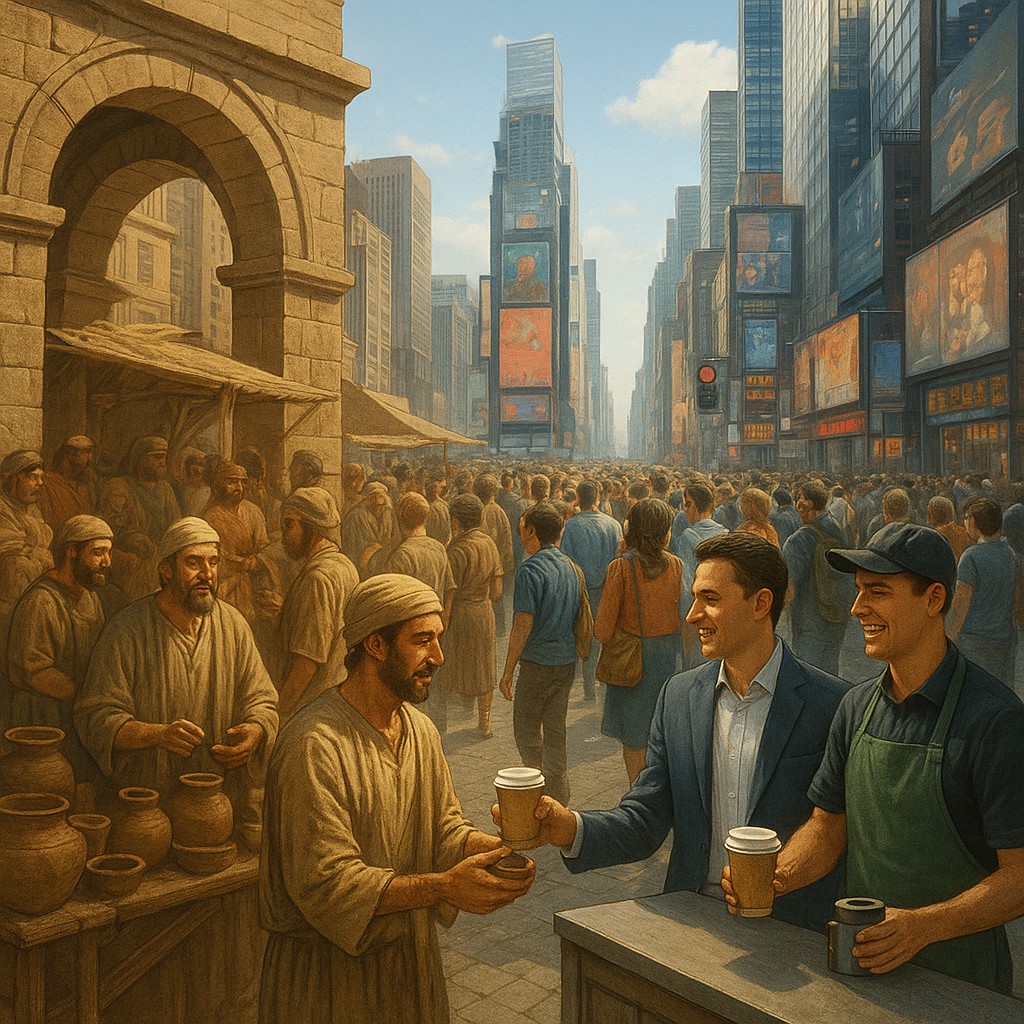
Imagine you are standing in a busy marketplace in ancient Mesopotamia, or perhaps in the middle of Times Square today. Around you are thousands of people, most of whom you have never met and will never see again. In a primitive world, this would be terrifying. Biologically speaking, a stranger is a potential threat. Yet, you feel perfectly fine buying a coffee from someone whose name you don’t know, using a piece of plastic from a bank a thousand miles away, while following traffic lights timed by engineers you will never meet. This seamless coordination of millions of strangers is not a lucky accident. It is the result of a brilliant "technology" known as social scalability.
For most of human history, we lived in tiny bands where everyone knew everyone else’s business. If you were lazy, the tribe knew; if you were a hero, they knew that too. This worked perfectly for groups of about 150 people. But as soon as we tried to build cities or empires, our biological "social hardware" began to crash. We simply didn’t have the brainpower to track the reputations and reliability of thousands of people at once. To grow further, we had to stop relying on personal trust and start relying on impersonal systems. This shift allowed us to move from the village to the global stage, turning the entire planet into one giant network of cooperation.
The Invisible Ceiling of Human Connection
To understand how we broke past our biological limits, we first have to look at the work of evolutionary psychologist Robin Dunbar. He famously suggested that there is a mental limit to the number of people with whom a person can maintain a stable social relationship-one where you know exactly who everyone is and how they relate to everyone else. This figure, known as Dunbar’s Number, usually hovers around 150. Beyond this point, the "cognitive tax" - the mental effort required to keep track of everyone’s favors, debts, and personality quirks - becomes too heavy for the human brain to handle. This is why small startups often feel like family, but once they hit 200 employees, they suddenly need HR departments, middle managers, and formal handbooks.
This limit exists because trust is expensive. In a small tribe, trust is built through years of shared meals, hunting trips, and stories told around a fire. You trust your neighbor because you know their parents, you saw them grow up, and you know they would be kicked out if they stole your grain. But you cannot have a campfire story with seven billion people. If we were forced to rely only on personal trust, the world would still be a collection of isolated villages. Any interaction with an "outsider" would be a high-stakes gamble, likely ending in conflict or deep suspicion. Social scalability is the magic wand that lets us treat a stranger like a friend - or at least makes their behavior predictable.
Hardcoding Trust into the System
So, how do we bypass the need to know someone personally? We create "standardized protocols" for human behavior. Think of these as the software rules of society. When you walk into a grocery store, you don't need to interview the cashier to see if they are honest. You rely on the institutional framework of the store, the legal system that punishes theft, and the medium of exchange we call money. These tools are socially scalable because they work just as well between two strangers as they do between two brothers. They lower the mental effort needed to work together by providing a rigid, predictable script that everyone follows.
Money is perhaps the greatest social scalability tool ever invented. Before money, if you wanted a chair and only had apples, you had to find a carpenter who happened to be hungry for apples. Economists call this the "double coincidence of wants," and it scales terribly. You would have to know the carpenter’s personal needs and negotiate a complex trade based on mutual trust. With money, the carpenter doesn't need to trust you or even like you; they only need to trust the currency itself. By moving trust from the person to the token, we unlocked the ability to trade across oceans and centuries. The carpenter accepts your coins because they know the rest of society will accept them too, creating a massive loop of trust.
The Pillars of Large-Scale Cooperation
The move from "who you know" to "what rules you follow" is supported by several key pillars that handle the heavy lifting of social organization. Each of these pillars takes a complex human problem, such as settling a fight or proving who owns a house, and turns it into a standard process. By doing this, we reduce the risk of being cheated, which makes us more willing to engage with the wider world.
| Tool |
How it Scales |
How it Saves Mental Effort |
| Money |
Provides a universal language for value. |
No need to haggle over bartering or track personal debts. |
| Written Laws |
Offers a public, predictable set of consequences. |
No need to rely on a chief's moods or personal revenge. |
| Digital Protocols |
Automates interactions through code (like the internet). |
No need for a human middleman to check every piece of data. |
| Property Rights |
Clearly defines ownership via public records. |
No need to physically guard your land or fight off every claimant. |
These pillars work because they are objective. If a law says "the speed limit is 55," it applies to everyone, regardless of their social status or whether the police officer knows them. This objectivity is what allows someone in Japan to buy stock in a Brazilian company. They don't need to trust the CEO in Brazil; they trust international accounting standards, stock market rules, and banking systems. The "social scalability" of the stock market is what allows millions of people to pool their money to build things that no single person could ever afford.
The Shift from People to Protocols
In the modern era, digital technology is giving social scalability a massive upgrade. Until recently, most of our scalable systems required a "trusted third party," such as a bank, a government, or a tech giant, to sit in the middle and verify everything. These institutions acted as the "trust providers." While this was a huge improvement over tribalism, it still has limits. Institutions can become corrupt, slow, or expensive to run. They are "human-heavy" systems that require thousands of employees to keep the gears turning.
We are now entering an age where we can replace some of these human-heavy institutions with "automated protocols." The internet itself is the best example. You don't need permission from a "Global Postmaster" to send an email; the protocol simply handles it. This is why the digital world grows so much faster than the physical world. When a system is governed by math and code rather than human judgment, it can handle billions of users with almost no extra cost. This is the ultimate form of social scalability: a system so predictable and automated that it works like a law of physics. We stop thinking about the "trust" involved and simply take the result for granted.
The Tradeoff Between Scale and Soul
While social scalability gave us modern medicine, air travel, and the internet, it comes with a psychological cost. These systems are designed to be impersonal by definition. To serve millions, a system must treat everyone as a number, a user ID, or a data point. This is why calling a customer service line for a global bank can feel so frustrating. The bank isn't being "mean"; it is being scalable. It cannot afford to have a deep, personal relationship with all five million customers, so it uses scripts, bots, and standard procedures.
This creates a strange paradox in modern life. We live in a world of incredible wealth and global connection, yet we often feel cold or alone. We are biologically wired for the village - for the 150 people who know our names and our stories - but we spend our lives interacting with protocols. Understanding social scalability helps us forgive the "coldness" of our institutions. We realize that the impersonality of the tax office or a digital platform is the price we pay for living in a civilization of billions rather than a tribe of dozens. We are effectively trading intimacy for reach.
Building the Future on Scalable Foundations
As we look toward the future, the challenge for humanity is to find the right balance between these two ways of living. We need massive, scalable systems to solve global problems like climate change, space exploration, and preventing pandemics. No small tribe can build a telescope powerful enough to see the edges of the universe. However, we also need to protect the "unscalable," low-tech world of family, friendship, and local community. These are the places where Dunbar’s Number still rules, and where trust is built the old-fashioned way - through time, presence, and shared vulnerability.
Once you understand social scalability, you start to see the hidden architecture of the world. You’ll see that a "brand" is just a way to scale trust in a product, a "contract" is a way to scale trust in a promise, and "software" is a way to scale human intent across the entire globe. By building better, more inclusive, and more transparent protocols, we can continue to expand human cooperation. We are no longer limited by what our brains can remember; we are only limited by the quality of the systems we choose to build. Go forth and be a thoughtful architect of these systems, remembering that while the rules let us scale, it is the people who make it worth doing.