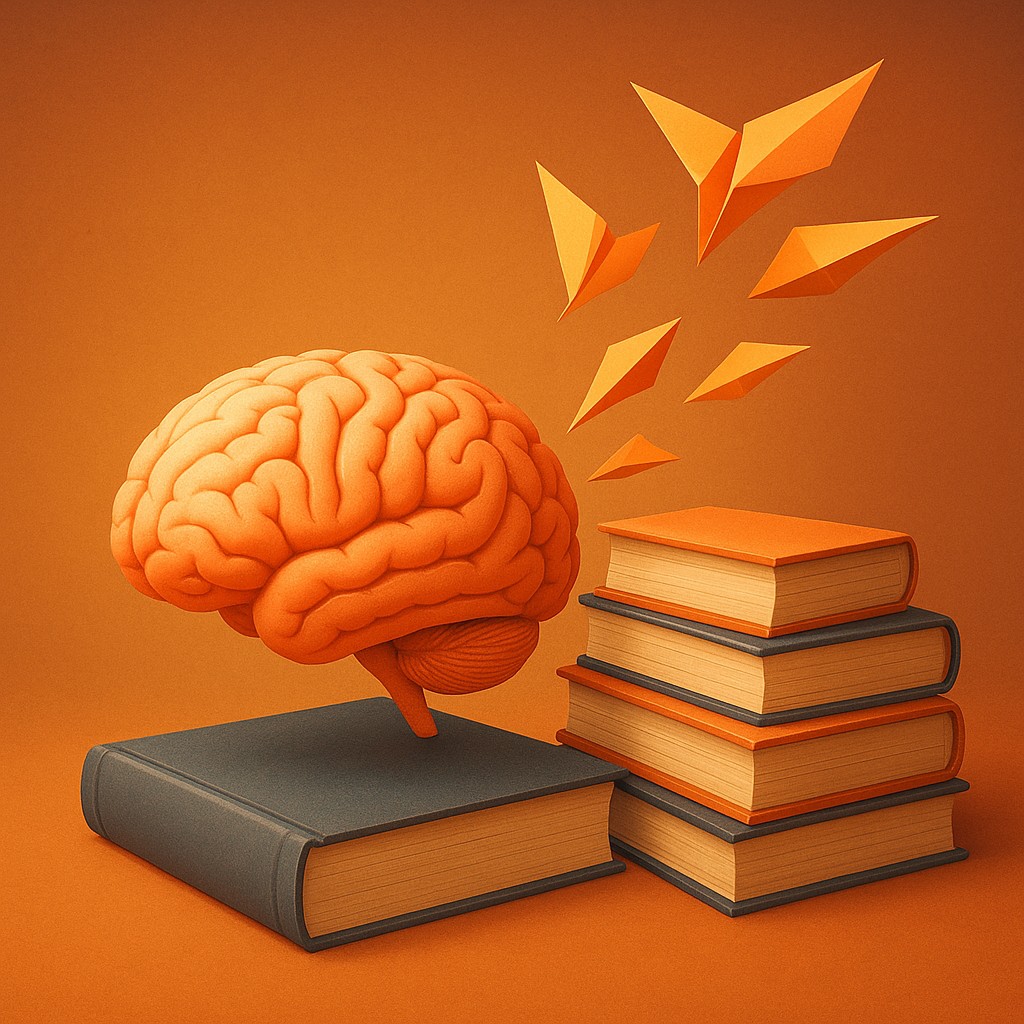
We often treat the human brain like a hard drive. We obsessively fill it with files - facts, dates, and formulas - until we reach total intellectual saturation. Our education system rewards those who can retrieve these files the fastest, assuming that the person with the most data stored is the best prepared for the future. It feels safe to believe that intelligence is a finite container for everything we have memorized, as if our success depended on storing the largest mental library.
Yet, reality has a disorienting way of setting fire to our books. When the environment changes, when a career field shifts, or when the rules of the game are rewritten in real-time, the person who only memorized the library often finds themselves holding nothing but ashes. True intelligence, and the success that flows from it, is not found in static information. It is found in the kinetic energy of a brain that constantly dismantles and repairs its own foundations. We must stop viewing our minds as storage units and start seeing them as high-speed navigators that thrive on the ability to abandon old ideas when they are no longer useful.
The Mirage of Stored Certainty
The allure of crystallized knowledge is understandable, as it provides a comforting sense of predictability. Crystallized knowledge consists of the facts, procedures, and patterns we build up over years of repetitive learning. In environments that never change, this is a massive advantage - which is why standardized tests are so effective at predicting how well a student will perform in their first year of college. If you are asked to perform the same task repeatedly, being a library of information is exactly what you need to be efficient and high-performing.
However, the world is rarely static, and the challenges that define adult success usually arrive without an instruction manual. When we prioritize the accumulation of information above all else, we often develop what psychologists call a status quo bias. We lean into the facts we know because they make us feel competent, causing us to ignore or reject new information that contradicts our existing mental models. This is where crystallized knowledge turns from an asset into an anchor, holding us in place while the rest of the world sails away from the shore of previous assumptions.
Mapping the Architecture of Adaptive Plasticity
If crystallized knowledge is our collection of static mental files, then adaptive plasticity is the operating system that writes, deletes, and reorganizes them. Think of the difference between a building's blueprint and the actual construction crew working on the site. A blueprint tells you where the walls are today, but the crew has the wisdom to tear down a non-structural wall if it keeps you from walking through a doorway. Adaptive plasticity is the biological mechanism that allows your neural pathways to shift, pruning away old habits and strengthening new routes when you realize that your current way of thinking is obsolete.
This process is not just about being smart or quick-witted, as it requires a deliberate willingness to be wrong. Truly plastic thinkers recognize that their mental models are only temporary maps, not the territory itself, and they treat every new input as an opportunity to update their internal navigation. While traditional educators might measure a person by their current stockpile of answers, a measure of adaptive plasticity evaluates how quickly someone can unlearn a failed strategy and how effectively they can synthesize new information into a working solution.
When Efficiency Becomes a Strategic Liability
There is a natural trade-off between the stability of our beliefs and our capacity for growth. In the short term, crystallized knowledge offers us efficiency. When you know a process perfectly, you do not need to pause or consider alternatives, and you can churn out results with minimal effort. This is why experts in stable fields often outperform newcomers, as their deeply ingrained expertise allows them to bypass the slow, grinding process of troubleshooting that defines the beginner's experience.
The danger emerges when that efficiency begins to override our curiosity. We naturally drift toward cognitive miserliness, favoring the mental shortcuts that served us well in the past even when the current context has shifted. We become so efficient at doing things the wrong way that we lose the ability to see that they are wrong at all. The following table contrasts the traits of crystallized reliance with the habits of adaptive plasticity:
| Feature |
Crystallized Knowledge |
Adaptive Plasticity |
| Core Value |
Maintenance of expertise |
Constant model optimization |
| Response to Change |
Resistance to protect status |
Re-patterning and testing |
| Goal |
Efficient recall of facts |
Creative problem resolution |
| Primary Risk |
Becoming obsolete |
Cognitive burnout or fatigue |
| Ideal Environment |
Static and predictable |
Messy and evolving |
The Art of Intellectual Disassembly
To foster adaptive plasticity, one must master the art of intellectual disassembly. This means you do not just learn new things; you must actively dismantle the components of your old knowledge to see how they might be reassembled to tackle a completely different problem. Many people are terrified of letting go of their old ideas because they feel as if they are abandoning their own identities. In reality, you are not losing your past by upgrading your thinking, but you are instead ensuring that your future self has a larger, more modern set of tools at their disposal.
Imagine you are looking at a complex puzzle, but the pieces keep changing shape while you try to fit them together. Someone relying strictly on crystallized knowledge will get frustrated, looking for the specific corner piece they memorized years ago that used to complete the image perfectly. A person with high adaptive plasticity will stop trying to force the static image and start observing the way the pieces are shifting. They begin to see the underlying geometry of the change, realizing that the value isn't in the finished picture, but in the ability to solve the puzzle in any shape it takes.
Rewiring the Habit of Certainty
We often mistake confidence for intelligence, believing that if we say something with enough conviction, it must be true. However, the most successful people in complex fields are often the most comfortable with admitting that they have no idea if their current model is correct. They recognize that their certainty is a measurement of their past experience, not necessarily a guarantee of their future relevance. Cultivating this mindset requires us to build in moments of friction where we force ourselves to look for information that contradicts our deepest beliefs, treating these moments not as threats, but as essential maintenance for our neural frameworks.
This does not imply that knowledge is useless, but rather that knowledge must be treated as a consumable good, one that expires and needs to be replaced. You should respect the facts you have learned while remaining emotionally detached from them, always ready to discard them the moment they no longer map to the reality you are facing. Success is less about the weight of what you have carried into the room and more about how quickly you can drop the heavy luggage that is preventing you from crossing new, difficult thresholds.
Embracing the Dynamic Process of Growth
As you move through your personal and professional life, remember that the most valuable asset you own is not your degree, your job title, or the years of experience you have logged in a specific industry. It is the raw, untamed capacity of your brain to reorganize itself in response to the unexpected. Your intelligence is not a static bucket that needs to be filled with information; it is a beautiful, churning process of modeling the world through constant observation and revision.
Do not fear the moments where you have to throw away a long-held view or admit that the way you have always done things is now a hindrance. Those moments of unlearning are actually the highest indicators of cognitive health. If you can maintain this sense of flexibility, you will find that you are not just moving through the world; you are co-evolving with it. Stay curious, keep your mental models light, and never allow the comfort of what you already know to overshadow the thrilling curiosity of what you have yet to realize.