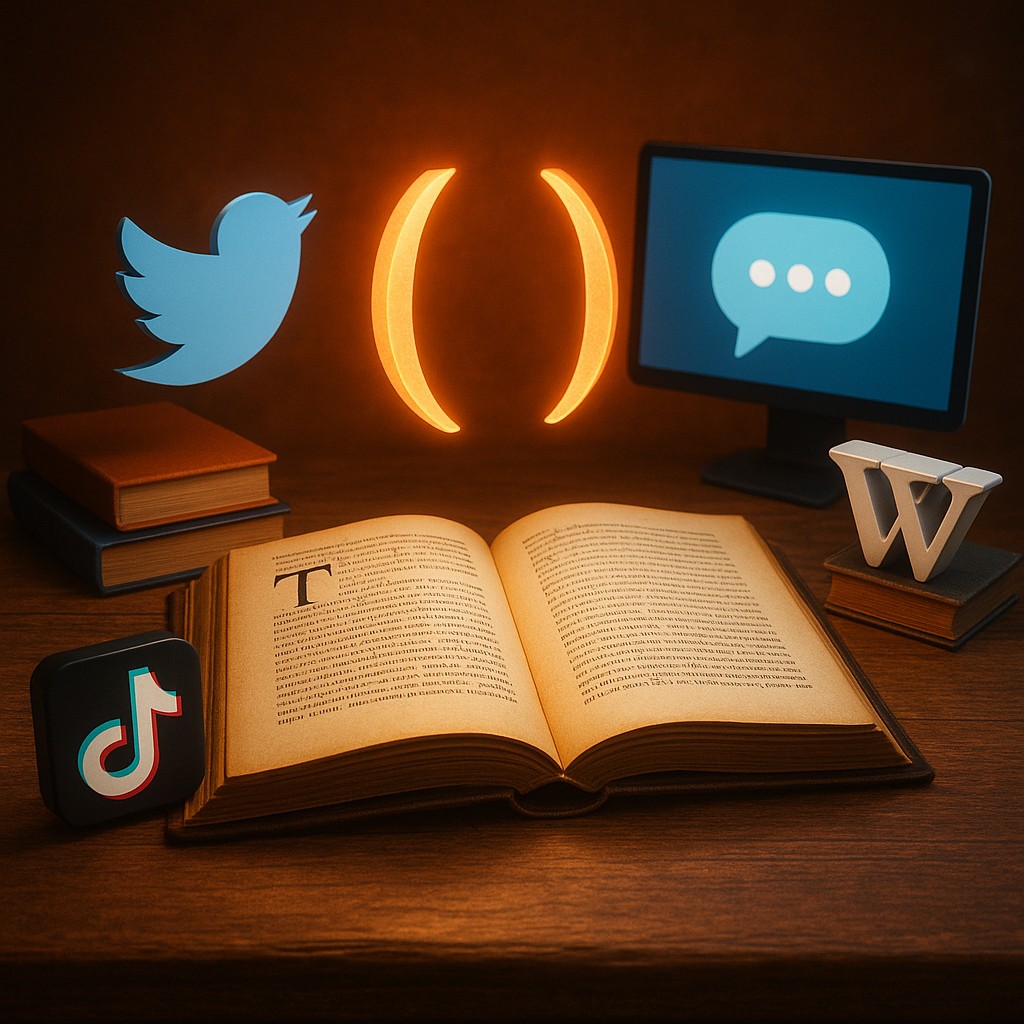
For the last five hundred years, we have lived in a world where truth was something solid, something you could drop on your foot. If a piece of information mattered, it was printed, bound, and placed on a shelf. This physical reality gave rise to our modern ideas about who counts as an author, how copyright works, and the belief that a "fact" is something static and permanent. We became a society shaped by the book, trained to believe that because a sentence was frozen in ink, it carried a sort of divine authority. We expected stories to have a clear beginning, middle, and end, and we expected the person whose name was on the cover to be the sole creator of the thoughts inside.
However, historians and media experts are starting to realize that this era of fixed, printed truth might have been a historical fluke. Known as the Gutenberg Parenthesis, this theory suggests that the age of print was merely a long pause in the normal flow of human communication. Before the printing press, knowledge was fluid, spoken, and shared by the community. Today, as we scroll through endless social media threads, remix videos, and update Wikipedia entries in real time, we aren't actually moving "forward" into a brand-new digital frontier. Instead, we are closing the parenthesis and returning to a way of life that looks remarkably like the Middle Ages, where information is a living conversation rather than a finished product.
The Era of the Living Word
To understand where we are headed, we have to look at how people handled ideas before Johannes Gutenberg revolutionized the world in the 1440s. In the era before printing, most people learned stories and news through performances and speech. If a traveling singer arrived in a village to tell the legend of Beowulf, the story changed every time it was told. The performer would speed up or slow down based on the crowd's reaction, add local details to make it feel relevant, or forget parts and invent new ones on the spot. There was no "original" or "correct" version of the story kept in a vault; the story existed only in the moment it was being told.
This fluidity meant that authorship was a group effort. A folk song belonged to everyone who sang it, and every person who added a line was considered a real contributor. Scholars call this "secondary orality." In this world, the truth wasn't found in a locked document but in the consensus of the community. If everyone in a village agreed that an event happened a certain way, that was the functional truth. Knowledge was seen as a process of constant negotiation rather than a collection of fossilized facts. It was messy, collaborative, and deeply social, much like the way a meme evolves today as it is shared and edited by millions of people across the globe.
The Great Flattening of the Print Revolution
When movable type arrived, it acted like a giant cooling agent on the warmth of human conversation. Suddenly, an idea could be captured, copied by the thousands, and sent across long distances without a single word changing. This created a sense of permanence that humanity had never known before. If two people in different countries read the same book, they were, for the first time, having an identical intellectual experience. This "fixity" of text built the modern world. It allowed for the scientific revolution, because experiments could be repeated exactly as written, and it paved the way for modern law, which relies on a "code" that stays the same no matter who reads it.
However, this shift also had a psychological cost. We began to value the "individual genius" over the community. Since one person's name sat on the spine of the book, we decided they were the sole owner of those ideas. We invented copyright laws to protect this ownership and developed a linear way of thinking. We learned to read from top to bottom and left to right, following a single logical argument from start to finish. The messiness of oral tradition was swept away to make room for the neat, ordered rows of library stacks. For five centuries, if it wasn't in a book, it didn't feel quite "real" or "official."
Comparing the Three Great Eras of Media
The transition between these eras serves as a roadmap for how our brains and societies adapt to new tools. The following table highlights the radical differences between the oral world, the print world, and the digital world we live in today.
| Feature |
Pre-Print (Orality) |
Print Era (The Parenthesis) |
Digital Era (Post-Print) |
| Stability |
Fluid and changing |
Fixed and permanent |
Fluid and unstable |
| Ownership |
Shared/Anonymous |
Individual Author |
Remixed/Networked |
| Structure |
Circular and repetitive |
Linear and sequential |
Fragmented and hyperlinked |
| Authority |
Tribal consensus |
The published source |
The viral network |
| Medium |
The human voice |
The physical book |
The digital stream |
Why Your Browser Tab Feels Like a Medieval Square
If you look closely at how we use the internet, the parallels to the pre-print world are staggering. Take a Wikipedia article, for example. It is never "finished." At any second, an editor in Tokyo or a student in London might be tweaking a sentence, adding a source, or deleting a paragraph. It is a living document that reflects the current state of shared knowledge, much like a town square rumor might have worked in the year 1200. There is no single author of Wikipedia; there is only the consensus of the network. This is a total departure from the old encyclopedia model, where a group of elite experts decided what was true and froze it in a heavy, leather-bound volume.
Furthermore, our communication has become "performative" and "temporary" again. Social media messages disappear, stories vanish after twenty-four hours, and livestream comments fly by in a blink. We are moving away from the idea of creating a permanent record and moving back toward the "event" of communication. When you join a fast-moving Reddit thread or a viral video trend, you aren't reading a finished work; you are taking part in a digital performance. You are "passing the word," and in the process of sharing, you inevitably change the context and the meaning, just as a medieval storyteller once did.
The Death of the Gatekeeper and the Crisis of Truth
The closing of the Gutenberg Parenthesis has caused a massive cultural shock because we are losing our traditional gatekeepers. In the print era, the high cost of paper, ink, and shipping meant that only certain people could get their ideas heard. Publishers, editors, and librarians acted as filters, making sure that what reached the public met a certain standard of "authority." While this was often elitist and excluded many voices, it provided a shared foundation for what a society considered true. You might disagree with an article in a major newspaper, but you generally agreed that the newspaper was a legitimate place for the debate.
In our new "digital orality," those filters have vanished. Today, anyone with a smartphone is their own printing press, but they are using that press to act like an oral storyteller. We see the rise of "echo chambers" where truth is once again defined by what our specific "tribe" believes. This is why misinformation is so hard to fight. In a print-based mind, you look for a primary source to find the truth. In a digital-based mind, you look at what your network is saying. If the consensus of the network says something is true, it feels true, regardless of what the official record says. We are relearning how to live in a world where authority is earned through social connection rather than being handed down by an institution.
Navigating a World Without a Final Draft
One of the deepest shifts in this new reality is the loss of the "final draft." In the print era, finishing a book or an article was a ritual of completion. Once it was sent to the printer, the work was done. In the digital age, nothing is ever truly finished. Software gets constant updates, news articles are updated live as events unfold, and your own social media profile is a never-ending work in progress. This creates a state of perpetual "beta," where we are constantly adjusting our views and our identities based on new information. It is an exhausting way to live if you are still trying to use a print-era brain that craves closure and permanence.
However, there is a certain beauty in this return to fluidity. It allows for a more democratic and inclusive culture where more voices can join the global conversation. We are seeing a return to the "remix culture" that defined human history before strict copyright laws existed. Just as Shakespeare took existing plots and characters and transformed them for his own theater, digital creators today take memes, songs, and video clips and turn them into new expressions of meaning. We are reclaiming the right to play with our culture rather than just consuming it as a finished product delivered from above.
Embracing the Digital Performance
As we move forward, it helps to stop seeing the internet as a broken library and start seeing it as a massive, global campfire. The rules of the book are not the rules of the screen. To be literate in the post-print age requires more than just the ability to read and write; it requires the ability to navigate a world where truth is a moving target and the community is the main editor. We have to develop new "truth filters" suited for a conversational world, focusing on transparency, track records, and reputation rather than just professional formatting.
Understanding the Gutenberg Parenthesis helps us see that we aren't watching the end of intelligence or the death of deep thought. We are simply returning to a more natural, human way of sharing ideas after a very long and productive 500-year detour. The challenge of our time is to take the best parts of the print era - the rigor, the logic, and the respect for evidence - and figure out how to weave them into the fast-moving, collaborative world of the digital future. We are no longer just readers of the world; we are once again its storytellers, and the story is ours to edit together.