Imagine you are sitting at a red light, humming along to the radio, when you catch a vehicle in your peripheral vision. It is coming from the side, and it is moving much too fast. In a standard car, your safety depends almost entirely on the reinforced steel of the door frame and an internal curtain airbag. That bag only pops out after the metal has already started to bend. You are essentially waiting for the blow to land before your car wakes up to defend you. It is a reactive way to survive. While this has saved millions of lives, it still leaves you vulnerable to the raw physics of a side-on collision.
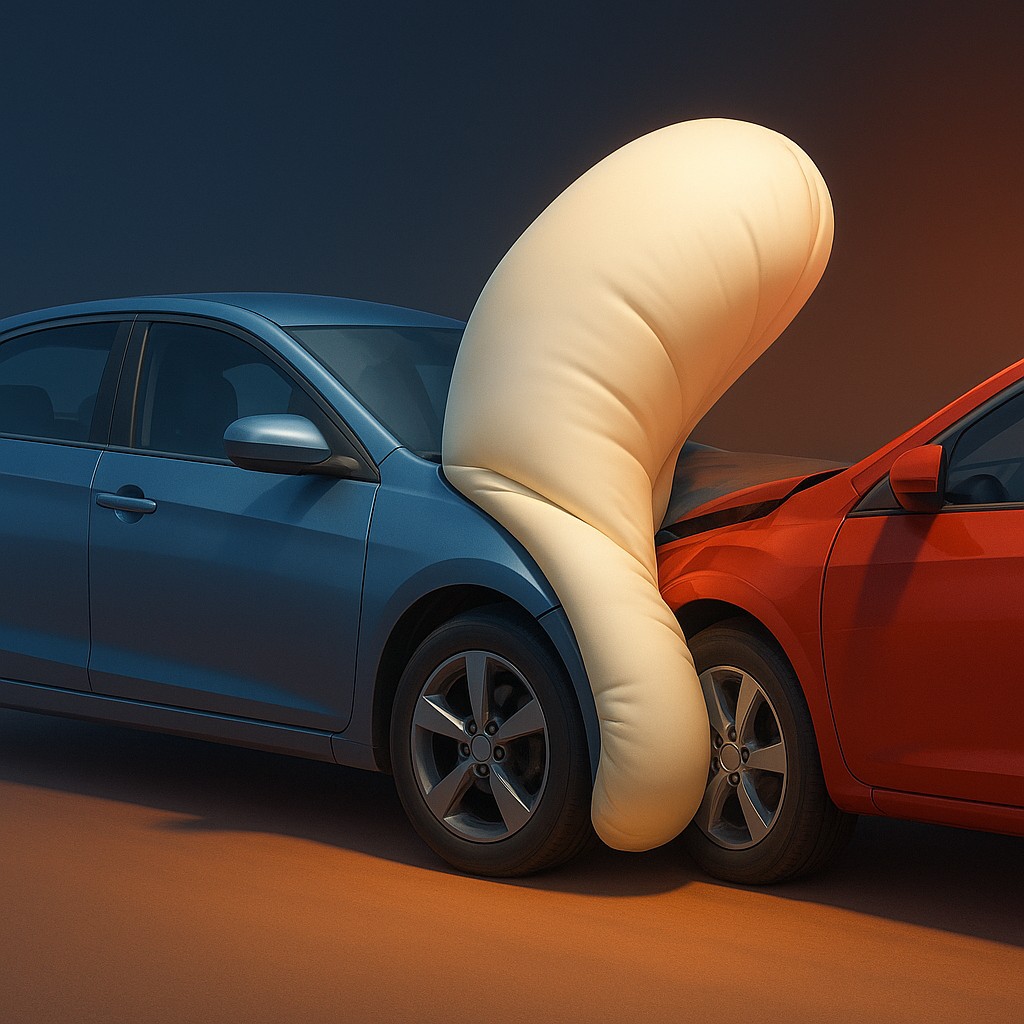
Now, imagine that same scenario, but instead of waiting for the crunch of metal, your car "inhales." Fractions of a second before the hit, a group of sensors confirms that a crash cannot be avoided. In less than 80 milliseconds, a large, sturdy cushion bursts from the side sill under your door, inflating outward and upward. This is more than just a pillow; it is a mobile crumple zone that meets the threat halfway. By the time the other car actually touches your vehicle's frame, the external barrier has already sapped much of its energy. This marks a shift from passive protection to proactive intervention, and it is changing how we think about the physics of a car crash.
The Geometry of the T-Bone Problem
To understand why external airbags are such a massive leap forward, we have to look at the grim reality of a side-impact collision, often called a "T-bone." Front-end crashes are relatively "easy" for engineers to handle because there is a lot of car between the bumper and the driver. You have the engine, the radiator, and several feet of steel frame designed to fold like an accordion to soak up the energy. This is the classic crumple zone, a sacrificial space that trades the car's structure for the passenger's life. The side of a car, however, offers no such luxury.
In a side impact, only a few inches of door panel and glass separate a passenger from the grill of an oncoming truck. Because there is almost no room to slow down the incoming force, the energy hits the people inside almost instantly. This lack of "crush space" is why side impacts cause nearly a quarter of all traffic deaths, even though most modern cars have interior side airbags. Engineers have spent decades trying to make doors stronger, but there is a limit to how much steel you can cram into a door before it becomes too heavy to open. The external airbag solves this by creating space where there was none, essentially building a temporary four-inch crumple zone on the outside of the car in the blink of an eye.
Teaching a Car to Predict the Future
The biggest hurdle for this technology is not the airbag itself, but the brain behind it. A standard interior airbag is a simple "if/then" machine: if the sensor detects a massive, sudden stop, then fire the bag. It is a system that reacts to a reality that has already begun. External airbags must be predictive. They have to deploy before the crash happens, which means the car needs to be absolutely certain it is about to be hit. If the system fires while you are just driving past a tall bush or a stray shopping cart, it could cause an accident rather than prevent one.
To manage this, cars are being equipped with a high-stakes mix of radar, LIDAR (laser-based sensors), and cameras. These sensors work together to build a 3-D map of the surroundings, calculating the path of every moving object near the car. The software has to decide, within about 150 milliseconds, if an approaching object is a true threat. It looks for specific clues: the size of the vehicle, how fast it is approaching, and whether its path will inevitably cross yours. This requires a massive amount of processing power and algorithms that can tell the difference between a "near miss" and a "deadly hit" faster than a human can even realize a car is nearby.
The Physics of Softening a Blow
When we talk about "absorbing energy" in a crash, we are really talking about time. Physics tells us that force depends on how quickly an object's momentum changes. If a car stops instantly, the force is devastating. If you can make that stop take just a few milliseconds longer, the force drops significantly. This is exactly what the external airbag does. By hitting the other car before it reaches your door frame, the airbag starts the slowing-down process early. It turns the moving car's energy into heat and the physical work of squeezing air inside the bag.
| Feature |
Internal Airbags |
External Airbags |
| Trigger |
Physical impact detection |
Predictive sensor data |
| Primary Goal |
Cushions the person against the interior |
Reduces total force hitting the cabin |
| Timing |
Post-impact (reactive) |
Pre-impact (proactive) |
| Space |
Uses interior cabin space |
Creates new exterior crumple zone |
| Effect |
Spreads force across the body |
Prevents metal from bending inward |
By the time the other vehicle actually touches your car's body, its "peak force" has already been weakened. Tests by automotive suppliers like ZF have shown that these external cushions can reduce how far a door is pushed into the cabin by up to 30 percent. They can also lower the severity of injuries by as much as 40 percent. It is the difference between being hit by a sledgehammer and being hit by a sledgehammer wrapped in thick foam. The foam does not stop the hammer, but it changes how the blow feels to your ribs.
The Challenge of the False Positive
If you have ever had your car's automatic brakes slam on because of a manhole cover or a weird shadow, you understand the "false positive" problem. With an external airbag, the stakes are much higher than a sudden jolt. An accidental deployment would be loud, startling, and expensive to fix. Furthermore, if a bag fires when it shouldn't, it could block the driver’s view or scare a nearby cyclist. This is why automakers use "multi-modal" systems where different types of sensors must all agree that a crash is happening before the bag fires.
Engineers are also working on making the system durable. Once an external airbag goes off, it is done; it has served its purpose. Until then, it stays tucked away inside the side sills, hidden under the plastic trim of the rocker panels. This ensures the car looks good and stays aerodynamic. The real challenge is making sure the bag can survive years of rain, salt, and road debris while remaining ready to explode into action in a tenth of a second when it is finally needed.
Redefining the Safety Envelope
Automotive safety is moving away from the idea of the car as a rigid "suit of armor." Instead, the car is becoming an intelligent, soft-touch guardian. This creates a "safety envelope" that extends beyond the metal skin of the vehicle. We are seeing pedestrian airbags that pop up from the hood to protect people outside the car, alongside these new external bags to protect those inside. This approach recognizes that the safest crash is one where the energy is managed before it ever reaches the "safety cell" where people sit.
As these systems improve, they will likely work with "active" suspension. Imagine a car that senses an incoming hit and not only fires an airbag but also raises its entire body by several inches. This would shift the impact from the thin door panel to the much stronger floor beams under the car. When you combine predictive airbags with reactive suspension and smart steering, the car stops being a passive object in a crash. Instead, it becomes an active participant in its own survival.
This move toward pre-crash intervention reflects a fascinating change in our relationship with technology. We are no longer just building tools that work when we use them. We are building environments that sense our needs and react to dangers we haven't even seen. The external airbag is a silent sentry, a cloud of compressed air waiting to stand between you and the laws of physics. It reminds us that even when space is tight and time is short, there is always room for a little more ingenuity to make the world a softer place.