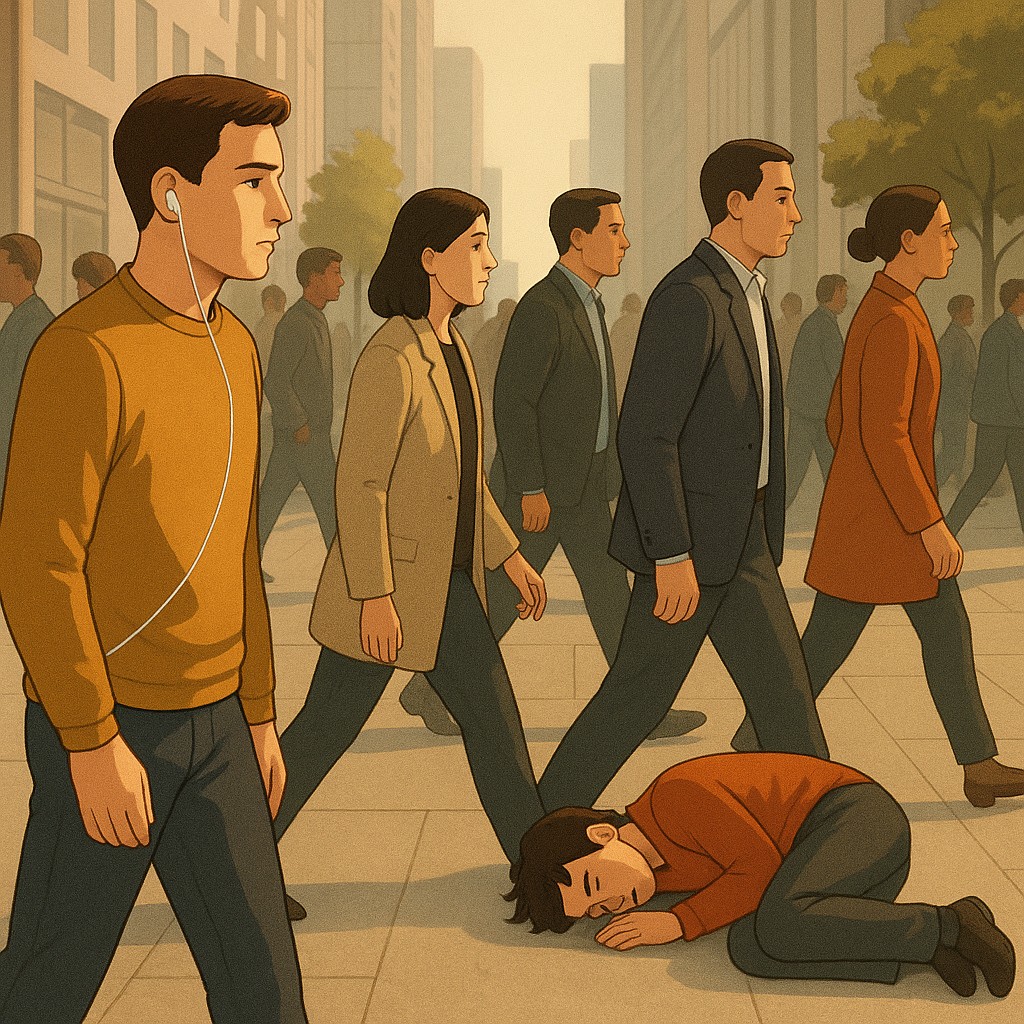
You are walking down a bustling city sidewalk, the rhythm of your day humming in your headphones, when suddenly, a person a few yards ahead trips and collapses onto the pavement. For a split second, your brain freezes, caught in a rapid-fire calculation of social risk. You look around, scanning the faces of other commuters, and notice that they continue walking, eyes fixed forward, seemingly oblivious to the fallen figure. In that moment of quiet tension, you decide to keep walking as well, telling yourself that if it were a real emergency, someone more qualified would have surely stopped to help.
This internal narrative is the hallmark of a phenomenon often mislabeled as the bystander effect. We tend to view this inaction as a cold form of human apathy, a tragic side effect of urban isolation where the presence of many somehow cancels out individual moral responsibility. However, the science points to a far more interesting and social mechanism at play. The hesitation you feel is not a lack of morality or care, but rather a psychological alignment with what we perceive to be the consensus of the group.
The Cognitive Architecture of Ambiguity
The human brain is a master pattern-recognition machine that hates uncertainty. When we witness an event in public, our first task is not to act, but to categorize the situation. Is that broken glass on the floor a sign of a hazardous accident, or is it merely construction debris? Is the person shouting on a bus experiencing a medical crisis, or are they rehearsing a monologue? These questions dominate our initial response because acting incorrectly, especially in public, carries social consequences.
If we act to "save" someone who is actually fine, we risk public embarrassment. To avoid this, we engage in social referencing, a process where we look to the behaviors of those around us to define reality. If everyone else is standing still, their collective inaction serves as a data point. We conclude that since no one else is responding, the situation must not be an emergency. This creates a feedback loop where my inaction informs your inaction, which in turn reinforces mine.
The Mirage of Pluralistic Ignorance
This collective state of confusion is known as pluralistic ignorance. Imagine a room full of people where everyone is privately concerned about a flickering light or a strange smell, yet everyone is outwardly maintaining a facade of calm. Because each person is busy monitoring the outward behavior of others, they fail to realize that their neighbors are feeling the same internal apprehension. The irony is that the group is paralyzed not by a disagreement, but by a shared, silent, and mistaken consensus.
When we are alone, this filter disappears. If you were the only person on that sidewalk when the individual fell, the ambiguity would be replaced by the urgency of the person's welfare. Without an audience to serve as a mirror for your own hesitation, the cost of being "wrong" regarding the severity of the incident becomes much lower than the cost of failing to act. Pluralistic ignorance thrives in the presence of others because it relies on the false assumption that if something were truly wrong, someone else would have already signaled the danger.
Breaking the Cycle of Indifference
The good news is that this social paralysis has an expiration date: the moment the ambiguity is shattered. Once an event is clearly marked as an emergency, such as someone explicitly calling out for help or suffering a visible injury, the bystander effect evaporates. In high-stakes, life-or-death scenarios, human beings are actually remarkably proactive. Evolutionary psychologists argue that our urge to preserve the lives of our peers is hardwired, though it is often tempered by our need to maintain social cohesion and avoid embarrassment.
The shift from hesitation to intervention occurs as soon as the consensus moves from "this is probably fine" to "this is definitely a crisis." Providing a clear cue creates an unambiguous reality that overrides individual social anxiety. Bystanders are not inherently selfish; they are simply cautious observers waiting for data. If you provide that data, or if you are the first to signal that action is required, you will often find that the rest of the group is eager to follow your lead rather than the previous, silent consensus.
The following table summarizes how your brain processes a potential emergency depending on the information available.
| Phase of Perception |
Level of Ambiguity |
Brain's Primary Focus |
Resulting Behavior |
| Initial Assessment |
High |
Social Referencing |
Hesitation as we scan others |
| Information Vacuum |
Moderate |
Consensus Seeking |
Mimicking the perceived calm of others |
| Clear Emergency |
Low |
Action Orientation |
Direct intervention |
| Post-Action Consensus |
Near Zero |
Task Efficiency |
Collaborative help and group support |
Designing for Decisive Action
Understanding this mechanism provides a practical framework for real-world action. If you suspect something is wrong but feel that familiar pang of hesitation to see if anyone else will act, perform a quick reality check. Acknowledge that the other bystanders are likely as confused as you are, and that they are looking to you just as you are looking to them. By taking the first step to clarify the situation, you act as a circuit breaker for the group’s inertia.
If you are the one in need of help, the most effective strategy is to eliminate ambiguity immediately. Do not rely on a general cry for help that might be misinterpreted. Instead, point to a specific person and give a clear instruction, such as "You in the blue coat, please call an ambulance right now." This directs the responsibility to a single individual, transforming them from a passive participant into an active agent of support.
The Power of the First Responder
Recognizing the mechanism behind our hesitation is the first step toward reclaiming our collective agency. We often imagine that being a hero requires extraordinary moral fortitude, but in reality, it is often just about being the person who chooses to define the situation rather than waiting for others to do so. By understanding that the crowd is not an obstacle, but a collection of people waiting for a signal, you can move through the world with a new sense of purpose.
The next time you find yourself in an uncertain, public space, remember that the silence of the crowd is not a sign of indifference. It is the result of millions of years of social calibration trying to find a footing in an unpredictable world. You have the power to change the emotional climate of any room simply by being the first to identify reality and act upon it. Trust your instincts, embrace the responsibility of the first move, and you will find that a hesitant crowd is often just a second away from becoming a cooperative team.