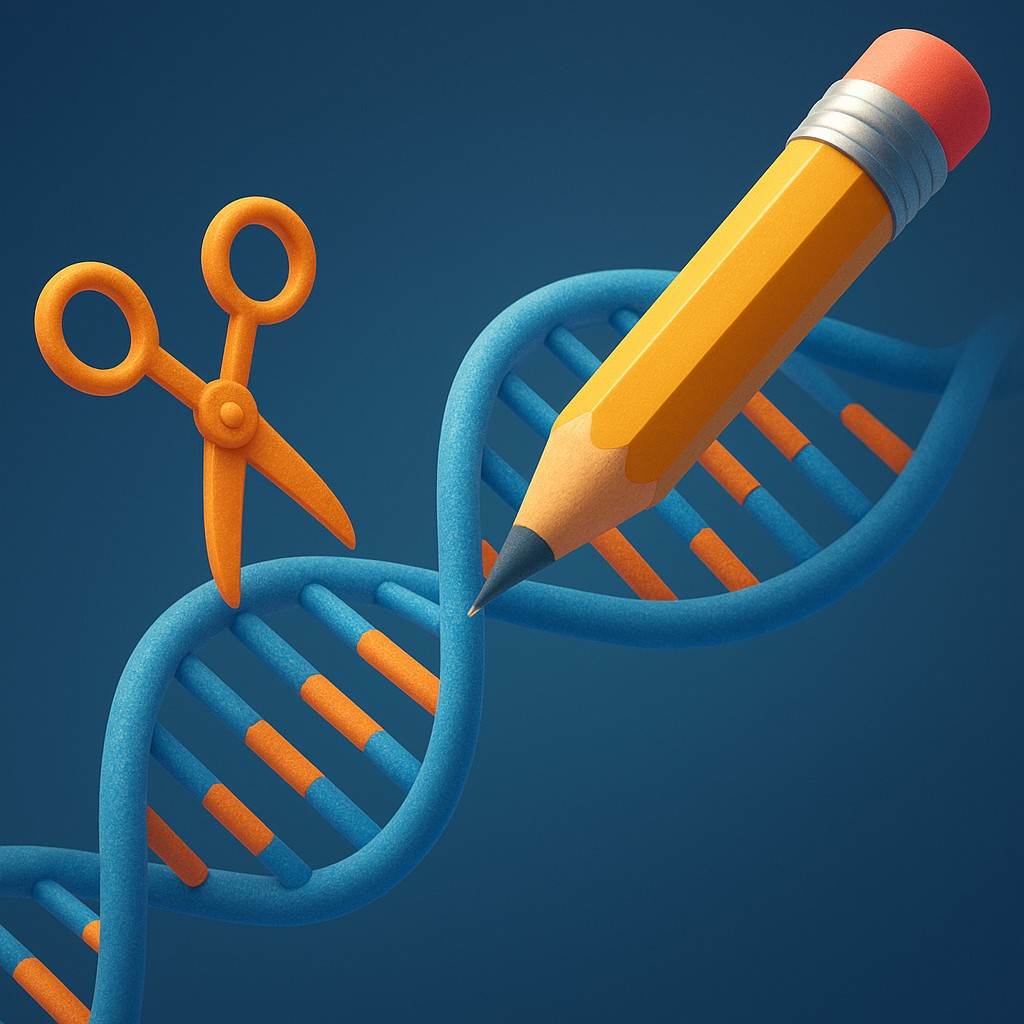
Imagine your entire biological blueprint is a library containing three billion letters. In this vast collection, a single typo, a "G" where there should be an "A" or a "C" instead of a "T", can mean the difference between a healthy life and a lifelong illness. For decades, genetic medicine dreamed of finding a way into this library to fix these tiny errors. When CRISPR-Cas9 arrived about ten years ago, it felt like we had finally invented the ultimate tool: a pair of programmable molecular scissors. These scissors could find a specific sentence in a specific book and snip the DNA, letting the cell's own repair system take over. It was a breakthrough, but it was also a bit like trying to fix a typo in a rare manuscript by cutting the page in half and hoping the librarian tapes it back together perfectly.
While traditional CRISPR is excellent at "breaking" things, such as turning off a faulty gene, it lacks the finesse needed for subtle corrections. When you cut through both strands of the DNA double helix, the cell panics. It rushes to glue the ends back together, often accidentally adding an extra letter or losing a few in the process. This randomness is fine if you want to shut a gene down, but it is risky for delicate repairs. This is where base editing comes in, marking the next step in mastering the genome. Instead of scissors, base editing works like a pencil with an eraser and a very steady hand. It allows scientists to zoom in on a single letter in the genetic code and chemically rearrange its atoms, changing it into a different letter without ever breaking the structural spine of the DNA.
The Chemistry of a Tiny Transformation
To understand why base editing is such a leap forward, we have to look at how the tools are built. A standard CRISPR system uses a "guide RNA," which acts like a GPS, and a "Cas9 enzyme," which acts like the blade. In a base editor, scientists have deactivated the blade so it can no longer cut through the DNA. This neutralized Cas9 is instead used as a delivery truck. It carries a second protein called a deaminase. This enzyme doesn't cut; it performs chemistry. It physically removes or rearranges specific chemical groups on the DNA base. By changing the chemical identity of that base, the editor tricks the cell into seeing a completely different letter.
This process is elegant because it avoids the cell's chaotic emergency repair mode. In the world of DNA, letters always come in pairs: Adenine (A) sits across from Thymine (T), and Cytosine (C) sits across from Guanine (G). If a base editor converts a C into a U (Uracil, which the cell reads as a T), the DNA has a temporary mismatch. The editor then gently nicks the opposite strand, nudging the cell to notice the mismatch and update the other side to match the new letter. The result is a clean, permanent change from a C-G pair to a T-A pair. It is the difference between performing surgery with a scalpel and editing a digital document with a cursor.
Moving from Demolition to Decoration
The main reason scientists are excited about base editing is that it reduces "genomic noise." Traditional CRISPR scissors create "double-strand breaks," which are violent events for a cell. Trying to fix these breaks can lead to large chunks of DNA being deleted, added, or even shuffled into the wrong place. While these side effects are rare, they are a major hurdle for treatments meant for millions of people. For diseases where a gene just needs to be turned off, the risk of a messy cut is often acceptable. Pero for "point mutation" diseases, where we only need to flip one bit of data, scissors are simply too blunt.
Base editing works through gentle persuasion. By avoiding the double-strand break, it keeps the chromosome intact. This makes it ideal for treating conditions like Sickle Cell Disease or Beta Thalassemia. In these cases, a single-letter error causes the body to produce misshapen hemoglobin, the protein that carries oxygen in the blood. Instead of cutting DNA to force the body to make a different type of hemoglobin (the current CRISPR approach), base editors could theoretically flip the "typo" back to the correct version. This precision could allow us to treat thousands of genetic diseases caused by single-letter mutations with a level of safety we couldn't reach before.
Comparing the Tools of the Genetic Trade
To see where base editing fits into medicine, it helps to compare it directly with "traditional" CRISPR-Cas9. While both use the same GPS system (the guide RNA) to find their target, their methods and results are very different.
| Feature |
Traditional CRISPR (Cas9) |
Base Editing (Nickase-Deaminase) |
| Primary Action |
Cuts both strands of DNA like scissors. |
Chemically changes one letter to another. |
| DNA Damage |
Creates a "Double-Strand Break." |
No double-strand break occurs. |
| Accuracy |
High targeting, but the repair is often random. |
Extremely high precision for single letters. |
| Primary Use |
Turning off or "knocking out" a gene. |
Correcting specific single-letter mutations. |
| Risk Profile |
Risk of large deletions or shuffled DNA. |
Lower risk of structural damage. |
| Versatility |
Can insert large new sequences of DNA. |
Limited to specific letter-to-letter swaps. |
The Limitations of the Chemical Pencil
Despite its potential, base editing is not a magic wand. Just as a pencil is great for fixing a typo but useless for rewriting a missing chapter, base editors have limits. Currently, they can only perform certain types of swaps. For example, we are good at changing C to T or A to G, but shifting a C to a G is much harder. This means that while many diseases are within reach, others are still outside the pencil's range.
There is also the issue of "bystander editing." Imagine you want to fix one "C" in a sentence, but there are two other "C" letters right next to it. The base editor works within a small "window." If there are multiple target letters in that window, the enzyme might change all of them, not just the one you intended. This could create a new mutation while trying to fix an old one. Scientists are working to shrink this window, but for now, the surrounding DNA determines if a base editor is the right tool. It is a reminder that even in genetic word processing, context is everything.
Toward a Future of Programmable Health
The shift from "genomic surgery" to "genomic word processing" is a fundamental change in how we view the human body. We are moving away from seeing genetic diseases as life sentences and toward seeing them as software bugs that can be patched. Clinical trials for base editing are already beginning, targeting high cholesterol and blood disorders with promising early results. These trials are not just testing a drug; they are testing a new philosophy where the treatment is as precise as the code it fixes.
As we refine these molecular pencils, the impact on human health could be enormous. We are gaining the ability to step into our own biology with a level of control that was science fiction twenty years ago. The goal is a future where "one size fits all" medicine is replaced by "one letter fits you" precision. While we must move forward carefully, the birth of base editing suggests we are finally learning how to correct the smallest errors in the book of life with grace and care. This is the start of an era where our genetic destiny is no longer written in permanent ink.