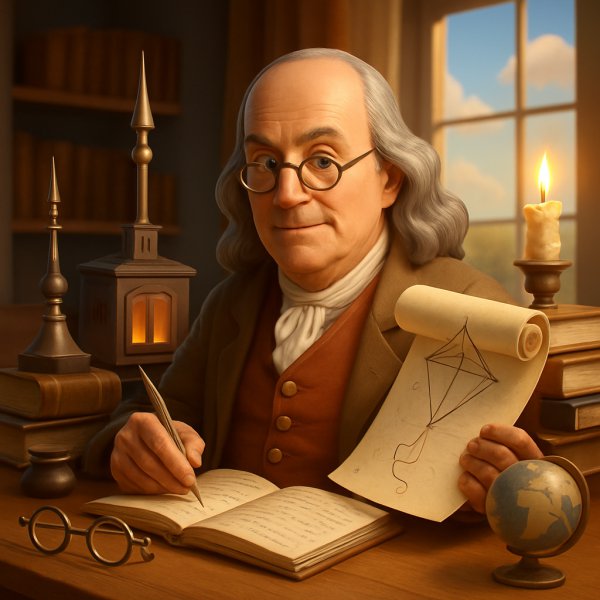
A surprising hook: what if Benjamin Franklin were your neighbor?
Imagine a neighbor who is part inventor, part CEO of local public works, part bestselling author, part secret diplomat, and part stand-up philosopher. That was Benjamin Franklin, who could fix a roof, found a library, publish a newspaper, draft public policy, wire a city for lightning, and make enemies laugh. His life reads like a how-to manual for curiosity, civic action, and practical wisdom, and it still offers usable lessons for anyone who wants to learn, build, or influence their world.
Franklin was not born brilliant in a vacuum, he practiced brilliance through experiments, mistakes, and social savvy. If you want to understand how one person can shape technology, politics, and culture simultaneously, start with Franklin as a model of combining curiosity with public-minded action.
From runaway apprentice to global influencer - the short biography that actually fits in your pocket
Benjamin Franklin was born in 1706 in Boston and apprenticed to his brother James to learn printing, a trade that became his lifelong engine. He ran away to Philadelphia at 17, built a successful printing business, launched the Pennsylvania Gazette and Poor Richard's Almanack, and used his paper to shape public opinion, teach useful skills, and seed civic projects.
He was a scientist who studied electricity and promoted the lightning rod, a civic leader who founded the first public library and a volunteer fire department, and a diplomat who negotiated the Treaty of Paris in 1783 that ended the American Revolution. He died in 1790, widely respected in Europe and America, remembered as a practical thinker who connected ideas to everyday life.
Big ideas and famous experiments - the inventions and actions that changed more than gadgets
Franklin's scientific curiosity led to improvements that were less about novelty and more about public benefit, such as the lightning rod, bifocal glasses, and the Franklin stove, all aiming to make life safer, warmer, and clearer. His kite experiment in 1752 made electricity visible to the public mind and helped move electrical science forward, while his writings spread practical knowledge in an era without YouTube tutorials.
Equally important were his social inventions: subscription libraries, fire brigades, hospitals, and improvements to postal service and municipal governance. These projects show how one person can scale local solutions into institutions that outlive them by combining persuasion, printing, fundraising, and clear public messaging.
"Either write something worth reading, or do something worth writing." - Benjamin Franklin
A compact table of Franklin's top contributions and why they matter
| Contribution |
What Franklin did |
Why it still matters |
| Printing and journalism |
Published newspapers, almanacs, essays |
Mass communication, shaping public debate |
| Electricity research |
Kite experiment, lightning rod |
Foundation for electrical safety and study |
| Civic institutions |
Libraries, fire companies, hospitals |
Models for public goods and community action |
| Diplomacy |
Negotiated with France and Britain |
Lessons in negotiation and reputation |
| Practical inventions |
Bifocals, Franklin stove |
User-centered design and everyday improvement |
Practical habits from Franklin you can use tomorrow
Franklin kept a daily schedule, tracked virtues, and used short, clear maxims to direct behavior; these methods are precursors to modern productivity hacks. Try his virtue chart - pick one trait to improve each week, track successes and failures, and iterate. This turns character work into small, measurable experiments rather than vague resolutions.
His approach to learning was active - read widely, write to clarify thought, and test ideas in public. You can apply this with a weekly learning loop: read a short book or essay, write a one-page summary with three applications to your life, then try one application the next week and record results. This loops curiosity into competence.
Myths debunked - what people often get wrong about Franklin
It is popular to simplify Franklin into a single image - the kite guy, the jolly sage, or the slick politician - but he was contradictory and complex, sometimes pragmatic to a fault and politically flexible in ways that make modern readers uneasy. He owned slaves early in life and later supported abolitionist causes - a moral evolution worth studying rather than erasing.
Another myth is that his kite experiment proved lightning is electricity in a neat flash of drama. The experiment was thoughtful, iterative, and controversial; it complemented other scientists work and fit within a broader network of correspondence and peer review. Historical sources, including Franklin's own letters and The Papers of Benjamin Franklin, show scientific method in social context rather than a lone genius moment.
Case study: the kite experiment as a lesson in scientific method and persuasion
In June 1752 Franklin famously used a kite to test the electrical nature of lightning, but the deeper story includes careful note-taking, collaboration with British scientists like Peter Collinson, and a strategic public explanation to build credibility. He combined experiment, publication, and public demonstration, turning a technical insight into a widely accepted fact and practical invention - the lightning rod.
For modern learners, this shows a repeatable pattern: form a hypothesis, gather evidence, share results with trusted peers, and use clear communication to persuade a broader audience. Scientists and entrepreneurs still use that pattern when they prototype, peer-review, and pitch.
Quick challenges, reflective questions, and next actions to think like Franklin
Try a one-week "virtue experiment": choose a single trait, track it daily, and write a one-paragraph reflection on Sunday about progress and obstacles. Consider a small civic project - start a neighborhood tool library or a community newsletter - and use Franklin's playbook of persuasion through helpful content, not confrontation. Reflective questions: What public problem can you solve with skills you already have? Who would be your modern Peter Collinson to test your ideas with?
Franklin's life teaches that curiosity without application is trivia, and action without thought is noise. By practicing measured curiosity, civic-mindedness, and clear communication, you can borrow his tools to become a practical innovator in your own context.
Why Benjamin Franklin still matters for curious, ambitious people
Franklin models a blend of humility and hubris - a willingness to try things, fail publicly, learn, and explain findings clearly. That combination produced inventions, institutions, and political changes that shaped modern life, and his methods are a practical template for anyone who wants to make ideas useful and lasting.
If you take one thing from Franklin, let it be this: cultivate curiosity, test boldly, and then put your work at the service of your community. That shift from personal talent to public benefit is the real legacy, and it is a recipe you can use today.