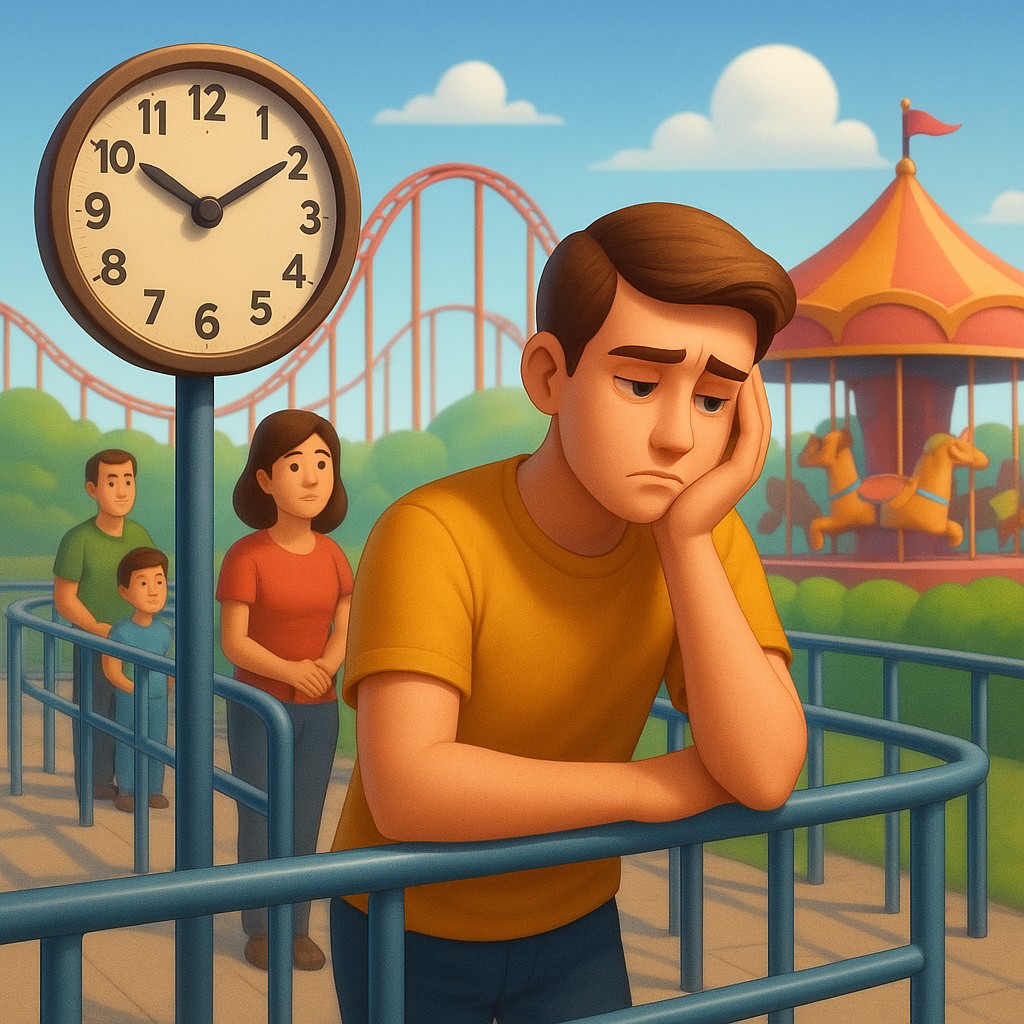
You have likely spent a good portion of your life standing in a line that felt like it was stretching toward the end of time. Whether you are at the DMV under flickering fluorescent lights or at a grocery store behind someone paying in loose pennies, the sensation is the same. Your brain begins to itch, your internal clock starts thumping like a loud heartbeat in a quiet room, and you become painfully aware of every passing micro-second. This happens because humans are surprisingly bad at measuring time objectively when we are bored. Without outside information to process, our brains turn inward, and the act of watching the clock actually makes time expand.
Theme park engineers - often called Imagineers or designers - are the masters of hacking this psychological glitch. They know they cannot always make a line shorter, given the limits of physics and space, but they can certainly change how your brain perceives those forty-five minutes. By the time you reach the front of a world-class attraction, you might feel like you have only been waiting for ten minutes, even if your fitness tracker tells a much grimmer story. This isn't done with magic, but through a calculated strategy called "active distraction."
The Cognitive Pulse and the Boredom Trap
To understand how theme parks trick us, we first have to look at how our brains count time. Think of your mind as having a tiny internal metronome that creates "ticks" of awareness. When you are focused on a task, like playing a fast-paced video game or laughing with friends, your brain is so busy processing information that it misses most of those ticks. This is why a three-hour movie can feel like twenty minutes. However, when you are standing in a sterile hallway with nothing to look at but the back of a stranger’s head, your brain has nothing to do but count every single beat of that metronome.
Researchers call this the "resource allocation model" of time perception. Essentially, we have a limited bucket of attention. If our environment is empty, 100 percent of our attention goes toward the "timer" in our heads. Designers call this "unoccupied time," and it is the enemy of a good guest experience. To fight this, engineers create "occupied time" by filling those empty mental buckets with sensory data. By giving you something to watch, touch, or listen to, they force your brain to look at the outside world instead of the clock.
The Architecture of Creative Pre-Shows
One of the most effective ways engineers stop your internal clock is by using a "pre-show." This is a transition zone where the line stops being a queue and starts being part of the story. If you are waiting for a haunted house ride, you aren't just standing in a hallway; you are in a library where books move on their own and portraits follow you with their eyes. These aren't just decorations. They are active distractions designed to give your brain a constant stream of new information to chew on.
The timing of these distractions is a literal science. Most people begin to feel the first "itch" of boredom after about three to five minutes of sitting still. To prevent this, designers break the line into "scenes" or "zones." Just as you start to get bored with the library, you move into a laboratory. Just as the laboratory starts to feel repetitive, a video screen flickers to life to give you a "mission briefing." By resetting the environment every few minutes, designers prevent a state called "habituation" - a fancy way of saying your brain has grown used to its surroundings and has started counting the seconds again.
Interaction as a Chronological Anchor
In recent years, the strategy has shifted from passive watching to active participation. This is where "gamified queues" come in. If you are in line for a high-tech space adventure, you might find digital consoles that let you "hack" into the ride’s computer or physical buttons that trigger sound effects. This moves the guest from the role of a spectator to the role of a participant. When you are busy solving a puzzle or coordinating a task with the person next to you, your brain is working too hard to monitor the passing time.
This approach also uses social psychology. When a line becomes interactive, people start talking to the strangers around them about the game or the hidden details in the room. Social interaction is one of the most powerful ways to make time fly. By creating a shared space that encourages conversation, designers let the guests distract each other. You aren't just waiting in a line; you are part of a group experience that feels productive rather than wasteful.
The Power of Perceived Progress
Another tool in the engineer’s kit is "perceived progress." This is less about what you see and more about how you feel you are moving toward a goal. A long, straight line is a psychological nightmare because the entrance stays the same distance away for a long time. This is why theme park lines almost always use "switchbacks" or winding paths. Every time you turn a corner, you feel like you have reached a mini-goal. This releases a tiny hit of dopamine - the brain’s "reward" chemical - which keeps your mood up and your frustration low.
To help visualize how these different strategies work, we can look at the typical impact of various queue designs:
| Queue Strategy |
Primary Method |
Effect on Time Perception |
Example Feature |
| Unoccupied |
No distraction |
Feels much longer than reality |
Empty halls, simple rope barriers |
| Atmospheric |
Themed environment |
Feels close to actual time |
Themed wallpaper, background music |
| Educational |
Narrative information |
Feels slightly shorter than reality |
Video briefings, maps, artifacts |
| Interactive |
Physical engagement |
Feels much shorter than reality |
Touch screens, buttons, games |
Managing the Exhaustion of Constant Stimuli
While distractions are great, there is a limit to how much "newness" a brain can handle before it gets overwhelmed. Designers must walk a fine line between keeping you busy and causing sensory overload. If a queue is too loud or too bright for an hour, the distraction stops being a gift and starts being an annoyance. This is why engineers often include "cool down" zones. These sections have lower lighting, softer music, and less clutter. They act as a mental palate cleanser, allowing your brain to rest before the next big scene.
The most advanced queues use a "crescendo" model. They start with light themes, build up to a major interactive moment in the middle, and finish with a high-energy pre-show right before you board. This structure mimics the arc of a story. Because our brains tend to remember the beginning and the end of an event more clearly than the middle, making the final few minutes exciting ensures your lasting memory is "That was fun!" rather than "That was a long walk."
The Illusion of Certainty
One of the greatest sources of stress in a line is not the wait itself, but not knowing how long it will take. Human beings hate the unknown. Engineers solve this with "Wait Time" signs. Interestingly, these signs are almost always a little pessimistic. If a sign says the wait is sixty minutes but you get on the ride in forty-five, you feel like you’ve "won" fifteen minutes of your life back. This is known as "under-promising and over-delivering." By setting your expectations low, designers ensure the reality of the wait feels like a success.
Combined with physical distractions, these signs provide a sense of control. When you see a sign that says "30 minutes from this point," your brain can stop worrying about the "when" and focus back on the "what." This mental clarity allows you to actually enjoy the scenery and hidden details the engineers spent millions of dollars creating. The goal is to turn the queue from a barrier into the first act of the play.
Applying the Lesson of the Occupied Mind
Understanding the secret of the "internal clock" can help you in daily life, far away from roller coasters and robots. The next time you are stuck in a subway delay or waiting for a slow computer update, remember that your brain is looking for something to do. If you give it nothing, it will punish you by making every second feel like an hour. By carrying a book, listening to a podcast, or even just playing a mental game like "find every red object in the room," you can take control of your own metronome.
Life is full of mandatory waiting, but as theme park engineers have proven, boredom is often a matter of design rather than a necessity of physics. You have the power to hack your own perception by feeding your brain the information it craves. When you turn a "wait" into an "experience," you aren't just passing the time; you are reclaiming the minutes that boredom usually tries to steal. So, the next time you see a long line, don't just look at your watch - look for the story hidden in the walls.