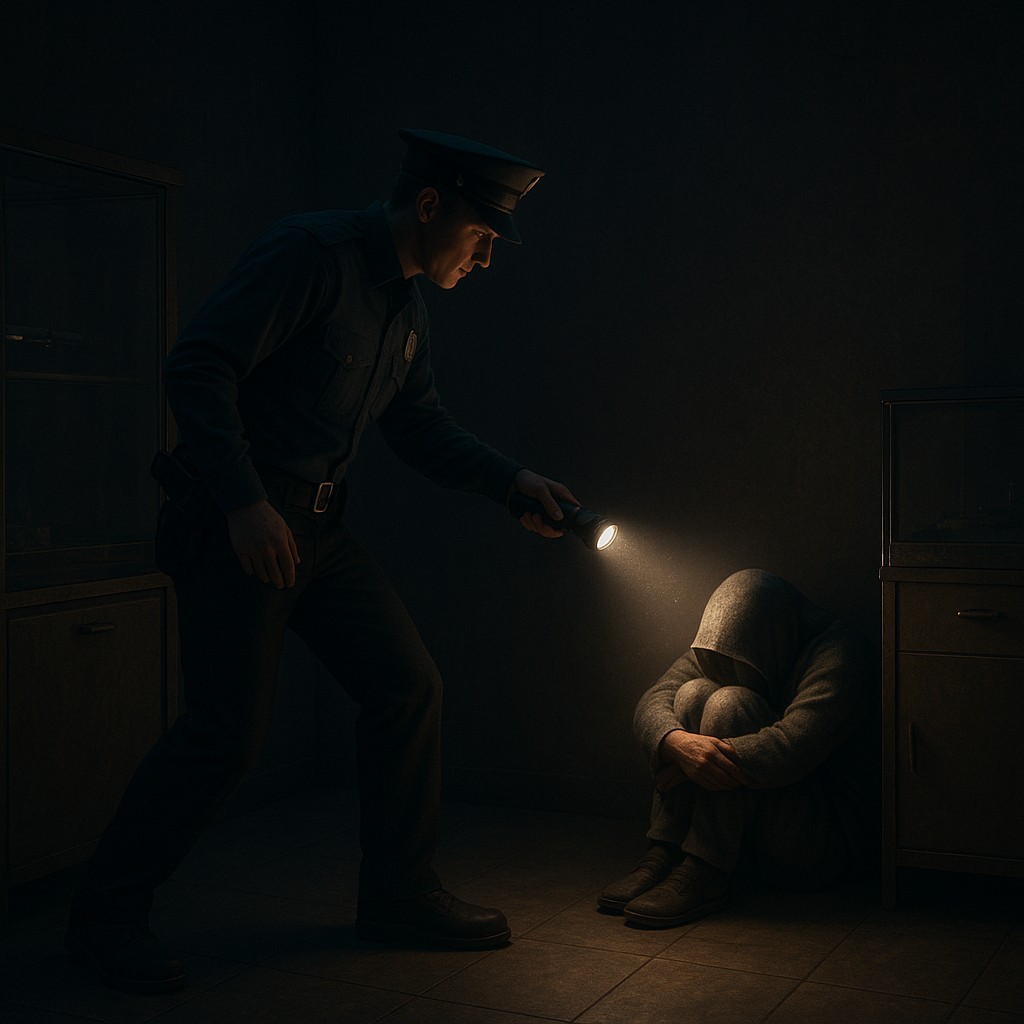
Imagine you are a security guard at a high-end jewelry store tasked with catching a thief who only steals when the lights are on. You have a foolproof plan to catch them, provided they are actually moving around and breaking into display cases. But what if one of the thieves simply hides in a dark corner, curls into a ball, and falls into a deep sleep the moment you enter the room? You could shine your flashlight around and even spray "anti-thief" mist into the air, but if that mist only works on people who are breathing heavily or moving their muscles, the sleeper remains untouched. When you eventually leave, thinking the room is secure, the sleeper wakes up, stretches, and finishes the job. This is not a story about a master criminal, but rather the standard operating procedure for some of the most frustrating bacterial infections on the planet.
We have been conditioned to think of "superbugs" as battle-hardened mutants that have evolved tiny pumps to spit out medicine or thick shields to block it. While genetic resistance is a massive problem, it involves a fundamental change to the bacteria's DNA. There is another, stealthier way that bacteria survive our best medical interventions, and it has nothing to do with evolution or mutation. It is a strategy of pure, stubborn laziness called persistence. Instead of fighting the antibiotic, these cells simply stop living for a while. They enter a state of metabolic hibernation, becoming "persister cells." Because the vast majority of our antibiotics are designed to sabotage active life processes, they find themselves powerless against a target that isn't doing anything at all.
The Strategy of Doing Absolutely Nothing
To understand why doing nothing is such an effective survival strategy, we have to look at how antibiotics actually work. Most of these drugs are precision-guided saboteurs. For instance, penicillin and its relatives work by interfering with the construction of the bacterial cell wall. Imagine a construction crew trying to build a skyscraper while someone is actively swapping their steel bolts for sticks of butter. The building collapses as it goes up. However, if the construction crew is on a three-week holiday and no work is being done, the "butter-bolt" sabotage has no effect. The skyscraper doesn't fall because it isn't being built.
Other antibiotics target the machinery that copies DNA or the ribosomes, which are the internal factories that churn out proteins. These are all growth-related processes. Bacteria are usually metabolic speedsters, dividing every twenty minutes and running complex internal chemistry at a breakneck pace. Our drugs take advantage of this high-speed lifestyle. Persister cells, however, hit the brakes. They flip a metabolic "off switch," reducing their energy consumption to almost zero. In this state of suspended animation, the antibiotic has no "handle" to grab onto. The drug stays in the patient's system, looking for work to do, but the persister cell just sleeps through the entire treatment.
It is important to distinguish this from traditional antibiotic resistance. If a bacterium is resistant, it can grow and multiply even while the drug is present because it has a genetic shield. A persister cell, by contrast, cannot grow in the presence of the drug; it just survives it. It is the difference between wearing a fireproof suit (resistance) and just hiding in a cold, underground bunker until the forest fire passes (persistence). Once the "fire" of the antibiotic treatment is over and the drugs are cleared from the body, these persister cells wake up, resume their normal activities, and restart the infection.
A Natural Insurance Policy for the Colony
You might wonder why a bacterium would choose to stop growing. In the cutthroat world of microscopic competition, speed is usually everything. If you aren't growing, your neighbor is, and they will soon outcompete you for food and space. However, bacteria play a long-term game of risk management. Scientific research suggests that in almost any colony of bacteria, a tiny fraction of the population (often less than one percent) will spontaneously become persisters even when conditions are perfect. This is known as "bet-hedging."
This small group of sleepers acts as an insurance policy. If the environment stays stable, the fast growers win. But if a sudden catastrophe strikes, such as a dose of antibiotics, a spike in temperature, or a period of starvation, the fast growers die off immediately. The sleepers, despite their lack of productivity, survive the storm. This is a built-in safety feature of microbial life. It ensures that the genetic lineage of the colony cannot be wiped out by a single event. It is a survival strategy that has been refined over billions of years, making it one of the most resilient biological tricks in existence.
The transition into persistence isn't a mistake; it is governed by complex internal signals. Bacteria use "toxin-antitoxin" systems to manage this. Under normal conditions, the bacterium produces a toxic protein that could shut down its metabolism, but it also constantly produces an "antitoxin" that cancels it out. If the cell detects stress, or sometimes just by random chance, the antitoxin breaks down or stops being made, allowing the internal toxin to put the cell into its protective coma.
The Difference Between Fighters and Sleepers
Because "resistance" and "persistence" sound similar, they are often confused in public health discussions. However, the patient outcomes and the biological mechanisms behind them are very different. When a doctor treats a resistant infection, the drugs simply don't work, and the patient's condition may continue to worsen immediately. With persistence, the drugs appear to work perfectly at first. The symptoms vanish, the vast majority of the bacteria die, and the patient feels better. Then, weeks or months later, the exact same infection returns.
| Feature |
Antibiotic Resistance |
Bacterial Persistence |
| Genetic Basis |
Caused by genetic mutations or acquired genes. |
Not genetic; a temporary state of the cell. |
| Duration |
Permanent and passed on to all offspring. |
Short-term; the cell wakes up and produces normal offspring. |
| Growth |
Bacteria grow and multiply during treatment. |
Bacteria are dormant and do not grow during treatment. |
| Clinical Pattern |
Treatment fails from the very beginning. |
Treatment seems to work, but the infection returns later. |
| Detection |
Easily caught in standard lab tests. |
Difficult to detect; bacteria look "vulnerable" in labs. |
This "relapsing" nature of persister-driven infections is what makes them so dangerous in chronic conditions. For patients with cystic fibrosis, urinary tract infections, or tuberculosis, the battle isn't necessarily against a super-powered mutant, but against a ghost that keeps disappearing and reappearing. Because persisters are genetically identical to the ones that died, they are technically "vulnerable" to the drug. This means that a lab test might tell a doctor a specific antibiotic should work, yet the patient fails to get permanently better.
Waking Up the Ghosts to End the War
If our current antibiotics are useless against sleepers, how do we fight an enemy that isn't really there? This is the cutting edge of modern microbiology, and the strategies being developed are as fascinating as the bacteria themselves. One approach is the "Wake and Kill" method. This involves using specific chemical signals to trick the persisters into thinking the environment is safe and full of food. By artificially boosting their metabolism or "waking them up" while the antibiotic is still present, we can force them to re-enter their vulnerable state just in time for the drug to catch them.
Another strategy focuses on "membrane depolarization." Even a sleeping bacterium needs to maintain a tiny electrical charge across its outer skin to stay alive. New research has shown that we can develop compounds that disrupt this electrical balance. Unlike wall-building or DNA-copying, maintaining a membrane charge is something a cell has to do even if it is hibernating. By draining the "battery" of the cell, we can kill persisters without needing them to be active or growing.
There is also a growing interest in host-directed therapies. Instead of targeting the bacteria directly, these treatments boost the human immune system’s ability to find and consume dormant cells. Normally, our immune cells are great at spotting active, noisy bacteria but might overlook a silent, dormant cell tucked away in a corner of a tissue. By sharpening the tools of our own white blood cells, we may be able to clear out the sleepers that antibiotics leave behind.
The Philosophical Shift in Modern Medicine
Recognizing the existence of persister cells requires a shift in how we think about "curing" an illness. For decades, the goal of antibiotic therapy was simply to kill enough bacteria that the immune system could handle the rest. We assumed that if the symptoms went away, the job was done. We now know that for many chronic infections, the disappearance of the enemy is just a tactical retreat. This is why finishing a full course of antibiotics is so critical, even when you feel better, though even a full course sometimes fails to reach the deepest sleepers.
The study of persistence teaches us that biology is rarely about who is strongest or fastest, but often about who is the most patient. These microscopic hibernators have survived every mass extinction and every environmental shift for eons. By understanding their silence, we are beginning to unlock new ways to ensure that when we treat an infection, we aren't just clearing the room - we are making sure the sleepers never have the chance to wake up.
As you step back and look at the broader picture of human health, it is humbling to realize how much we still have to learn from the simplest organisms on Earth. Persistence reminds us that survival isn't always about aggression; sometimes, it is the quietest among us who endure the longest. Armed with this knowledge, the next generation of medicine won't just be about building stronger weapons, but about becoming smarter observers of the intricate, sleepy rhythms of the microbial world.