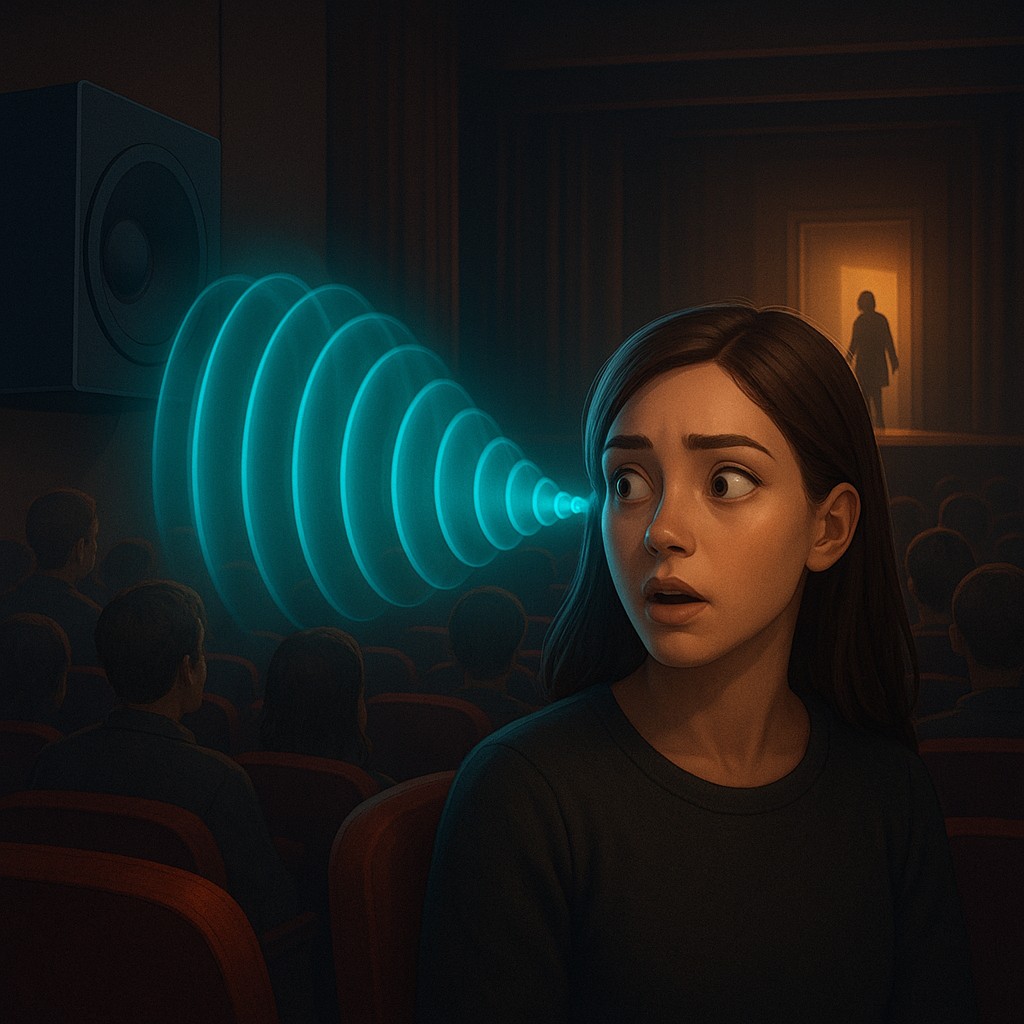
Imagine sitting in a packed theater during a tense psychological thriller. The lights are low, and the actor on stage is creeping toward a closed door. Suddenly, you hear a wet, raspy whisper right in your left ear, as if someone is standing inches away and breathing your name. You jump and look around to see if the person next to you is playing a prank, but they are sitting perfectly still, eyes glued to the stage, completely unaware of the sound that just rattled your nerves.
You have just been caught in the crosshairs of an ultrasonic audio beam. This technology is quietly changing the traditional shared experience of theater, replacing it with something far more personal - and perhaps a bit more unsettling.
For over a century, the goal of theater and concert hall acoustics was "uniform distribution." Engineers worked tirelessly to ensure that everyone, from the front row to the nosebleed seats, heard roughly the same thing at the same time. Sound was treated like a warm bath, flooding the room and bouncing off the walls to create a rich, shared environment. But the rise of ultrasonic audio "spotting" has flipped the script. Directors are no longer limited to broadcasting to the entire room. They can now "paint" sound onto specific people or small clusters of seats, turning the auditorium into a complex grid of private audio channels. Now, what you hear depends entirely on where you are sitting.
The Physics of the Invisible Searchlight
To understand how sound can be "beamed" like a laser, we first have to look at how pitch and direction work together. Standard speakers - the kind in your living room or a movie theater - produce sound across the audible spectrum, ranging from low bass thumps to high-pitched whistles. Because these waves are relatively large, they spread out in all directions, overlapping and reflecting off every flat surface they hit. This is why you can hear a television even if you are standing behind it. The wave is simply too big and flexible to stay in a straight line.
Ultrasonic audio spotting takes a different approach by using frequencies far above the limit of human hearing, typically starting at 20,000 Hertz. At these extreme frequencies, the wavelengths are incredibly short, measuring only millimeters. Because the waves are so small, they do not spread out like typical sound. Instead, they can be tightly packed into a narrow, column-like beam that stays focused over long distances. In this state, the energy moves through the air in total silence. It acts as a "carrier" for a secret, waiting for the right moment to reveal it.
The real magic happens through a process called non-linear demodulation. As this high-intensity ultrasound beam travels, the air itself acts as a distortion filter. Because air cannot perfectly compress and decompress at such high speeds, it "crushes" the signal, stripping away the silent carrier wave and leaving behind the audible sounds hidden inside. This transformation doesn't happen at the speaker; it happens along the path of the beam or when it hits a solid surface, like the back of a chair or a human head. The result is a pocket of sound that seems to appear out of thin air, placed exactly where the director wants it.
Forcing the Air to Play Translator
If you were to stand in the path of one of these beams, the experience would feel very different from wearing headphones. With headphones, the sound source is physically attached to your ears, making it feel like the noise is inside your head. With ultrasonic spotting, the sound feels like it is hovering right in front of your face or whispering from a specific spot nearby. This happens because the air within the beam is acting as its own speaker. This phenomenon, called a "parametric array," allows for a level of precision that was once thought to be physically impossible without putting listeners in separate rooms.
The technical setup requires a sophisticated grid of hundreds of tiny ultrasonic transducers - small devices that turn electricity into vibration. These are managed by a digital processor that times the output of each one perfectly to keep the beam strong and focused. By slightly delaying the signal to certain devices, engineers can even "steer" the beam electronically, moving a sound effect across the audience without moving any hardware. A ghostly footstep can literally walk across the tops of the audience's heads, moving from seat A1 to seat A20 in a second, while the rest of the theater remains in total silence.
| Feature |
Traditional Cinema Audio |
Ultrasonic Audio Spotting |
| Wave Shape |
Spherical (spreads everywhere) |
Columnar (narrow, laser-like) |
| Audibility |
Audible at the source |
Silent until it hits the air |
| Audience Experience |
Communal and shared |
Personalized and localized |
| Reflections |
Bounces off walls (creates echo) |
Minimal (stays in one spot) |
| Accuracy |
General "surround sound" zones |
Targets individual seats |
The Fragility of the Sweet Spot
While the idea of a personal audio beam sounds like the ultimate tool for a movie or play, it has major limitations. The biggest issue is the "sweet spot." Because the beam is so narrow - often only a foot or two wide - the effect is highly sensitive to how you sit. If a theatergoer leans over to check their phone or tilts their head to whisper to a friend, they might move out of the beam's path. In an instant, the "secret" audio vanishes, replaced by the background noise of the rest of the room.
This fragility creates a challenge for storytellers. If a play relies on a character hearing a specific clue delivered through an ultrasonic beam, a director has to make sure that "missing" the sound doesn't ruin the story for that person. Currently, this technology is used more for atmosphere and psychological tricks than for critical plot points. It is the jump-scare that only you feel, or the sound of a fly buzzing around your ear that makes you swat at the air while your partner looks at you like you're losing your mind. The technology succeeds by creating a gap between your reality and the reality of the person sitting next to you.
There is also the problem of how the beam hits surfaces. Ultrasonic beams reflect much like light. If a beam is aimed at a person but misses and hits a hard marble floor or a wooden wall, the sound will "splash" off that surface. Anyone standing near that reflection point will then be able to hear it. This requires theater technicians to map the room with extreme precision. They must account for the fabric of the seats, the angle of the balcony, and even the height of the average audience member to keep the sound from wandering into sections of the crowd where it wasn't invited.
Beyond the Jump-Scare: New Ways to Tell Stories
The potential for "audio spotting" goes far beyond scaring people in the dark. We are entering an era of "branching acoustics," where a director can give different information to different parts of the audience at the same time. Imagine a courtroom drama where the jury (one half of the audience) hears the defendant's internal thoughts, while the spectators (the other half) hear only the official testimony. This creates a fascinating social dynamic once the lights come up, as audience members realize they didn't all hear the same play.
This technology also solves a long-standing accessibility problem. For decades, guests who needed audio descriptions or translations had to wear bulky headsets that kept them tethered to a system and often leaked sound to their neighbors. With ultrasonic spotting, a theater can beam a Spanish translation directly to seat C12 and a French translation to seat C13 without either guest needing extra equipment. It turns the entire venue into a multilingual environment where the air itself is sorted into different streams of information.
We are also looking toward a future of "hyper-real" soundscapes. In nature, sound is often very localized - a bird chirping on a specific branch or a dry leaf crunching under a foot. Traditional speakers struggle to copy this because they are too large and their sound is too spread out. Ultrasonic beams allow sound designers to place "audio objects" in the theater with pinpoint accuracy. This allows the stage to breathe; sound effects can follow actors so naturally that the speakers themselves seem to disappear. The theater becomes less of a place where you watch a story and more of a place where you are physically part of one.
A New Era of Sensory Intimacy
The shift from the roar of a loudspeaker to the precision of an ultrasonic beam marks a turning point in how we experience public spaces. For centuries, the power of the theater was found in the "collective" - the shared laugh, the synchronized gasp, the unified silence. Now, technology is introducing a layer of isolation into that experience, creating a "private public" space. This contradiction is exactly what makes ultrasonic audio spotting so interesting. It uses advanced physics to bring back something ancient: the feeling of a secret whispered directly into your ear.
As we continue to master the ability to aim sound like light, the boundaries of how we perceive the world will continue to shift. We are no longer just passive observers; we are targets in a sophisticated grid of sensory data. This technology invites us to pay closer attention to our surroundings and to realize that even in a room full of people, there is always room for a story meant only for us. Embracing this invisible architecture of sound allows us to experience the world with a new sense of wonder, knowing that just a few inches to the left or right, a completely different reality might be waiting to be heard.