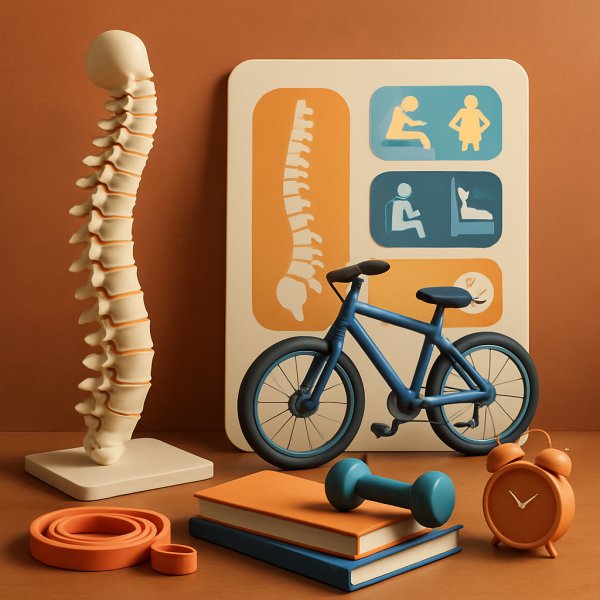
What if your back pain had a user manual you never read?
Imagine your spine as a well-used old bike that creaks on certain bumps, but rides fine once tuned. Back pain is often like that bike problem: annoying, sometimes scary, usually fixable with smarter care rather than heroic rest or endless scans. You are about to get a compact, practical user manual that teaches what to do, why it works, and how to make pain smaller and life fuller.
Why your back hurts more often than you expect, in plain English
Back pain is rarely one single dramatic injury. Most of the time it develops from small stresses adding up - poor movement patterns, tight hips, weak core muscles, long sitting stretches, stress, disrupted sleep, or a past injury that did not fully recover. The brain interprets signals from tissues and context - including fear, sleep, and mood - and decides whether to sound the alarm. That means pain can be louder than tissue damage alone would predict. Clinical research shows staying active and doing targeted exercise reduces disability and recurrence more reliably than rest or routine imaging.
Quick, calm actions you can use today to reduce pain
When pain flares, the first priority is to reduce the alarm without immobilizing life. Start by moving gently; stiffening up makes things worse. Alternate heat for 15 to 20 minutes to relax muscles and cold for 10 to 15 minutes if there is sharp inflammation. Try easy walking - even five to ten minutes - and controlled bends to remind your brain movement is safe. Over-the-counter pain relievers can help short term, but use them as tools, not long-term solutions. If a position relieves pain, note it and repeat it gently to reprogram comfort.
"Movement is medicine, but the dose matters." - think of short, frequent walks as a prescription you can fill every few hours.
Everyday habits that actually stop pain from coming back
Start with posture and ergonomics that support movement rather than rigid alignment. Sit with your feet on the floor, hips slightly above knees when possible, and change position every 20 to 40 minutes. For workstations, ensure the top of the screen is near eye level and use a chair that supports a neutral spine. Lift using hip hinge mechanics - push your hips back, keep a neutral spine, and let the legs do the work - instead of bending at the waist. Sleep on a mattress that supports your spine and use a pillow that keeps your neck neutral. Address stress and sleep hygiene, because poor sleep and high stress amplify pain signals. Small changes in these daily habits add up fast.
A simple 10-minute routine to start today - easy, evidence-based, and repeatable
Do this routine once or twice per day. Move smoothly, breathe, and stop if a movement increases sharp or spreading pain.
- Cat-cow flow: 8 slow reps to mobilize the spine and mobilize breath.
- Bird-dog: 8 reps per side, hold 2 to 3 seconds, focus on a stable low back and glutes.
- Hip hinge to dumbbell or book: 10 reps, light resistance, practice the movement pattern.
- Glute bridges: 12 reps, squeeze at the top for 2 seconds each rep to strengthen hips.
- Standing hamstring stretch: 30 seconds per side to reduce posterior chain tightness.
Table: Quick exercise guide
| Exercise |
Purpose |
Reps |
| Cat-cow |
Gentle mobility |
8 slow reps |
| Bird-dog |
Spinal stability, core control |
8 per side |
| Hip hinge |
Safe lifting pattern |
10 reps |
| Glute bridge |
Hip strength |
12 reps |
| Standing hamstring stretch |
Flexibility |
30 sec each |
How to progress so you actually get better - a sensible pathway
Begin with mobility and control, then add strength, then load the spine with functional tasks. Weeks 1 to 2 focus on movement confidence and hip/glute activation. Weeks 3 to 6 add resistance - heavier bridges, deadlifts with light weight, rows and squats - aiming for progressive overload. By week 6 to 12, practice sport or job-specific movements with coaching. Exercise-based treatment is the most consistently supported approach in clinical trials for chronic low back pain, and combining exercise with education about pain reduces fear and improves outcomes.
Common myths that make things worse, and the truth to swap in
Myth - "If I have back pain, I should rest in bed." Truth - Short rest for a day may help, but extended bed rest delays recovery and increases disability. Myth - "An MRI will tell me exactly what to fix." Truth - Many imaging findings like disc bulges are common in people without pain and may mislead. Imaging is helpful when red flag signs suggest serious conditions. Myth - "Core exercises alone will cure it." Truth - Core work helps, but you also need hip strength, aerobic fitness, and movement variability.
Small, scientific nudges that actually change outcomes
Evidence supports staying active, exercise therapy, and cognitive education about pain. Psychological approaches such as cognitive behavioral therapy and pain education improve function when combined with physical treatment. Smoking cessation, weight management, and improved sleep also reduce chronic pain risk. These are proven by multiple clinical guidelines and randomized trials that prioritize function over perfect scans.
When pain is a signal to see a professional right away
Seek urgent care if you have numbness in both legs, difficulty walking, loss of bladder or bowel control, severe unexplained weight loss, fever with back pain, or a history of cancer or a major recent trauma. For persisting pain despite consistent exercise and habit changes after 6 to 12 weeks, consult a physical therapist, pain specialist, or spine clinician to tailor treatment and rule out less common causes.
Two short real-life cases you can learn from
Case 1 - Maria, 38, office worker: Maria had recurrent midline low back pain from long sitting and a weak hip. She started a 10-minute twice-daily routine, set a phone alarm to stand every 30 minutes, and learned hip hinges. Within four weeks her pain dropped from daily 6 out of 10 to occasional 1 to 2, and she returned to weekend hikes. Case 2 - James, 56, manual laborer: James avoided bending after a lifting strain and became deconditioned. With graded exposure to lifting techniques, progressive strengthening, and reconditioning under a physical therapist, he regained confidence and reduced flares that had plagued him for years.
A two-week challenge to test what works for you
Commit to these five items for 14 days, then reflect on changes. 1) Move for at least 10 minutes twice daily using the short routine. 2) Stand or walk for 2 minutes every 30 minutes of sitting. 3) Use the hip hinge for any lifting task. 4) Improve sleep by setting a consistent bedtime and limiting screens an hour before bed. 5) Write down one fear about your back each day and challenge it with a small action - for example, if you fear bending, do five safe hip hinges.
Final checklist to leave you feeling smarter and empowered
- Keep moving, even slowly, when pain flares. Movement beats immobilization.
- Build strength in hips, glutes, and core as part of a progressive plan.
- Fix habits - sitting time, lifting technique, and sleep quality matter.
- Learn about pain - understanding reduces fear and improves recovery.
- See help for red flags or if you fail to improve after consistent effort.
Reflective questions: What daily habit could you tweak this week with tiny effort? What movement have you avoided because of fear, and what is one micro-step to try it safely?
Takeaway line with a smile: Your back did not break in a day and will not be fixed in a day, but with the right movements, habits, and curiosity you can turn down the alarm, ride your bike smoothly again, and get your life back.