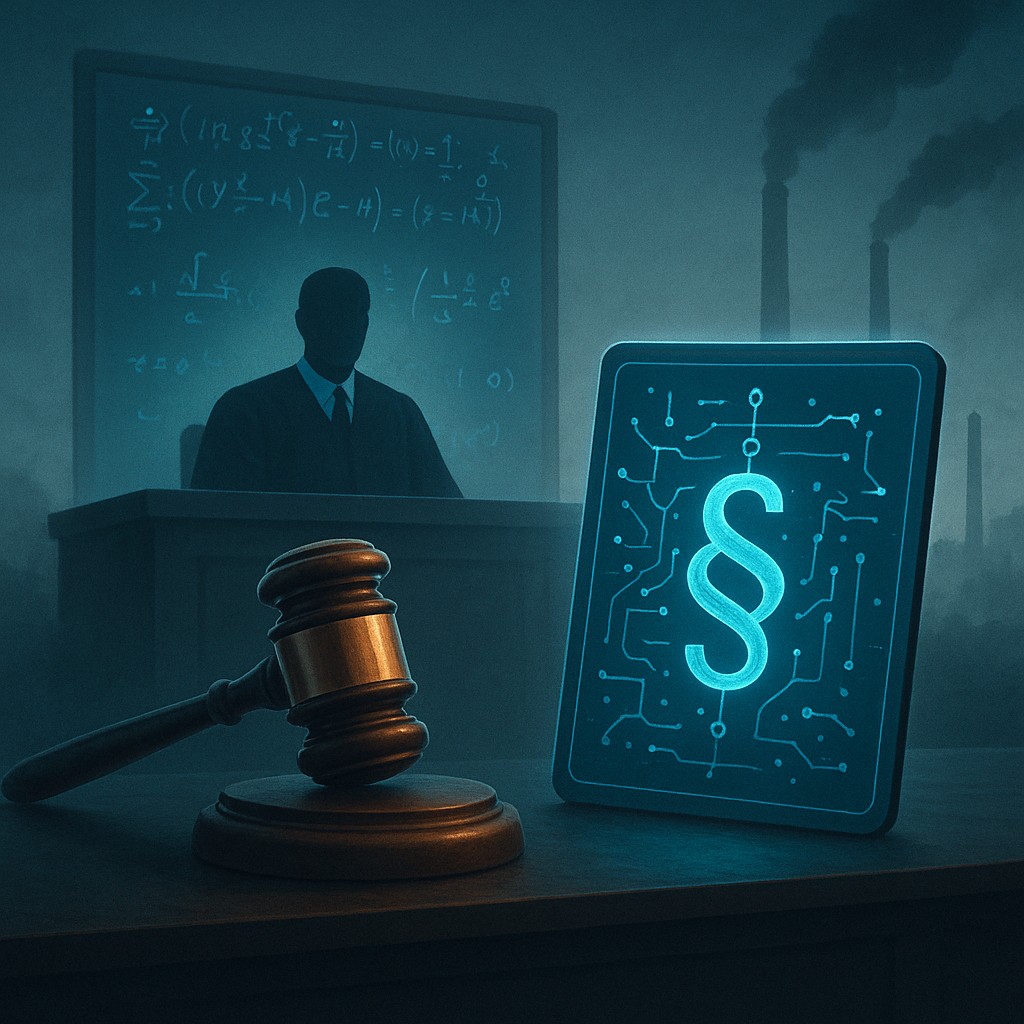
Imagine a courtroom where the judge never sleeps, the jury consists of mathematical equations, and the verdict arrives in milliseconds instead of months. In the complex world of international environmental law, this is no longer a scene from a sci-fi novel. Across the globe, observers are watching glowing screens to monitor a new kind of justice: smart contracts acting as the primary enforcers of carbon emission rules. These digital agreements do not wait for a process server or a bailiff to knock on a door. Instead, they are linked directly to the physical world through industrial sensors, ready to pull a penalty fee the moment a factory chimney breathes out too much carbon dioxide.
This shift marks a total change in how we think about the "rule of law." Traditionally, law reacts after the fact through language. We write down rules, someone breaks them, and eventually, a group of people debates the evidence and the intent before deciding on a punishment. In the world of automated law, the code is the rule. By turning a legal duty into an "if-then" statement, we move away from a system of polite requests and toward physical limits. It is the difference between a sign that says "No Parking" and a retractable pillar that physically blocks a car from entering a spot. As these trials unfold, we are seeing the birth of a world where following the law is not a choice made by a CEO, but a hard-wired reality of the infrastructure itself.
The Architecture of Inevitability
To understand how a computer can legally fine a corporation, we have to look "under the hood" at the blockchain-based smart contract. At its heart, a smart contract is a self-running program stored on a decentralized ledger, which is a shared digital record that cannot be changed. Unlike a traditional contract - a piece of paper that relies on a court for enforcement - a smart contract enforces itself. For carbon monitoring, the contract is "fed" data by a network of "Internet of Things" (IoT) sensors installed at the source of the emissions. These sensors act as the eyes and ears of the legal system, measuring the chemicals in exhaust fumes in real-time and sending that data to the blockchain.
When the sensor data crosses a pre-set legal limit, the "if-then" logic kicks in immediately. If the carbon concentration stays above 400 parts per million for too long, the contract automatically triggers a transaction. This moves a set amount of digital money from the company’s locked payment account to a public environmental fund. This happens without a lawyer filing a motion or a judge signing a warrant. The beauty, or perhaps the fear, of this system is that it is completely neutral. The code does not care if the company is a major political donor or if the CEO is a great public speaker. It only sees the data and follows its programmed logic.
Navigating the Oracle Problem
A constant challenge in this new legal frontier is what experts call the "Oracle Problem." A blockchain is a closed, secure loop. This makes it great for keeping records but terrible at knowing what is happening in the outside world. To "know" how much carbon is being released, the smart contract must rely on an external data source called an Oracle. This creates a single point where things can go wrong. If a bird builds a nest over a sensor, or if a technician drips coffee on a circuit board, the Oracle might report a massive spike in pollution that never actually happened. Because smart contracts are designed to be irreversible, a hardware glitch could cause a million-dollar penalty to vanish before anyone realizes the sensor was just "hallucinating."
To fix this, the current trials use "decentralized oracles" and "multi-signature verification." Instead of trusting one sensor, the system checks a group of sensors and compares their readings. If nine sensors say the air is clean and one says it is toxic, the system assumes the outlier is broken and ignores it. This consensus-based approach works like a jury, but at the speed of light. International observers are particularly interested in "dispute resolution layers." These are "emergency brake" rules that allow humans to step in if the data looks suspicious.
Comparing Traditional Law to Automated Enforcement
It helps to view these two systems side-by-side to understand why the international community is so focused on this experiment. Traditional law is flexible but slow and prone to human error or bias. Automated law is rigid and fast, but it cannot understand "special circumstances." If a factory goes over its emission limit because it is rushing to make life-saving medicine during a crisis, a human judge might be lenient. A smart contract, by default, will show no such mercy unless that specific exception was written into the code from day one.
| Feature |
Traditional Legal Enforcement |
Automated Smart Contract Law |
| Speed of Action |
Months or years of lawsuits |
Instant (Real-time) |
| Enforcement Method |
Physical (Police, Courts, Bailiffs) |
Digital (Cryptographic Transfer) |
| Operating Costs |
High (Legal fees, admin costs) |
Low (Network fees, sensor upkeep) |
| Risk of Corruption |
High (Bribes, political pull) |
Very Low (Public, unchangeable code) |
| Flexibility |
High (Judge's choice, context) |
Low (Rigid "If-Then" logic) |
| Evidence Used |
Witnesses, paper documents |
Sensor data and digital logs |
The Friction Between Code and Context
The most heated debates among legal experts involve the loss of "legal nuance." Law has historically been a flexible, human process. Terms like "reasonable effort" or "good faith" are left vague on purpose to handle the messiness of real life. Smart contracts, however, hate vagueness. You cannot program "good faith" into computer code. This creates a tension: we must decide if the efficiency of an automatic penalty is worth losing the ability to be fair in unusual situations. If a sensor fails during a power outage caused by a natural disaster, should the company still be fined for the missing data?
There is also the issue of "irreversibility." A major selling point of blockchain is that once a transaction is confirmed, it cannot be undone. This prevents fraud, but it also means that getting back a wrongful penalty is an administrative nightmare. Observers are now testing "hybrid models" where the penalty money is moved into a neutral holding account first. This creates a "cooling-off period" where human auditors can check the sensor logs before the money is permanently sent away. This suggests the future of law isn't a total takeover by robots, but a partnership between automated systems and human oversight.
Turning Law into a Physical Constant
Perhaps the deepest change is how these systems change how companies behave. In a traditional system, a company might treat a fine as just a "cost of doing business." They calculate the odds of getting caught, the cost of a legal team, and the chance of a settlement. They might decide it is's more profitable to pollute now and fight it in court later. Automated law removes the "fight it later" option. When a penalty is triggered by the laws of physics and math, the deterrent is much stronger. It is no longer a gamble; it is a certainty.
This move from "normative" law (what you should do) to "functional" law (what you can do) follows the path of safety features in other industries. We used to tell people to wear seatbelts (normative); then we built cars that beep until you buckled up (functional). By building legal penalties into the machinery of production, we are essentially creating a digital speed limit for the planet's atmosphere. The observers in these trials are not just watching a new way to collect fines; they are watching the growth of a global immune system, where the response to environmental damage is triggered the moment the problem is detected.
The horizon of legal technology now reaches far beyond the walls of any courtroom and into the very heart of our industrial world. As we improve sensors, sharpen our code, and balance human mercy with digital precision, we are creating a more accountable world. This era of automated justice asks us to be more than just people who follow rules; it challenges us to design a system that is as fair as it is fast. By moving into this technological future with both curiosity and caution, we can ensure the laws of tomorrow are not just written in books, but are woven into our progress, protecting the world in real-time.