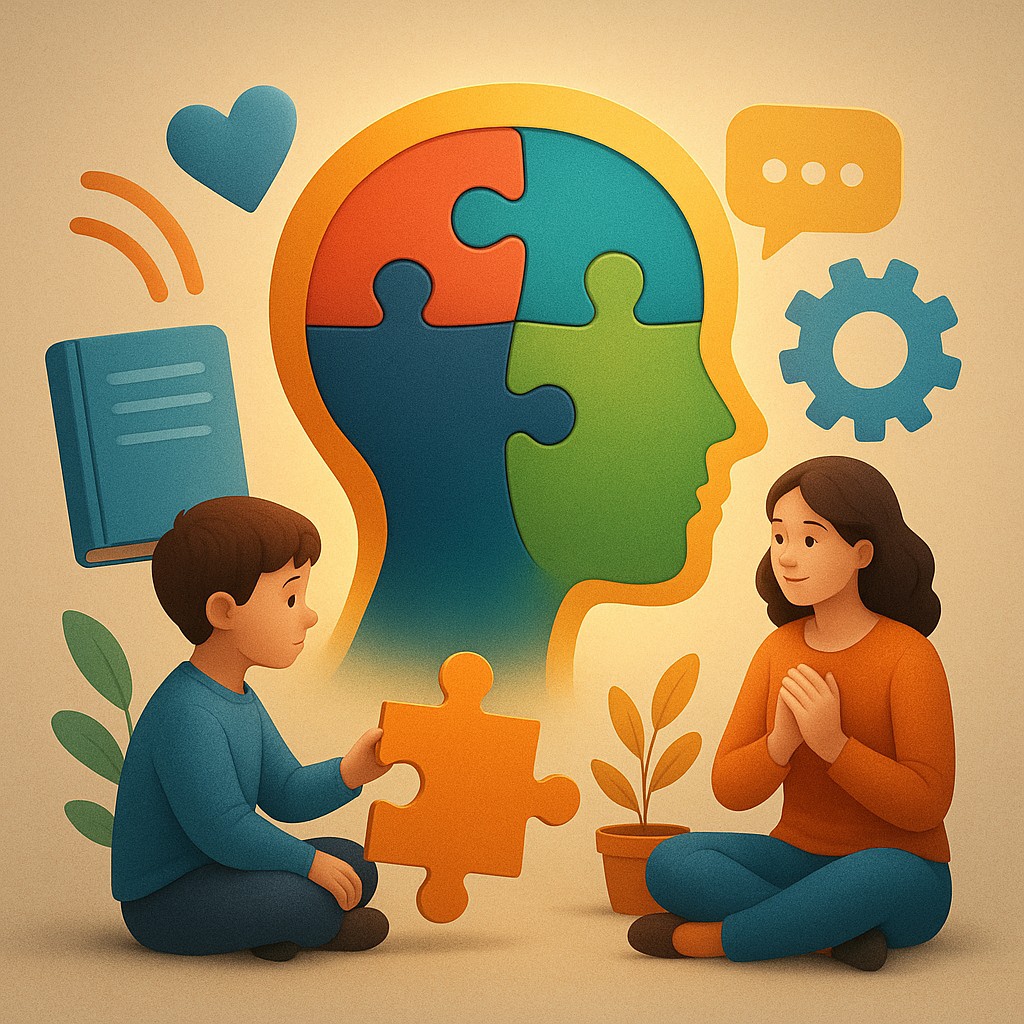
Autism is a topic you hear about everywhere now: at school meetings, on social media, around family tables, and in TV shows that suddenly want to teach a lesson. For some people, that visibility is a relief, because it gives words to experiences they have always had. For others, it raises questions: is autism new, is it spreading, or is it being overdiagnosed?
Autism is not a trend, a fad, or a modern invention like the air fryer. It is a way of developing and experiencing the world that has probably existed as long as people have. What has changed is how we notice it, how we define it, and who is counted.
To make sense of it, it helps to separate three questions that often get tangled: What is autism? What causes it? And why does it look like there are more autistic people now than before? Let us walk through those questions with science, everyday examples, and some myth-busting.
Seeing autism clearly: a different kind of brain wiring
Autism, also called Autism Spectrum Disorder (ASD), is a neurodevelopmental condition. Neurodevelopmental simply means it relates to how the brain develops, especially in early childhood. Autism shows up as differences in social communication and interaction, and differences in behavior, interests, how the senses are experienced, and need for routines. The word "spectrum" is important because autism is not one single set of traits. It covers a wide range of ways people can be.
A useful way to think about autism is as a pattern, not a single symptom. An autistic person may read social signals differently, speak in a direct way, or find small talk boring compared with a deep focus on something like subway maps. They might prefer predictable routines, have intense interests, or notice sounds, lights, textures, and smells more—or less—than others do. None of these traits are automatically bad, but they can become disabling when settings are not designed for them or when expectations are strict and unhelpful.
Autism is not the same as intelligence. Some autistic people have intellectual disability, some have average intelligence, and some have very high intelligence. Some talk early and love language, others speak later, use few words, or communicate by typing or using assistive devices. The key point is that autism describes how the brain processes information and experience, not a single level of ability or a single personality type.
What "the spectrum" really means (and what it does not)
Many people picture the spectrum as a straight line from "mild" to "severe." That is simple, but it can be misleading. In reality, autistic traits vary across many areas. Someone might need little help with daily tasks but a lot of help with sensory overload. Another person might speak fluently but struggle a lot with changes in routine or with social expectations at work.
It is often more accurate to think of autism like a sound mixing board with many sliders: sensory sensitivity, social energy, need for routine, communication style, motor coordination, anxiety, and more. Each person has a different mix. That is why two autistic people can seem very different from each other, yet both clearly be autistic once you understand the pattern.
How autism shows up in everyday life, not just in textbooks
Clinical descriptions can feel abstract, so let us put them into real situations. Imagine a classroom where fluorescent lights buzz, chairs scrape, and twenty conversations overlap. A non-autistic student might find this distracting. An autistic student might find it painful or so overwhelming that they cannot think. Or think about a workplace full of unwritten social rules: when to laugh, how long to make eye contact, how to join a group conversation without "interrupting." Some autistic people learn these rules by watching carefully, but it can feel like running social software in the background all the time, draining energy.
Autism can also bring strengths that are easy to miss if you only focus on problems. Many autistic people are excellent at spotting patterns, focusing deeply, telling the truth, noticing details, and building deep knowledge in a subject. They may notice inconsistencies others miss, or come up with new solutions because they are less bound by "the way we always do things."
A small but important note: autism often comes with other conditions. These can include ADHD, anxiety, depression, epilepsy, sleep problems, stomach issues, and differences in motor coordination. Sometimes what looks like "autism symptoms" are actually the effects of stress, sensory overload, or untreated anxiety on top of autism.
What could cause autism: a mix of genes and early development
Autism is not caused by a single thing. The most accurate view today is that autism comes from a complex mix of genetics and early brain development. Think of it as many possible paths that can lead to similar outcomes, not one single route everyone follows.
Genetics: the strongest piece of the puzzle
Research shows that genetics play a major role in autism. Autism often runs in families, and twin studies show higher rates in identical twins than in fraternal twins, which points to heritability. But genetics does not mean there is one "autism gene." It is more like many genetic differences, each adding a little risk, plus a smaller number of rare genetic changes that can have a larger effect.
Also, having genetic risk does not mean something is "wrong" with a person’s genes. Human brains vary, and that variety helps people do many things: write poetry, build airplanes, or sometimes just eat cereal for dinner. Some genetic differences can be strengths, challenges, or both, depending on the situation.
Early brain development: timing and pathways
Autism is linked to differences in brain development that start early in life, often before birth. This does not mean anyone did something wrong during pregnancy. It means the roots of autism usually appear very early. Researchers study how brain regions connect and communicate, how sensory information is handled, and how the brain grows in its first years.
One image that helps is city planning. Two cities can both work well, but one may rely on subways and the other on highways. Both move people around, but the commute, noise, and traffic feel different. Autistic brains are not broken cities; they are often organized in a different way.
Environmental influences: not the scary things people imagine online
When people hear "environmental factors," they sometimes think of dramatic ideas like toxins, vaccines, or one modern villain. In science, "environment" covers many things: prenatal health, birth complications, parental age, and other biological factors that can affect early development. These factors may add risk in some cases, usually together with genetics.
Crucially, environmental influence does not mean "parenting style." Autism is not caused by cold or distant parenting. That old idea did real harm and belongs in the same historical drawer as bloodletting and using cigarettes for asthma.
Myths that refuse to retire (and the facts that replace them)
Autism draws myths because it is complex, and people like simple answers. Let us clear up a few big ones.
-
Myth: Vaccines cause autism.
Fact: Large, high-quality studies in many countries have found no link between vaccines and autism. The original paper that started the claim was fraudulent and has been retracted.
-
Myth: Autism is caused by bad parenting.
Fact: Autism is a neurodevelopmental condition with strong genetic influences. Parenting can affect well-being, confidence, and coping skills, but it does not create autism.
-
Myth: Autistic people lack empathy.
Fact: Many autistic people feel deep empathy, sometimes so strongly it becomes overwhelming. What can differ is how empathy is shown, how social cues are read, or how quickly someone responds in the expected social way.
-
Myth: Autism always comes with a "special talent."
Fact: Some autistic people have remarkable skills, many have average skills, and everyone has strengths worth respecting. Turning autism into a "superpower" cliché can be as limiting as treating it only as a tragedy.
Why it seems like autism is more common now
This is the question that makes people squint and ask, "Why does it feel like there is so much more autism?" The short answer is that most of the rise is explained by better recognition and diagnosis, not by autism suddenly appearing.
Better awareness, less hiding
More parents, teachers, and doctors now know what autism can look like. Decades ago, a child who was anxious, sensitive to sensory input, or socially different might have been called "shy," "difficult," "odd," or "bad at school." An adult might have been labeled eccentric or rigid, and that was that. Today, those same patterns are more likely to be seen as autism, which can lead to support and better self-understanding.
Awareness has also improved for groups that were overlooked for years. Girls and women, for example, often mask autistic traits, copy social behavior, and stay under the radar until the effort becomes exhausting. People of color and people in low-resource communities have also been underdiagnosed because of unequal access to care and bias in referrals.
Broader and clearer diagnostic definitions
Diagnostic rules have changed over time. Conditions that used to be separate (such as Asperger syndrome in older systems) are now included under the autism spectrum in many places. Clinicians also recognize a wider range of presentations, including people with average or high verbal ability, people with subtle social differences, and people whose main problems show up as burnout, anxiety, or sensory overload.
This matters because changing definitions can increase the number of people who qualify for a diagnosis, even if the true number of autistic people in the population has not changed much.
Services and school supports create incentives to identify needs
In many places, a diagnosis can unlock help: school accommodations, therapy, social services, workplace protections, and insurance coverage. When support depends on a label, more people go for assessment, and schools have stronger reasons to document needs. That does not mean diagnoses are fake. It means systems that once ignored people now have ways to notice them.
Some cases are reclassified from other labels
Another factor is diagnostic substitution. In the past, many autistic people were diagnosed with intellectual disability, language disorder, ADHD, anxiety, or "behavior problems" without autism being recognized. As autism assessment improves, some people who would have had a different label now get an autism diagnosis instead, which changes the numbers.
A quick summary of the "more autism" puzzle
| What changed over time |
What it does |
Does it mean autism itself is spreading? |
| Increased awareness |
More people recognize traits and seek evaluation |
Mostly no |
| Broader diagnostic criteria |
More presentations fit under "autism spectrum" |
No, it changes counting |
| Better access to services |
More assessments happen, more support is available |
No, it changes detection |
| Reduced stigma |
People are more willing to pursue diagnosis and disclose |
No, it changes visibility |
| Diagnostic substitution |
People get labeled autism instead of other categories |
No, it reshuffles labels |
Researchers continue to study whether any environmental or biological factors might affect rates, but the best evidence says the large rise in diagnoses is mainly due to better detection and changing diagnostic practices. In plain terms: autism did not suddenly appear, we got better at seeing it.
What helps autistic people thrive: support, acceptance, and smart environments
If autism is a different neurodevelopmental path, the aim is not to erase it. The aim is to help autistic people live well, communicate, and have their needs met without shame. Support looks different for different people, so listening matters more than guessing.
Useful supports can include speech and language therapy that helps communication without forcing someone to act non-autistic, occupational therapy for sensory and daily living skills, mental health support for anxiety or depression, and school accommodations like predictable routines, clear instructions, movement breaks, and sensory-friendly spaces. For adults, supportive workplaces often provide clear expectations, written instructions, flexible ways to communicate, and respect for sensory needs.
The environment is powerful. A noisy, unpredictable, socially intense place can turn manageable traits into daily distress. A calmer, clearer, more flexible place can make the same person feel capable and comfortable. If you want to see how "disability" can depend on context, try concentrating while someone taps a spoon on a glass next to your ear and then tells you to "just ignore it."
Leaving with the big picture: curiosity beats fear
Autism is a real, lifelong neurodevelopmental condition shaped mainly by genetics and early brain development, with many possible pathways and a wide range of traits. It looks more common today mainly because society has become better at recognizing it, diagnosing it, and finally paying attention to people who were always there but not counted. The more we replace myths with evidence, the more room we make for practical support and human dignity.
If you take one thing away, let it be this: understanding autism is not about memorizing a checklist, it is about learning to respect different minds. When we build communities that are flexible, aware of sensory needs, and kind to people who communicate differently, we do not only help autistic people. We make the world easier for anyone who has ever felt overwhelmed, misunderstood, or forced to pretend. That is a future worth aiming for.