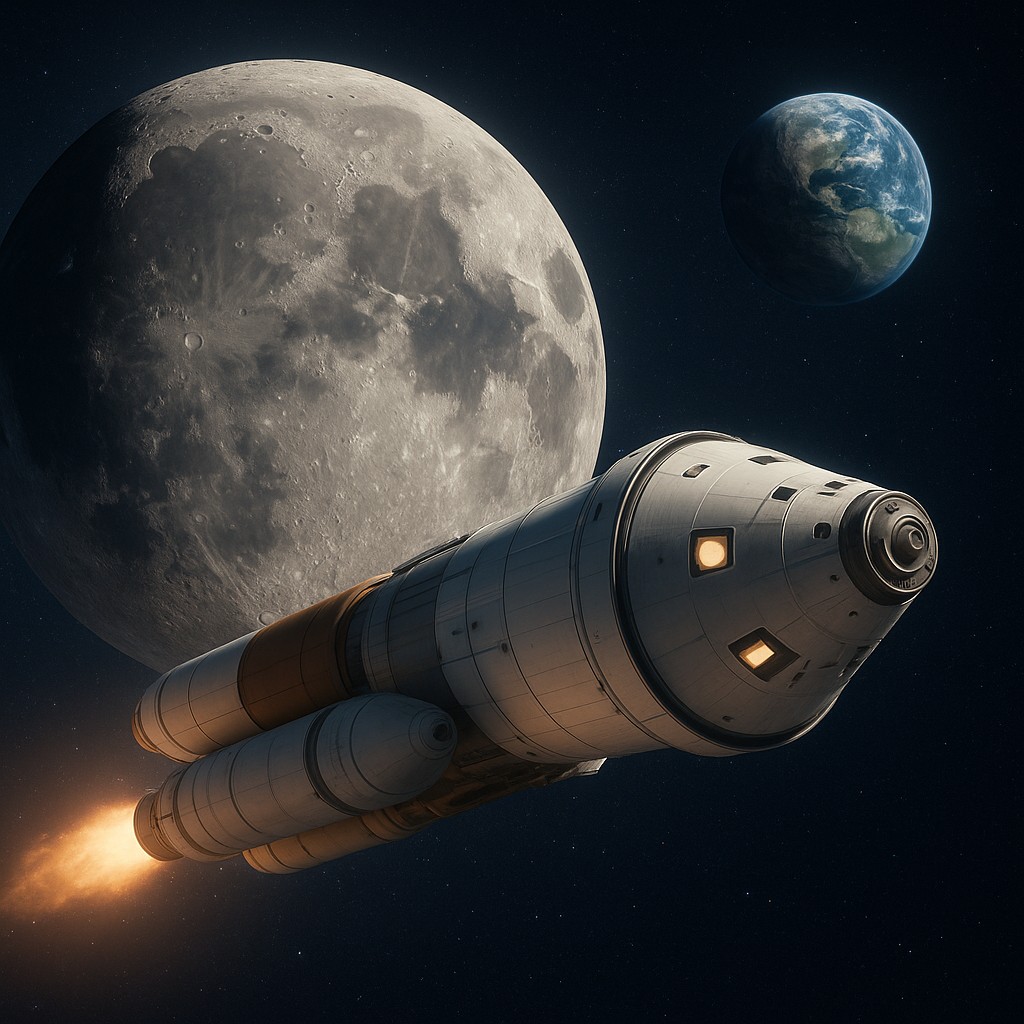
For the first time in over half a century, humanity is preparing to turn its gaze and its reach back to the silver orb that has captured our curiosity since the dawn of time. While the Apollo missions of the sixties and seventies are remembered as a frantic sprint to beat a geopolitical rival, the Artemis program represents a more sustainable, methodical, and inclusive marathon. Artemis 2 is the pivotal second act in this grand celestial drama, acting as the bridge between "we can get there" and "we can live there." It is a mission of "firsts" wrapped in a blanket of "finallys," designed to ensure that when we eventually step back onto the lunar dust, we do so with a plan to stay.
Think of Artemis 2 as the ultimate test drive for a brand-new, multi-billion-dollar camper van designed for the most inhospitable road trip imaginable. It carries four brave souls on a journey that will take them further from Earth than any human in history, looping around the far side of the Moon before slingshotting back home. This mission is not just about checking boxes or planting flags; it is about verifying that the life-support systems, navigation displays, and communication arrays can handle the rigors of deep space with fragile humans on board. It is the moment where science fiction becomes engineering reality, proving that the Space Launch System (SLS) and the Orion spacecraft are more than just impressive pieces of metal-they are vessels for the human spirit.
The Galactic Chariot and the Giant Leap Forward
To understand Artemis 2, one must first appreciate the scale of the machinery involved. At the heart of this mission lies the Space Launch System, the most powerful rocket NASA has ever built. This towering giant generates 8.8 million pounds of thrust at liftoff, which is roughly equivalent to 160,000 Corvette engines screaming in unison. It is designed to heave the Orion spacecraft out of Earth’s gravity well and set it on a path toward the Moon. Unlike the rockets of the past, the SLS is designed to be upgraded, serving as the foundation for missions that will eventually take us to Mars.
The Orion spacecraft, perched atop this mountain of fire, is where the crew will live for about ten days. While it looks somewhat like a beefed-up version of the Apollo capsules, the interior is a high-tech marvel. It features glass cockpit displays that replace the thousands of toggle switches used by Neil Armstrong, and it boasts a radiation-shielded "safe haven" to protect the crew from unpredictable solar flares. Artemis 2 is the first time these systems will be tested with actual people breathing the air and using the toilets. The mission is essentially a high-stakes stress test to ensure that the air scrubbers remove carbon dioxide efficiently and the temperature controls keep the cabin comfortable, even while the outside of the craft fluctuates between intense heat and freezing darkness.
Meet the Pioneers Behind the Controls
The crew of Artemis 2 was not chosen by throwing darts at a map; they represent a curated blend of experience, technical prowess, and a historic shift in who gets to explore the cosmos. Commander Reid Wiseman, a seasoned NASA veteran, leads the team with a calm authority earned through years of flying high-performance aircraft and living on the International Space Station. Joining him as pilot is Victor Glover, who will become the first person of color to fly a lunar mission. His role is critical, as he will be the primary navigator for the Orion capsule, ensuring that the manual piloting controls work perfectly during the mission's proximity operations.
The mission specialist roles are held by Christina Koch and Jeremy Hansen. Koch, who holds the record for the longest single spaceflight by a woman, will be the first woman to ever venture into deep space. Her background in electrical engineering and her extensive experience with spacewalks make her the perfect problem-solver for any technical hiccups that might occur millions of miles from the nearest repair shop. Rounding out the quartet is Jeremy Hansen, a colonel in the Canadian Armed Forces and the first non-American to ever leave Earth's orbit. His inclusion highlights the international spirit of the Artemis Accords, a set of agreements between nations to explore the Moon peacefully and transparently. Together, this crew of four acts as the eyes and ears for the billions of people watching from below.
The Path to the Far Side of the Moon
The trajectory of Artemis 2 is a masterpiece of orbital mechanics known as a "Hybrid Free Return Trajectory." Instead of entering a tight orbit around the Moon like Apollo 11 did, Artemis 2 will perform a massive loop. After launching from Kennedy Space Center and spending some time in High Earth Orbit to check that the spacecraft is functioning perfectly, the crew will fire the ICPS (Interim Cryogenic Propulsion Stage) to head toward the lunar neighborhood. This "free return" path means that if the engines failed to fire near the Moon, the laws of physics and gravity would naturally pull the spacecraft back toward Earth, acting as a built-in safety net.
Once the crew reaches the Moon, they will pass behind the lunar far side, reaching deep space thousands of miles beyond our celestial neighbor. At this point, they will be the furthest any human has ever been from home. During this phase, the Moon's gravity will whip them around, setting them on a direct path back to Earth. The return journey is just as intense as the launch, as the Orion capsule must hit the Earth's atmosphere at a precise angle while traveling at nearly 25,000 miles per hour. If the angle is too steep, the craft burns up like a meteor; if it is too shallow, it skips off the atmosphere like a stone on water and drifts into the void.
A Technical Summary of the Mission Parameters
Because space travel is as much about numbers as it is about bravery, it helps to look at the specific goals and statistics that define Artemis 2. The following table summarizes the key milestones and technical aspects of the journey.
| Mission Milestone |
Primary Objective |
Duration/Distance |
| Launch and Orbit |
Initial health check of Orion systems |
24 hours in High Earth Orbit |
| Trans-Lunar Injection |
Fire engines to escape Earth's gravity |
Speed increases to 24,500 mph |
| Lunar Flyby |
Test deep-space navigation and communications |
~6,400 miles from Moon's surface |
| Maximum Distance |
Record-breaking distance from Earth |
~230,000 miles from Earth |
| Re-entry and Splashdown |
Test the largest heat shield ever built |
Pacific Ocean recovery |
Testing the Invisible Threads of Communication
One of the most fascinating aspects of Artemis 2 is the O2O system, or the Orion Artemis 2 Optical Communications System. In the past, all communication with spacecraft has relied on radio waves, which are reliable but have limited bandwidth. It is like trying to download a high-definition movie using a dial-up modem from the 1990s. Artemis 2 will test laser communication, which uses infrared light to transmit data at much higher speeds. This technological leap will allow the crew to send back 4K video feeds and massive amounts of scientific data in near-real-time, making the mission feel more "live" to the public than anything that has come before.
Beyond just the high-quality video, this laser system is essential for future Mars missions. When humans eventually travel to the Red Planet, they will be millions of miles further away than they are on the Moon. Traditional radio waves would take far too long to send back the complex topographical maps or medical data needed for survival. By mastering laser communication during the Artemis 2 lunar flyby, NASA is essentially building the "interplanetary internet" that will support the pioneers of the next century. It is a vital part of the mission that ensures we are not just visiting the Moon, but building the infrastructure for a multi-planetary future.
Debunking the Myths of Space Exploration
In an era of high-definition CGI and skeptical social media, it is common to wonder why we are doing this again or if the technology is really that much better than it was in 1969. One common misconception is that Artemis 2 is just a "re-run" of the Apollo missions. In reality, the two are barely comparable. Apollo was about survival and a quick "touch and go." Artemis is about sustainability and precision. The Orion capsule is designed to land anywhere on the Moon, including the treacherous South Pole where water ice is hidden in permanently shadowed craters. Artemis 2 is the flight that proves the ship can survive the harsh radiation of the Van Allen belts for an extended period, something we have not done with humans in decades.
Another myth is that space exploration is a waste of money that could be spent on Earth. While the price tag for a mission like Artemis 2 is high, that money is not being packed into a suitcase and launched into a black hole. It is spent here on Earth, in thousands of small businesses and laboratories across the country. The technologies developed for Artemis, from water purification systems to advanced medical imaging and lightweight materials, eventually find their way into our daily lives. When you use a smartphone camera or a high-tech prosthetic limb, you are using the benefits of space-race engineering. Artemis 2 is an investment in human ingenuity that pays dividends in ways we cannot always predict.
The Physical and Psychological Toll of Deep Space
Living inside a space capsule for ten days is not a vacation. The crew will be living in a space roughly the size of a small professional kitchen. They also have to contend with microgravity, which causes fluids in the body to shift toward the head, often resulting in "puffy face" and persistent sinus headaches. One of the primary jobs of the Artemis 2 crew is to document these physical changes using advanced sensors. They are, in a sense, the ultimate human test subjects for deep-space medicine.
The psychological aspect is just as demanding. Once the crew passes the far side of the Moon, they will be out of direct contact with Earth for a period of time. Looking out the window and seeing the Earth as a tiny, fragile blue marble that can be covered by a thumb is a profound experience often called the "Overview Effect." It evokes a sense of global unity and an intense desire to protect our home planet. For the Artemis 2 crew, managing this emotional weight while staying focused on complex manual maneuvers and system checks requires a level of mental toughness that few people possess. Their success will prove that humans are psychologically ready for the long, lonely voyage to Mars.
Preparing for the Ultimate Splashdown
After nearly two weeks of traveling through the vacuum, the mission concludes with a dramatic return to Earth. The heat shield on the bottom of the Orion capsule is designed to withstand temperatures of nearly 5,000 degrees Fahrenheit, which is about half as hot as the surface of the sun. As the capsule plummets through the atmosphere, the air around it turns into a glowing plasma, cutting off communication for several minutes. This is the "blackout" period where the flight controllers in Houston can do nothing but wait and hope the engineering holds true.
The descent is slowed by a series of eleven parachutes that deploy in a careful sequence. First, the small drogue chutes stabilize the craft, followed by three massive main parachutes that bloom like giant orange-and-white flowers in the sky. The capsule will splash down in the Pacific Ocean, where a recovery team from the U.S. Navy and NASA will wait to retrieve the crew and their vessel. This final stage is just as critical as the launch, as it validates the recovery procedures that will be used for all future Artemis missions. A successful splashdown marks the official conclusion of Artemis 2 and the green light for Artemis 3, the mission that will finally return humans to the lunar surface.
As the parachutes settle into the waves and the recovery divers approach the bobbing capsule, a new chapter in human history will be firmly written. Artemis 2 is more than just a flight; it is a declaration that the children of Earth are no longer content to simply watch the stars from a distance. We are a species of explorers, driven by a restless desire to see what is over the next horizon and to push the boundaries of what is possible. By following this mission, you are witnessing the birth of a new era where the Moon is not a destination, but a stepping stone toward the vast, untamed wonders of the solar system. The courage of the Artemis 2 crew reminds us that no matter how divided we may seem on the ground, we are all passengers on a small blue planet, united by the stars and the potential of the human mind.