In most areas of modern life, technology follows a predictable path: it gets better while the price drops. Your smartphone is a million times more powerful than the computers that sent humans to the moon, yet it fits in your pocket and costs a tiny fraction of what those massive machines did. However, if you step into the world of high-end horology - the formal term for watchmaking - logic seems to go on a permanent vacation. You will find mechanical watches that cost as much as a luxury SUV or even a three-bedroom house, even though they are technically less accurate than a ten-dollar digital watch from a gas station.
It is a beautiful paradox that leaves many people confused. Why would someone pay fifty thousand dollars for a device that might lose five seconds a day when a smartphone stays perfectly synced to an atomic clock for free? The answer is that expensive watches are not really about telling time at all. They are tiny, wearable monuments to engineering, history, and craft. To understand why these metal circles command such staggering prices, we have to look past the dial and into the soul of the machine, where human effort and microscopic gears replace silicon chips and batteries.
The Invisible Engine of Gears and Springs
The biggest difference between a standard watch and a luxury timepiece is what happens "under the hood." Most affordable watches are quartz watches. These are powered by a battery that sends electricity through a tiny quartz crystal. This crystal vibrates at a very specific frequency, and a circuit counts those pulses to move the hands. It is efficient, cheap, and very accurate. Luxury watches, however, are almost exclusively mechanical. They use a tightly wound spring for power and a complex series of gears to move that energy along. There are no electronics, no batteries, and no software updates.
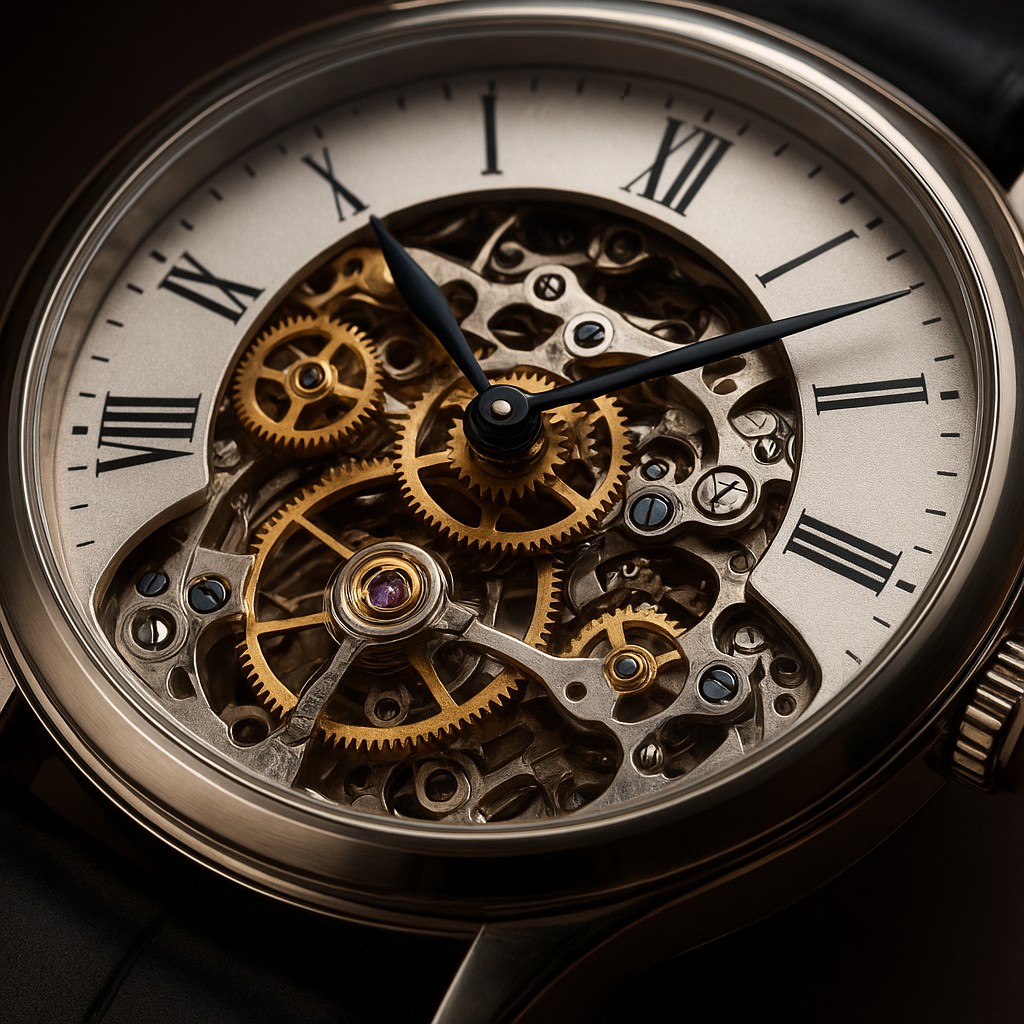
A high-end mechanical movement is a feat of micro-engineering that seems almost miraculous. Imagine hundreds of individual parts, some as thin as a human hair, all working together perfectly inside a space no larger than a coin. These parts are often made from high-grade materials like specialized steel, gold, or even silicon to reduce friction. In a "normal" mechanical watch, these parts are stamped out by machines and put together on a belt. In a true luxury piece, a master watchmaker spends weeks or even months hand-finishing every single component. They polish edges that no one will ever see, simply for the sake of perfection.
This level of detail is what enthusiasts call "finishing." If you look at an expensive watch through a magnifying glass, you will see delicate patterns like Cotes de Geneve (Geneva stripes) or Perlage (circular graining) etched into the metal. These decorations do not help the watch tell time better, but they show a level of human skill that mass production cannot match. When you pay for a luxury watch, you are paying for the hundreds of hours a person spent squinting through a magnifying loupe to make sure every microscopic screw shines like a mirror.
Complications and the Art of Doing Too Much
In the watch world, any function beyond telling the hour, minute, and second is called a "complication." This is a very honest name because adding these features makes the mechanical build incredibly complex. A standard watch might show you the date. A luxury watch might feature a Perpetual Calendar - a mechanical computer made of gears that knows exactly how many days are in each month and even accounts for leap years until the year 2100. It does all of this without a single line of computer code.
Then there is the Tourbillon, perhaps the most famous and expensive complication of all. Invented in the late 1700s, the tourbillon places the heart of the watch - the escapement - inside a rotating cage. The original goal was to cancel out the effects of gravity on a pocket watch held upright. In a modern wristwatch, it is mostly unnecessary for accuracy, but it is incredibly difficult to build. Watching a tourbillon spin is like watching a mechanical heart beat. Because it requires such extreme precision to assemble, it serves as a badge of honor for both the brand and the owner.
| Feature |
Budget Quartz Watch |
Luxury Mechanical Watch |
| Power Source |
Silver-oxide battery |
Tightly wound mainspring |
| Accuracy |
+/- 15 seconds per month |
+/- 4 seconds per day (COSC standard) |
| Longevity |
5 to 10 years (disposable) |
Multiple generations (heirloom) |
| Manufacturing |
Mass produced in factories |
Hand-finished by artisans |
| Resale Value |
Drops instantly |
Often holds or increases in value |
| Maintenance |
Battery change every 2 years |
Full service every 5 to 10 years |
Rare Materials and the Science of the Case
While the movement is the heart, the case and dial are the "face" the world sees, and luxury brands go to extremes to make them special. While a standard watch uses basic stainless steel, luxury brands often use 904L steel, which is harder and more rust-resistant, or special gold alloys that will never fade. Some brands even use materials like forged carbon, ceramic, or sapphire crystal cases that are nearly impossible to scratch but incredibly difficult to shape.
The dial of an expensive watch is often a work of art. Some are made of "Grand Feu" enamel, a process where glass powder is dusted onto a metal plate and fired in a kiln at extreme heat. One tiny air bubble or a microscopic crack during cooling means the entire dial is thrown away and the artist starts over. Others use guilloche, an intricate pattern engraved into the metal using a hand-turned machine that dates back centuries. This obsession with materials ensures that the watch doesn't just work, but also catches the light in a way that feels premium and intentional.
This pursuit of excellence even extends to the parts you can't see from the front. Many high-end watches feature a "sapphire sandwich," where the back of the case is made of clear sapphire glass so you can watch the movement working inside. The weight of the watch also matters. A gold or platinum watch has a reassuring "heft" on the wrist that reminds the wearer they are carrying something substantial. It is a physical experience that a lightweight plastic or aluminum watch simply cannot provide.
The Legend of the Brand and Heritage
Why is a painting by Van Gogh worth millions while a perfect digital print of the same image is worth twenty dollars? The answer is soul, history, and rarity. Luxury watch brands like Patek Philippe, Vacheron Constantin, and Audemars Piguet have been in business for hundreds of years. They have survived world wars, economic depressions, and the "quartz crisis" of the 1970s that nearly wiped out the Swiss watch industry. When you buy one of these watches, you are buying into a tradition of craftsmanship passed down through generations.
There is also the element of "exclusivity through difficulty." Many of the most expensive watches are not expensive just because the brand says so, but because they are physically impossible to make in large numbers. If a specific model requires hand-engraving that takes a master craftsman three months to finish, the company can only produce four of those watches per year. This natural rarity creates high demand. In the used market, some watches actually sell for much more than their original price because the list of people who want them is far longer than the number of watches available.
This leads to the idea of a watch as an investment. While most things we buy (like cars, electronics, or clothes) lose value the moment we use them, certain luxury watches act like "currency on the wrist." Collectors view them as assets that can be sold or traded decades later. This is why people are willing to pay a premium; they aren't just spending money, they are "storing" it in an object they can enjoy every day.
Correcting the Myth of Perfect Accuracy
A common mistake is thinking that a more expensive watch must be better at keeping time. In reality, the opposite is often true when it comes to pure seconds and minutes. If your main goal is to never be late for a bus, a twenty-dollar Casio is better than a hundred-thousand-dollar Patek Philippe. Mechanical watches are subject to the laws of physics in a way that digital devices are not. Temperature changes, magnets in your laptop, and even the way you move your arm can cause a mechanical watch to gain or lose a few seconds.
The "accuracy" people pay for in luxury watches is actually about "chronometry" - the ability of a mechanical system to stay as consistent as possible under various conditions. High-end watches undergo strict testing, such as the COSC (Official Swiss Chronometer Testing Institute) certification, to ensure they stay within a very tight margin of error. But the real appeal isn't that the watch is perfectly accurate; it is that it is remarkably accurate for something powered by a spring and a tiny swinging wheel. It is a win for human ingenuity over the messy nature of the physical world.
Furthermore, we should address the "status symbol" myth. While some people buy luxury watches to show off, the true community of watch collectors is often quite private. They find joy in hidden details: the way a movement clicks when it is wound, the specific shade of blue on a heat-treated screw, or the history behind a dial design. For many, the watch is like a secret handshake - a way to show an appreciation for fine engineering to others who "get it," rather than a loud display of wealth.
The Psychology of the Heirloom
We live in a "throwaway" culture. Our phones are designed to be outdated in three years, and our appliances often break right after the warranty ends. A luxury mechanical watch is one of the few things left in the modern world that is built to last forever. Because it is purely mechanical, any part that breaks can be painstakingly rebuilt by a skilled watchmaker. There are no computer chips that will stop being made and no software that will stop working. A well-maintained mechanical watch can easily last two hundred years.
This longevity changes our relationship with the object. It stops being a tool and becomes an heirloom. There is a famous Patek Philippe ad that says, "You never actually own a Patek Philippe. You merely look after it for the next generation." This resonates with people because it offers a sense of permanence in an ever-changing world. When a parent passes a watch down to a child, they aren't just giving them a way to tell time; they are giving them a physical piece of history that has ticked through every second of their life.
Finally, there is the simple human joy of the "analog." In a world where we are constantly hit with notifications and digital noise, a mechanical watch is a silent, offline companion. It doesn't track your heart rate, it doesn't tell you that you have an unread email, and it never needs to be plugged into a wall. It just sits there, ticking away, a tiny masterpiece of logic and art on your wrist. For many, that peace of mind and physical connection to the world is worth every penny of the price.
Whether you see them as overpriced jewelry or as feats of micro-engineering, luxury watches remind us that there is still a place for "unnecessary" perfection. They prove that we still value things made by hand and that we are willing to celebrate the difficult and the beautiful just because they exist. The next time you see a watch with a price tag that makes your eyes water, don't just look at the numbers. Look at the centuries of tradition, the thousands of hours of work, and the incredible mechanical dance happening behind the glass. Perhaps then, the price won't seem quite so crazy.