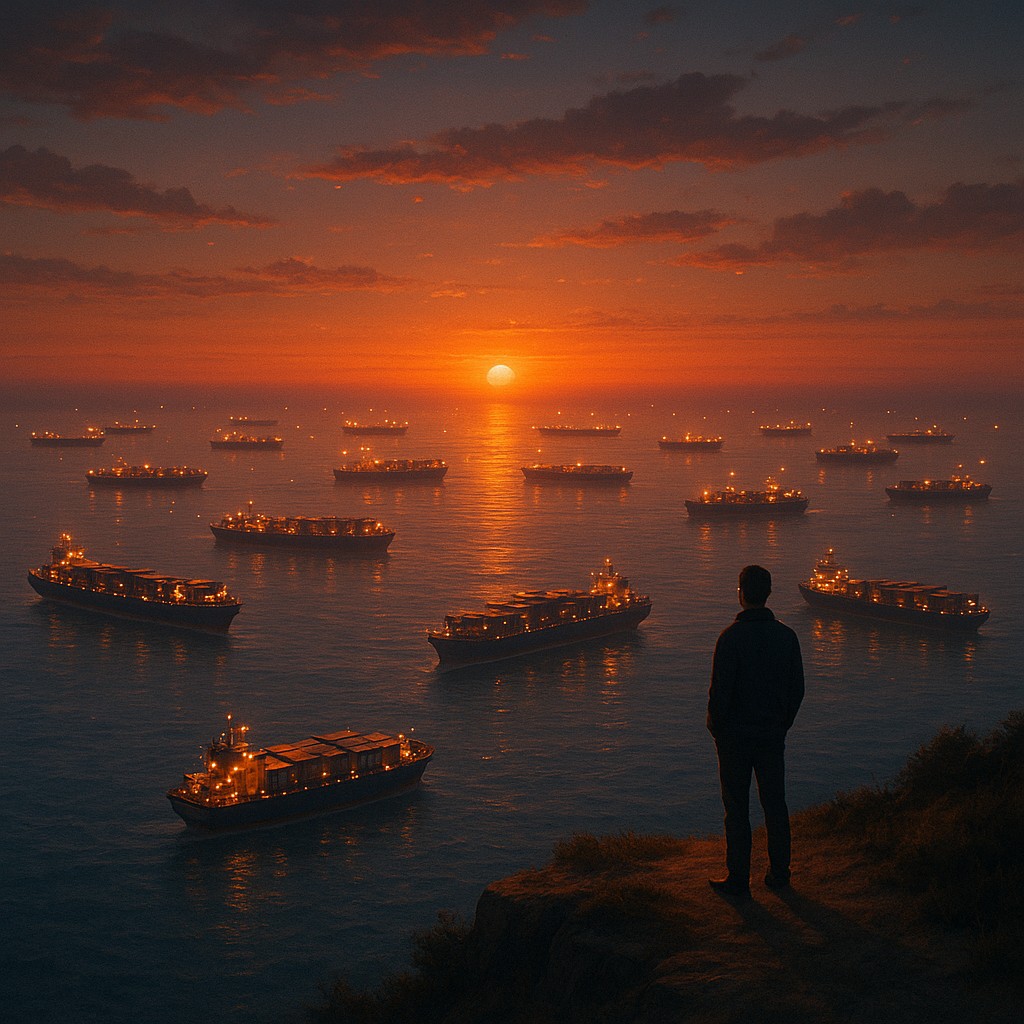
Imagine standing on a coastal cliff at sunset, looking out over the horizon at dozens of tiny, flickering lights. At first, it looks like a floating city or a beautiful constellation of stars reflected in the water. In reality, you are looking at an oceanic parking lot. These are massive container ships, some carrying thousands of tons of electronics, clothing, and grain, sitting idle and burning fuel just to keep their lights on and their engines warm. They raced across the ocean at top speed only to face the harsh reality that there is no room at the inn. The port is full, the docks are busy, and they have nowhere to go but to drop anchor and wait for days, or even weeks.
This "hurry up and wait" phenomenon is more than just a logistical headache; it is a global environmental crisis hidden in plain sight. When a ship travels at high speeds, it consumes fuel at an exponential rate, much like a car flooring it on the highway only to slam on the brakes at a red light. If that ship could have known 500 miles ago that the red light was coming, the captain could have eased off the gas, enjoyed a leisurely pace, and arrived at the exact moment the light turned green. This simple yet revolutionary concept is known as Virtual Arrival. It is currently rewriting the rules of international trade by replacing frantic racing with digital coordination.
The High Cost of the Ocean Parking Lot
To understand why Virtual Arrival is such a game changer, we first have to look at the traditional "first come, first served" rule that has governed the seas for centuries. Under typical maritime contracts, a ship is often required to reach its destination as quickly as possible to secure its place in line. Once a ship arrives, it "tenders its notice of readiness," a formal announcement that starts the clock on the port's responsibility to unload the cargo. This creates a flawed incentive where captains push their engines to the limit to claim a spot, knowing full well they will likely spend three days drifting outside the harbor once they get there.
The environmental toll of this practice is staggering. Large cargo vessels are among the most fuel-efficient ways to move goods per ton, but their sheer scale means they still burn enormous quantities of heavy fuel oil. When a ship increases its speed by just 10 percent, it often requires a 30 percent increase in engine power. This leads to a massive spike in carbon dioxide, sulfur, and nitrogen oxides. By rushing to a crowded port, the shipping industry is essentially burning money and pumping pollutants into the air just for the right to sit still. Furthermore, the congestion created by dozens of idling ships near the coast leads to local air pollution and noise that harms marine life and seaside communities.
Beyond the smoke and soot, there is a human and mechanical cost. Ships are designed to move, not to sit at anchor where they are at the mercy of coastal weather, dragging anchors, and the constant wear of running engines at low power. When a vessel sits in a crowded zone, the risk of collisions goes up, and the crew remains in a state of constant alert. Virtual Arrival seeks to dissolve this tension by turning the vast, empty ocean into a buffer zone where time is managed through data rather than physical proximity.
Navigating the Digital Handshake
The magic of Virtual Arrival does not happen in the engine room; it happens in the cloud. The process begins when a ship is still hundreds or even thousands of miles away from its destination. Using satellite tracking and port management software, the port authority or terminal operator identifies that a specific berth (a designated spot at a pier) will not be available until a certain time. Instead of letting the ship steam ahead at full power, the port sends a digital "handshake" to the vessel's operators. They agree on a new, later "virtual arrival" time, which legally honors the ship's place in the queue as if it had arrived at top speed.
Once this agreement is reached, the ship's captain can perform a "slow steaming" maneuver. By calculating the exact speed required to meet the new window, the crew can tune the engine for maximum efficiency. This is not just a guess; it involves complex weather routing and sea-state analysis to ensure that even at a lower speed, the ship arrives exactly when the crane is ready to swing. It is a transition from a competitive race to a choreographed dance. Below is a comparison of how the traditional model stacks up against the Virtual Arrival framework.
| Feature |
Traditional "Hurry Up and Wait" |
Virtual Arrival Protocol |
| Speed Philosophy |
Maximum speed to secure a spot |
Optimized speed based on dock availability |
| Fuel Consumption |
High (due to fast transit and idling) |
Significantly lower (efficient engine load) |
| Emissions |
High carbon and sulfur output |
Reduced footprint per voyage |
| Port Congestion |
High; crowded anchorages |
Managed; ships arrive "just in time" |
| Contractual Logic |
Physical arrival triggers "start" time |
Digital agreement honors "start" time |
| Communication |
Limited and reactive |
Constant, data-driven, and proactive |
Overcoming the Contractual Storm
If Virtual Arrival is so obviously beneficial for the planet and the bottom line, you might wonder why it has not been the universal standard for decades. The answer lies in the murky waters of maritime law and "charter party" agreements (the contracts used to rent ships). In the shipping world, the ship owner, the person paying for the fuel (the charterer), and the person waiting for the cargo are often three different parties with conflicting interests. For instance, a ship owner might be happy to slow down to save fuel, but if the contract says they must arrive by a certain date or pay a penalty, they will keep the pedal to the metal regardless of port conditions.
Furthermore, there is the issue of "demurrage," which is essentially a late fee. If a port is crowded and a ship has to wait, someone usually has to pay for 그hat lost time. In a Virtual Arrival scenario, everyone has to agree on who "owns" the time saved. If a ship slows down and saves $50,000 in fuel, does that money stay with the ship owner, or is it shared with the cargo owner who agreed to the delay? These financial tugs-of-war have historically been the biggest barrier to change. It requires a level of transparency and trust that is often rare in a cutthroat global industry.
To solve this, international maritime organizations and tech startups are introducing "Standard Virtual Arrival Clauses." These are pre-written legal templates that allow parties to decide ahead of time how fuel savings will be split and how arrival times will be verified. By standardizing the paperwork, these rules help move the conversation from "Who is trying to cheat me?" to "How much carbon can we save today?" This shift is being led by "Green Corridors," specific trade routes between major ports (like Los Angeles to Shanghai) that have committed to using these digital protocols to hit zero-emission targets.
The Ripple Effect of Real-Time Data
The implementation of Virtual Arrival is part of a larger movement called "Just-in-Time" (JIT) arrivals. This concept is borrowed from lean manufacturing, where parts arrive at a factory exactly when they are needed for assembly, eliminating the need for massive warehouses. In the maritime world, the "warehouse" is the anchorage outside the port, and the "factory" is the dock where the cranes operate. By using JIT principles, ports can transform from chaotic bottlenecks into streamlined transit hubs.
The technology required to power this is more than just a simple GPS. It involves "Digital Twins" of ports, where every crane, truck, and tugboat is tracked in real time. If a crane breaks down in Rotterdam, a ship leaving New York can be notified within minutes. That ship can then adjust its engine speed to account for the delay. This level of connectivity creates a "butterfly effect" of efficiency. When one ship slows down, it clears the way for another, reducing the overall noise and turbulence in shipping lanes. This is a massive win for whales and other marine mammals that rely on sound to communicate.
Interestingly, this data-driven approach also helps with "berth waiting forecasts." Weather is the oldest enemy of the sailor, and it remains a primary cause of port delays. Virtual Arrival systems now integrate hyper-local weather forecasting to predict how a coming storm might slow down the unloading process. If a terminal knows a storm will stop crane operations for six hours on Tuesday, they can tell all inbound ships on Sunday to slow down. The ships stay in calmer, safer waters further out at sea, rather than battling the storm while trying to drop anchor in a crowded harbor.
Why Slowing Down is Actually Moving Forward
It is a beautiful irony that the future of high-tech global trade involves ships moving more slowly. We live in an era obsessed with "overnight delivery" and "instant gratification," where we assume that faster is always better. Virtual Arrival teaches us that intelligence is often more valuable than raw power. By using math and communication to replace brute force, the shipping industry is proving that we can maintain our global supply chains while significantly reducing our impact on the environment.
This protocol also encourages a shift in the culture of the sea. For centuries, the captain's word was law, and the ship was an island unto itself. Today, the ship is a node in a global network. This connectivity allows for "Collaborative Decision Making," where the captain, the port pilot, the tugboat operator, and the truck driver on land are all looking at the same digital dashboard. When everyone sees the same reality, the stress of the "race to the port" evaporates, replaced by a shared goal of precision and safety.
As we look toward the future, Virtual Arrival is likely just the first step. Eventually, autonomous vessels and AI-managed ports will communicate without human intervention, carving out the most efficient paths across the oceans. But even as the technology evolves, the fundamental lesson remains: we don't always need to push harder to get where we are going. Sometimes, the most progressive move we can make is to simply check the schedule, ease off the throttle, and arrive exactly when we are expected.
Sailing into a Slower, Cleaner Tomorrow
The transition to Virtual Arrival is a powerful reminder that some of the most effective solutions to our climate challenges aren't found in exotic new fuels or experimental engines, but in how we choose to communicate. By breaking the cycle of "hurry up and wait," we are reclaiming wasted energy and turning it into a more sustainable way of life. It takes courage for an industry built on tradition to embrace the transparency required for these digital handshakes, but the rewards - cleaner air, quieter oceans, and a more resilient economy - are worth every bit of the effort. As you go about your day, perhaps wearing a shirt or using a phone that traveled across an ocean to reach you, take a moment to appreciate the quiet revolution happening on the high seas. We are learning that moving with purpose is far superior to moving with haste, and in that subtle shift, we find the path to a brighter, more synchronized world.