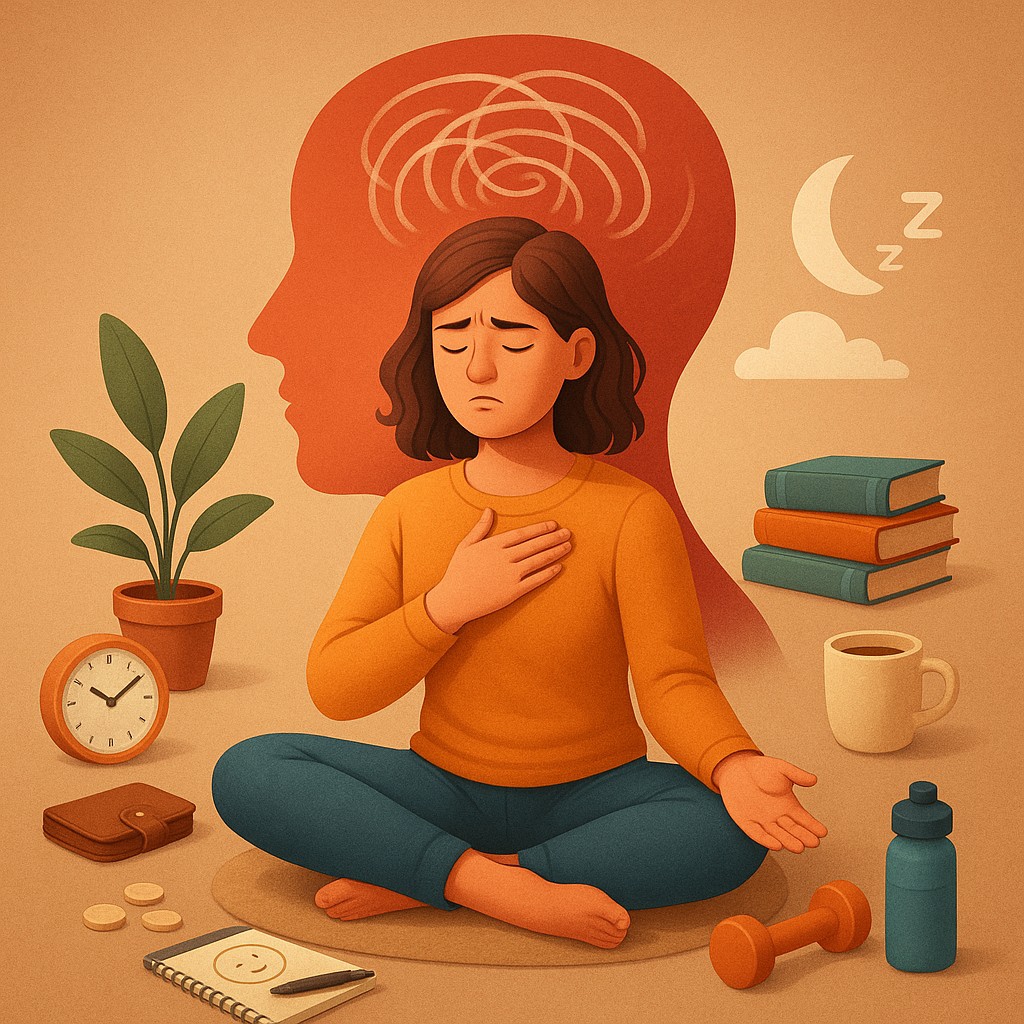
Anxiety has a sneaky way of shrinking your world. One minute you are replying to an email, and the next you are sure you committed an unforgivable professional crime by typing "Best" instead of "Kind regards." It can show up as racing thoughts, a tight chest, a restless body, or the urge to Google symptoms until you become your own very stressed medical drama.
The tricky part is anxiety is not always wrong. It is your brain's ancient security system doing its job: scanning for danger, predicting problems, and helping you stay alive long enough to pass on your genes and those odd family recipes. In modern life, though, this system often misfires. Instead of protecting you from predators, it reacts to meetings, uncertainty, social situations, and the daily chaos of life with a calendar.
The good news is you can reduce anxiety without becoming a monk, deleting all apps, or moving to a cabin where your only worry is whether the squirrels are judging you. The best approach combines short-term tools to calm your body now, long-term skills to train your mind over time, and a few lifestyle habits that make your nervous system less jumpy to begin with.
Anxiety, decoded: what’s actually happening in your body and brain
Anxiety is more than worry. It is a whole-body state driven by your nervous system, stress hormones, attention, and how you interpret threat. When your brain thinks something might go wrong, it shifts into protection mode: your heart rate climbs, breathing gets shallow, muscles tense, and your mind narrows toward worst-case scenarios. That is useful if something with teeth is chasing you. It is less useful when your own thoughts are the chase.
A key idea: anxiety keeps itself going in a loop. You notice a sensation, like a tight chest, interpret it as danger, and your body revs up further, creating more sensations to interpret. Over time you can even start fearing the anxiety itself, like being afraid of your smoke alarm and panicking at the smallest beep.
Reducing anxiety often means breaking this loop two ways. First, calm the body so your brain gets the message we are safe enough. Second, change how you relate to thoughts so your mind stops treating every anxious prediction like breaking news.
Quick calming strategies that actually work in the moment
When anxiety spikes, your goal is not to win an argument with your brain. Your brain is acting like a bouncer at an exclusive club, and it has decided calm is not on the guest list. Start with the body, because it is easier to change physiology than wrestle thoughts while your heart is sprinting.
Use your breath like a remote control (but not in a magical way)
Slow breathing is one of the fastest ways to lower physical arousal. The most reliable version is to lengthen the exhale, which nudges the nervous system toward rest and digest. Try inhaling gently through your nose for about 4 seconds, then exhaling for about 6 to 8 seconds. Do that for 2 to 5 minutes and keep it comfortable, not heroic. If you feel lightheaded, you are overdoing it, not levitating.
Breathing works best when it is boring and steady. Many people quit because they expect instant bliss and get annoyed when thoughts keep showing up. The win is not zero thoughts. The win is lower intensity, like turning the volume from 9 down to 6 so you can function again.
Ground your senses to exit the mental time machine
Anxiety loves time travel. It drags you into the future - "what if everything collapses?" - or the past - "why did I say that?" Grounding pulls you into the present using sensory details. A classic option is the 5-4-3-2-1 technique: name 5 things you see, 4 you feel, 3 you hear, 2 you smell, and 1 you taste. This is not childish. It is tactical attention training.
Another grounding method is label and locate. Say, "I am noticing anxiety in my chest and stomach." Naming sensations reduces the urge to treat them like emergencies. You can add, "This is a body state, not a prophecy."
Move your body to release the stress response
Your stress system prepares you for action. If you do not act, that energy has nowhere to go and turns into jittery discomfort. A brisk 10-minute walk, a few flights of stairs, light jogging, or a few minutes of stretching helps. Think of it as giving your body a completion signal that the threat phase is over.
If you are stuck in a meeting or public space, use small movements. Press your feet firmly into the floor, tense and relax your hands, roll your shoulders, or do slow calf raises. Subtle, but surprisingly effective.
A small “emergency kit” you can actually remember
When you are anxious, your memory narrows and picks panic. Keep a simple sequence you can recall:
- Name it: "This is anxiety, not danger."
- Breathe out longer than in for a few minutes.
- Ground: identify sensory details around you.
- Move: a short walk or some muscle releases.
- Next best step: one tiny action (send one email, take one sip of water, step outside).
The last step matters. Anxiety shrinks choices. A tiny action expands them.
The long game: retraining anxious thoughts without arguing with them
Many people try to beat anxiety by telling themselves they should not feel it. That is like trying to put out a grease fire by yelling "this is fine." A more effective approach is to change your relationship to thoughts, especially the sticky ones.
Cognitive reframing: challenge the story, not the feeling
Cognitive Behavioral Therapy (CBT) has strong evidence for anxiety. One practical CBT skill is reframing: identify the thought that fuels anxiety and check it against reality. You are not forcing fake positivity, you are seeking accuracy. For example, "If I make a mistake, I will be fired" becomes "Mistakes happen, and I can fix them. One mistake usually brings feedback, not exile."
Helpful questions:
- What evidence supports this fear, and what evidence goes against it?
- Is this a possibility, or am I treating it like a certainty?
- If a friend said this, what would I tell them?
- What is a more balanced thought I could practice?
This works best when you practice it regularly, not only during full panic. Think of it like learning to steer before you drive through a storm.
Acceptance and defusion: stop wrestling the thought monster
Some thoughts do not respond to debate, especially repetitive what-if loops. Acceptance and Commitment Therapy (ACT) offers useful skills here. Defusion means seeing thoughts as mental events, not commands. Instead of "I am going to fail," try "I am having the thought that I am going to fail." It sounds small, but it creates space.
Acceptance does not mean liking anxiety or giving up. It means dropping the extra struggle of "I must not feel this." Ironically, when you stop fighting anxiety like it is a personal insult, it often eases faster.
Exposure: the misunderstood superhero of anxiety treatment
Avoidance is anxiety's favorite snack. It feels good short-term, but it teaches your brain that the avoided thing was truly dangerous. Exposure works by gently approaching what you fear, in a planned and repeated way, until your nervous system learns you can handle it.
Good exposure is gradual and specific. If social anxiety is the issue, start by saying hello to a neighbor, then asking a store clerk a question, then attending a small gathering. The goal is not to be fearless. The goal is to be willing, while your body learns that discomfort is not catastrophe.
Exposure often works best with a therapist, especially if panic attacks, trauma, or obsessive fears are involved. But the basic idea is useful for most fears: approach, do not orbit.
Lifestyle upgrades that make your nervous system less jumpy
Lifestyle changes are not the whole story, but they make everything else easier. Anxiety gets worse when your body is underfed, underslept, overstimulated, and marinating in caffeine. Think of these changes as lowering the baseline noise so your mind has room to respond.
Sleep: the closest thing to emotional time travel
Poor sleep increases amygdala reactivity, which is your brain's alarm center, and makes worries feel more convincing. You do not need perfect sleep to improve anxiety, but consistency helps. Try a stable wake time, a wind-down routine, and reduce late-night screen brightness if possible. If insomnia is chronic, CBT-I, a therapy specifically for insomnia, is very effective.
Also, do not underestimate the anxiety-sleep spiral: anxiety disrupts sleep, poor sleep amplifies anxiety, and suddenly you are negotiating with your pillow at 2 a.m. Break the cycle with routines and realistic expectations, not pressure to "sleep right now."
Food and caffeine: steady the chemistry, not your whole life
Blood sugar swings can mimic anxiety symptoms: shakiness, irritability, dizziness. Regular meals with protein and fiber can smooth that out. Hydration matters too, because dehydration can raise physical stress sensations.
Caffeine is a frequent culprit, especially for people prone to panic. If you are anxious and drink a lot of coffee, try cutting back slowly. This is not a moral judgment against coffee, it is a compatibility check. Some nervous systems treat espresso like an air horn.
Exercise: the simple, evidence-based miracle
Regular aerobic exercise reduces anxiety over time and improves mood regulation and stress resilience. You do not need intense workouts. Walking, cycling, swimming, or dancing in your kitchen all count. Strength training helps too, partly because it builds a sense of physical capability.
A simple target is 20 to 30 minutes of moderate movement most days, even if you split it into shorter segments. Consistency beats intensity.
Digital hygiene: curate your attention like it is valuable
Your brain cannot tell the difference between a real threat and a convincing headline at midnight. Doomscrolling feeds your alarm system a constant stream of maybe-danger signals. Try some boundaries: no news before bed, set app time limits, turn off nonessential notifications, and create phone-free zones like the dinner table or the first 20 minutes after waking.
This is not about becoming uninformed. It is about getting information at a dose your nervous system can handle.
Choosing the right tool: a practical comparison table
Not every strategy fits every moment. Some give quick relief, others train your system. Use this map without a psychology degree.
| Strategy |
Best for |
How fast it helps |
Common mistake |
A better way to use it |
| Slow breathing (longer exhale) |
Physical panic symptoms |
Minutes |
Forcing deep breaths and getting dizzy |
Keep breaths gentle, extend the exhale, 2-5 minutes |
| Grounding (5-4-3-2-1, sensory) |
Racing thoughts, feeling unreal |
Minutes |
Expecting it to erase anxiety completely |
Use it to anchor attention, then take one small action |
| Movement (walk, stretch) |
Restlessness, adrenaline |
Minutes to hours |
Waiting until you feel "motivated" |
Do a short, scheduled burst, even 5-10 minutes |
| CBT reframing |
Persistent worry, catastrophizing |
Days to weeks |
Using it to argue anxiety away |
Aim for balanced accuracy, practice daily |
| ACT defusion/acceptance |
Sticky loops, intrusive thoughts |
Minutes to weeks |
Thinking acceptance means approval |
Accept the feeling, choose actions aligned with values |
| Exposure practice |
Phobias, avoidance patterns |
Weeks to months |
Going too big too fast |
Build a gradual ladder, repeat until it gets easier |
| Sleep routine |
High baseline anxiety |
Weeks |
Trying to "fix" sleep in one night |
Stabilize wake time, wind-down, address insomnia systematically |
Clearing up myths that keep anxiety stuck
One myth is that anxious people just overthink and should "calm down." If only anxiety responded to scolding. Anxiety is a body-based state, and telling someone to calm down is like telling a sneeze to be more reasonable. Skills work better than shame.
Another myth is you must eliminate anxiety to be healthy. In reality, some anxiety is normal and even useful. The goal is not a life with zero nerves. The goal is a life where nerves do not run the show. Confidence often grows by doing things while anxious and learning you can cope.
A third myth is that avoidance is self-care. Sometimes stepping away is wise, but chronic avoidance trains your brain to fear more situations, not fewer. Real self-care often looks like gentle courage: small steps, repeated, with compassion and structure.
When extra support is the smartest move (not a last resort)
If anxiety significantly interferes with your life, causes panic attacks, ruins sleep for weeks, or pushes you into constant avoidance, professional help is a strong option. Therapies like CBT and ACT have solid evidence, and exposure-based approaches work especially well for phobias, social anxiety, and panic. Medication can also help some people, especially when anxiety is severe or paired with depression; discuss that with a qualified clinician.
Also get help right away if you are having thoughts of self-harm, feel unsafe, or are using substances in a way that is getting worse. Seeking support is not failing at coping. It is choosing not to handle a heavy problem alone.
Turning insight into a plan you’ll actually use
Treat yourself like a coached athlete, not a critic. Pick one or two in-the-moment tools (breathing and grounding pair well), one long-term practice (reframing, defusion, or exposure), and one realistic lifestyle change, like a consistent wake time or a daily walk.
Anxiety shrinks when your brain gathers new evidence: I can feel this and still act. Each time you ride out a wave without feeding it with avoidance, you teach your nervous system that discomfort is temporary and survivable. That learning compounds quietly and powerfully, until things that once felt impossible become merely unpleasant, then manageable, then ordinary.
You do not need to become a different person to feel better. You need a small set of repeatable skills, a bit of patience, and the willingness to practice on normal days, not only crisis days. Start small, stay consistent, and let your nervous system learn what you already deserve to know: you can handle more than your anxiety gives you credit for.