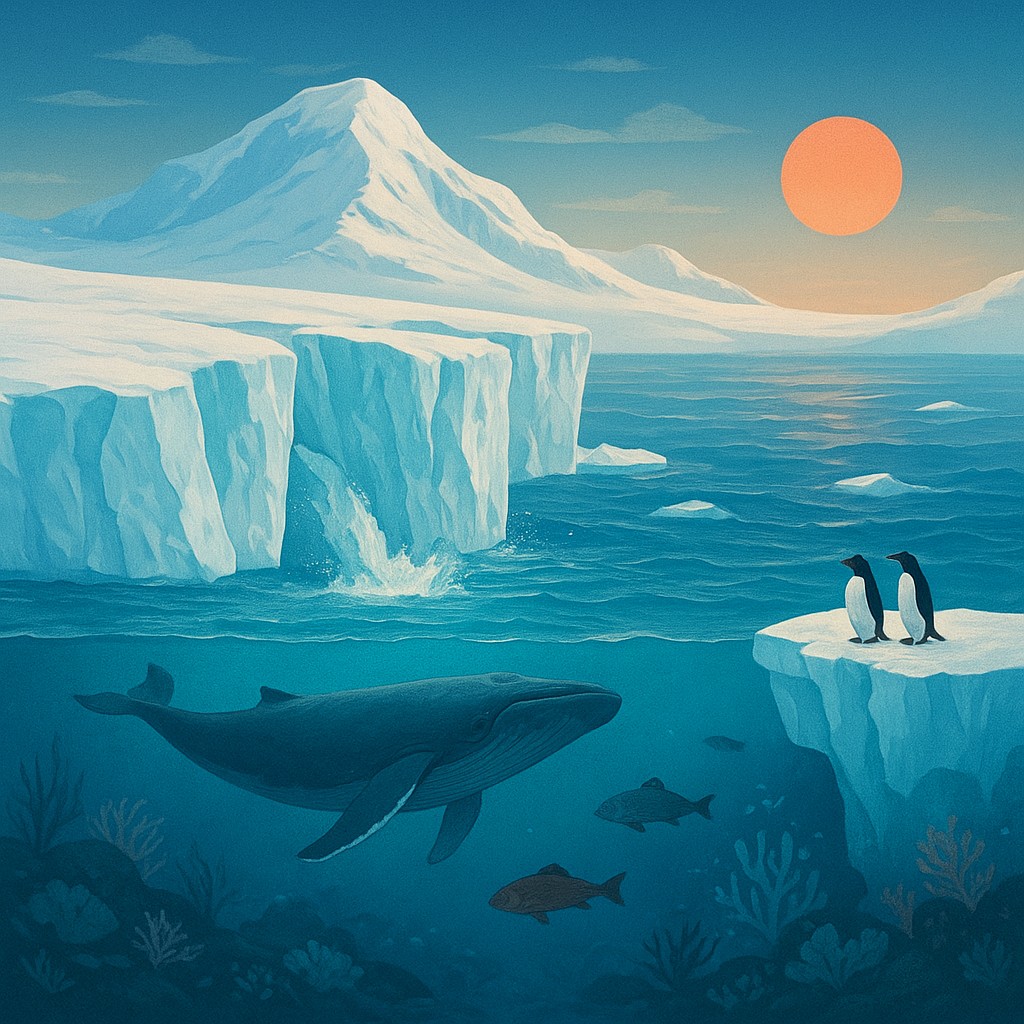
Why Antarctica matters - a cold continent that shapes the whole planet
Imagine a place so vast and white that it holds almost all of Earth’s freshwater, acts like a planetary thermostat, preserves a deep climate archive, and hosts ecosystems that thrive on the edge of life. That is Antarctica. Far from being an empty icebox, Antarctica is central to understanding sea level, climate change, ocean currents, and even how life adapts to extremes. What happens at the bottom of the world can ripple to the coasts where you live.
Antarctica also writes the story of discovery, human stubbornness, and scientific cooperation. From wooden sledges and heroic-age explorers to international satellite networks and ice-core laboratories, our knowledge of Antarctica is a triumph of curiosity and technology. The continent’s harsh beauty and scientific value explain why 50 countries agreed to keep it as a place for peace and research, rather than for conquest or mining.
This Learning Nib will take you from the basics - where Antarctica is and how it works - into the fascinating complexities of ice dynamics, life under the ice, human presence, and the urgent questions about a warming world. Along the way we will bust myths, highlight the big numbers to remember, and finish with some clear takeaways you can carry into any conversation about climate, oceans, or exploration.
The geography you can picture - size, coasts, and ice as a landscape
Antarctica sits over the South Pole and covers roughly 14 million square kilometers, about 1.5 times the size of the United States. Around 98 percent of the land is covered by ice sheets and glaciers, forming a landscape where the ice itself is the terrain. The ice sheet is not uniform - thick interior domes rise to several thousand meters, while coastal ice flows into floating shelves and outlet glaciers.
There are three broad geographic regions worth knowing. The East Antarctic Ice Sheet is the largest and oldest, generally colder and more stable, underlain by high bedrock. West Antarctica includes basins where bedrock lies below sea level, making its ice more vulnerable to ocean-driven melting. Then there is the Antarctic Peninsula, a long finger reaching toward South America that has seen pronounced warming and ecosystem changes in recent decades.
To a traveler you would notice stark contrasts - dry valleys where wind keeps snow away and exposed rock shows ancient geology, and coastal seas that teem with life in summer. Antarctica is also technically a polar desert - while it is full of ice, the interior receives very little snowfall, often less than 50 millimeters of water equivalent per year. That dry cold helps preserve some of the oldest, most valuable climate records.
Ice, ice, and more ice - how Antarctic ice controls sea level and climate
The Antarctic ice sheet stores about 60 percent of the planet’s fresh water. If all Antarctic ice melted, global sea level would rise by roughly 58 meters. That number is almost impossible to visualize, but it shows why changes on Antarctica are not a local problem - they are a planetary risk.
Ice sheets grow where snowfall accumulates and declines where ice flows to the ocean and melts or calves into icebergs. Important processes include surface melting, basal melting from warm ocean waters, and the dynamics of outlet glaciers that channel ice from the interior to the sea. A few glacier systems, especially in West Antarctica - think Thwaites and Pine Island - are losing mass rapidly because warm ocean waters undercut the ice at their bases. Scientists worry about feedbacks such as marine-ice-sheet instability - in simple terms, once a grounding line retreats into deeper bedrock, retreat can accelerate.
Antarctica gives us one of our best climate monitoring tools: ice cores. Layers of snow compress into ice and trap bubbles of ancient air, letting researchers read atmospheric composition and temperature proxies back hundreds of thousands of years. The Dome C and Dome Fuji cores provide continuous climate records stretching back about 800,000 years, showing natural cycles of ice ages and warm intervals. These records helped show how carbon dioxide and temperature rise together over glacial-interglacial cycles.
Life at the edge - ecosystems from plankton to penguins
When people picture Antarctica, they often imagine desolate ice with no life. That is a myth. Most Antarctic life is marine and highly productive during the summer months. Tiny crustaceans called krill form the base of a food web that supports fish, penguins, seals, and whales. Phytoplankton blooms fuel this productivity, often following seasonal sea-ice retreat.
On land, life is sparse but remarkable. No trees grow, but mosses, lichens, and simple plants like Antarctic hair grass survive in ice-free coastal patches. Microbial communities persist in subglacial lakes and within the ice itself, adapting to cold, dark, and nutrient-poor conditions. Penguins are iconic here - species such as the Emperor, Adelie, Gentoo, and Chinstrap have different niches. Emperor penguins breed on sea ice during the dark Antarctic winter, a dramatic example of endurance and parental cooperation.
Birds like the wandering albatross range far across the Southern Ocean while seals - Weddell, leopard, crabeater - use the sea ice and open water in diverse ways. Biodiversity is centered on the ocean, and changes to sea ice, krill abundance, or ocean temperature can cascade through the system.
Hidden worlds - subglacial lakes, mountain ranges, and new discoveries
Under the ice lies a secret continent. Radar and seismic surveys reveal mountain ranges such as the Gamburtsev Subglacial Mountains, deep basins, and thousands of subglacial lakes - Lake Vostok is the most famous. These lakes have been isolated from the atmosphere for millions of years, making them targets for astrobiology and studies of life in extreme isolation. Drilling into them requires extreme care to avoid contamination.
Geology also tells a story of deep time. Antarctica was once part of the supercontinent Gondwana, joined to Africa, South America, India, and Australia. Plant fossils and dinosaur remains found in previously ice-free areas document a much warmer past. Plate tectonics and past climates help explain how the ice sheet formed and why some areas are more stable than others.
How humans fit in - exploration, research stations, and international cooperation
People first sighted Antarctic shores in the early 19th century, and the heroic age of exploration brought dramatic tales of survival and discovery. Roald Amundsen reached the South Pole in 1911, beating Robert Falcon Scott, whose return journey ended tragically. Ernest Shackleton’s Endurance expedition is another story of near-impossible survival that still captivates people today.
Today the human footprint is scientific and diplomatic. About 70 permanent research stations operate on the continent, with many more seasonal bases. Winter populations dip to around 1,000 people, swelling to 3,000 to 5,000 in summer. Scientists study glaciology, astronomy (thanks to clear skies), climate, marine biology, and more. Logistics are complex - supplies arrive by ship and plane, and harsh weather can isolate stations for weeks.
The Antarctic Treaty, signed in 1959 and entered into force in 1961, is a landmark of international cooperation. It designates Antarctica as a zone for peaceful research, bans military activity, and suspends sovereign claims. The Protocol on Environmental Protection, adopted in 1991, established strong environmental rules and effectively banned mineral resource exploitation, though the treaty framework allows for review of that ban after 2048. For now, Antarctica is protected as a global commons for science.
Climate change and the big uncertainties - what we know and what we do not
Climate change is already affecting Antarctica, but not uniformly. The Antarctic Peninsula experienced strong warming in the late 20th century, causing ice shelf collapse and ecological shifts. Antarctica as a whole is losing mass, with satellite data showing accelerating ice loss mainly from West Antarctica and parts of the Peninsula. East Antarctica has been relatively stable, though regional changes have been detected.
The main worry is sea-level rise. Melting and increased glacier flow are contributing to global sea-level rise today, and potential thresholds exist where parts of the ice sheet could commit to long-term retreat. The West Antarctic Ice Sheet, sitting on bedrock below sea level, is particularly susceptible to warm ocean-driven melting. Glacier systems like Thwaites are thus monitored intensely because their collapse could increase the pace of sea-level rise.
But there are uncertainties. Ice dynamics are complex and models are improving rapidly, yet projections over centuries involve many unknowns - how quickly the ocean warms, feedbacks within the ice, and the potential for rapid, nonlinear changes. That is why continued observation, fieldwork, and improved modeling are essential.
Common myths and quick corrections you can share at parties
- Myth - Antarctica is one unbroken, solid chunk of ice. Correction - It is ice-covered, but the ice moves, floats, calves, and overlies varied bedrock with mountains, valleys, and lakes beneath.
- Myth - No life survives there. Correction - The Southern Ocean teems with life, penguins and seals thrive, and microbial life persists in extreme habitats including subglacial lakes.
- Myth - Penguins live both poles. Correction - Penguins are southern only; polar bears live only in the Arctic.
- Myth - Antarctica is getting uniformly colder. Correction - Parts are cooling, others are warming. Recent decades show net mass loss and regional warming, especially on the Peninsula.
- Myth - The Antarctic Treaty forbids any human activity. Correction - The treaty allows scientific research and cooperation, but bans military activity and currently bans commercial mining under strong environmental protocols.
A handy comparison table - East versus West and the Peninsula at a glance
| Region |
Climate and stability |
Key features |
Main research and concerns |
| East Antarctica |
Colder, thicker ice, generally more stable |
Vast high plateaus, oldest ice, thickest ice up to ~4,700 m |
Ice-core climate records, long-term ice-sheet mass balance |
| West Antarctica |
Warmer ocean influence, basins below sea level, more vulnerable |
Rapidly changing glaciers like Thwaites and Pine Island, floating ice shelves |
High concern for sea-level rise, ocean-ice interaction studies |
| Antarctic Peninsula |
Strongest recent warming, seasonal sea-ice change |
Rugged peninsula reaching toward South America, ice-shelf collapses |
Ecosystem shifts, glacial retreat, rapid climate-driven changes |
How scientists study Antarctica - tools from sleds to satellites
Studying Antarctica is a mix of old-school fieldwork and high-tech observation. Drilling ice cores, measuring glacier flow with GPS, and operating automatic weather stations give direct data. Ships and submersibles explore the continental shelf and ocean waters that undercut ice shelves.
Satellites are indispensable: they measure ice-surface elevation, mass changes via gravity (GRACE), and ice velocity. Airborne radar and seismic surveys reveal what lies beneath the ice. Computers and models knit these observations together to simulate future behavior, but models need more data and experiments to reduce uncertainties. Citizen science and remote sensing also help map biological activity like phytoplankton blooms.
What to remember - the big numbers and concepts that stick
- Antarctica covers about 14 million square kilometers and is 98 percent ice-covered.
- The Antarctic ice sheet holds roughly 60 percent of Earth’s freshwater and could raise sea level by about 58 meters if fully melted.
- Ice cores provide climate records going back hundreds of thousands of years, demonstrating links between greenhouse gases and temperature.
- West Antarctica, especially glaciers like Thwaites, is a hotspot for present-day ice loss and sea-level risk.
- The Antarctic Treaty makes the continent a place for peaceful research and environmental protection.
How you can stay curious and why your attention matters
Antarctica may seem remote, but what happens there matters to coastlines, weather patterns, and global sea level. Following Antarctic science is one of the clearest ways to see how human choices and physical systems interact across continents and centuries. If you enjoy data, watch satellite updates and ice-core findings. If you prefer stories, revisit the age of exploration and modern fieldwork accounts - they are full of extraordinary human resilience and ingenuity.
Learning about Antarctica also teaches a useful scientific habit - think across scales. Tiny organisms in the Southern Ocean influence carbon cycles, which influence climate, which then feeds back into ice dynamics that affect sea level globally. That chain of cause and effect is why interdisciplinary research and international cooperation are critical.
If you want to go deeper, look up recent papers on Thwaites Glacier, explore the results of the EPICA ice cores, or follow programs like SCAR - the Scientific Committee on Antarctic Research. You will discover that Antarctica is not static - it is a dynamic, central, and increasingly urgent part of our planet’s story.
Closing nudge - keep asking questions and tell better stories about our planet
Antarctica is at once a freezer, a library of Earth’s climate, and a living laboratory. It challenges our intuition about how life, ice, and oceans interact. Study it and you learn about time - deep time written in ice layers - and responsibility - the policy choices that determine whether future generations will inherit stable coastlines or rising seas. The next time someone imagines Antarctica as merely an empty white void, you will have the facts and the stories to show how that white continent holds a majority of Earth’s freshwater, steers ocean currents, and records the pulse of past climates. Keep the curiosity, share what you learn, and remember that understanding Antarctica helps protect many places closer to home.