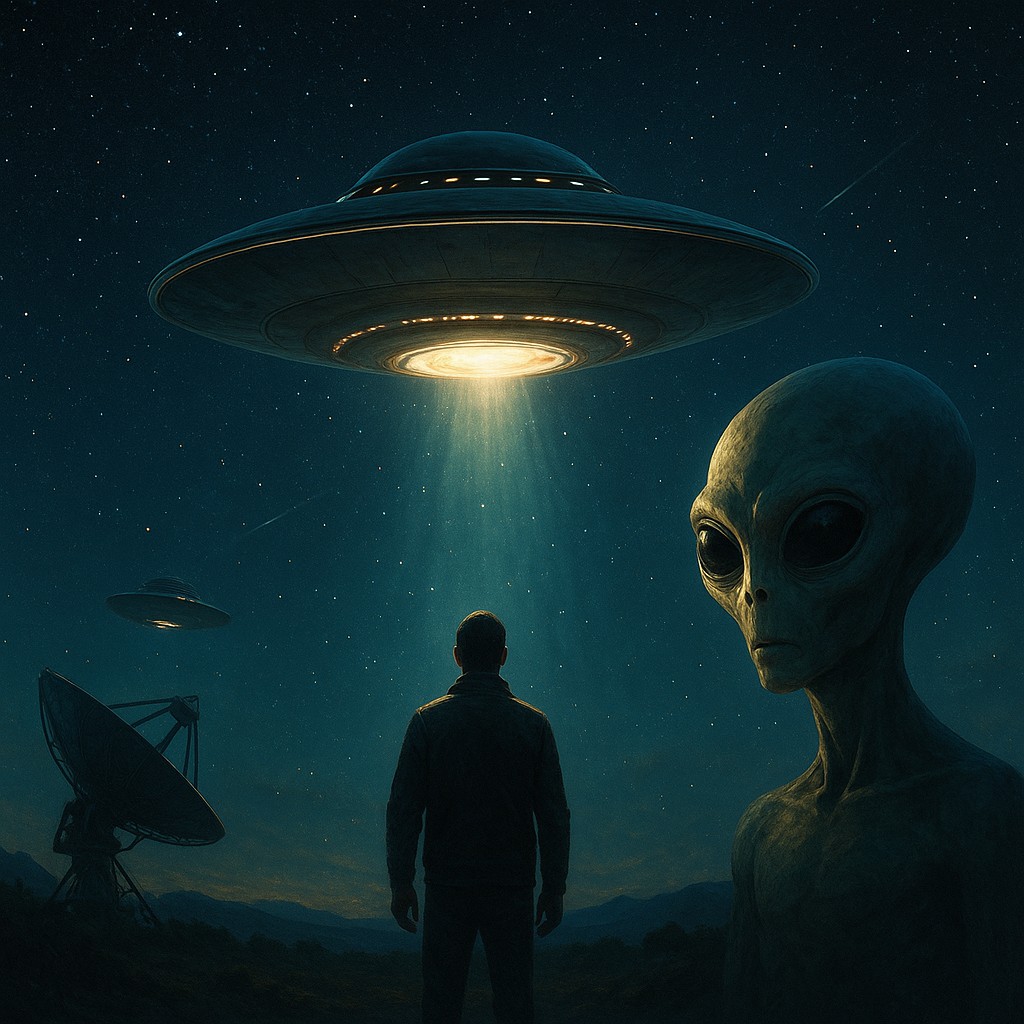
For decades, the idea of alien life was tucked away in the dusty corners of science fiction novels and late-night radio shows. We looked at the stars and wondered if we were truly alone, or if someone out there was looking back at us with the same mix of curiosity and dread. Recently, the conversation has moved from the fringes of society into the halls of government and the palms of our hands. When figures like former President Barack Obama publicly admit there are objects in the sky we cannot explain, the world stops feeling like a movie and starts feeling like a very different reality.
The shift in tone regarding Unidentified Aerial Phenomena (UAP) suggests we are no longer asking "if" they exist, but "who" they are. While the government is still careful not to confirm there are "little green men" in flying saucers, admitting that physical objects are moving in ways that defy our understanding of physics is a massive leap forward. It invites us to weigh old stories against new scientific possibilities, building a bridge between the wild tales of the past and the data-driven discoveries of the future. To understand this change, we need to look at the biology of what might be out there, the history of those who claim to have met them, and why the "secret" is finally leaking out.
A Menu of Potential Visitors
If we assume the universe is teeming with life, the next logical question is: what do they look like? Pop culture gives us a narrow view, usually showing small gray beings with large eyes or terrifying monsters with acidic blood. However, astrobiology - the study of life in the universe - suggests that evolution on other planets would be shaped by the specific environment of that world. A planet with high gravity might produce short, stocky beings with multiple legs for stability. Meanwhile, a low-gravity moon might allow for tall, spindly creatures that look more like delicate sticks than mammals.
Scientists often group potential aliens by their level of technology, but we can also categorize them by how people say they interact with Earth. In the world of UFO research, there are several "recurring characters." These range from the classic "Grays" to more exotic beings that sound like they stepped out of a fantasy novel. By looking at these descriptions, we can see patterns in human testimony. These patterns either point toward a shared reality or a deeply ingrained cultural image that influences what we think we see in the dark.
The variety of these beings often reflects our own biological biases. We tend to imagine life that is symmetrical, has a head with sensory organs, and uses limbs to move. Yet, some researchers argue that the most advanced aliens might not be biological at all. If a civilization is thousands of years ahead of us, they may have long ago traded flesh and blood for silicon-based bodies or digital consciousness. This would explain how they could survive the crushing G-forces and immense distances of space travel that would turn a human body to liquid in seconds.
Comparing Common Types of Reported Beings
| Type of Being |
Reported Appearance |
Common Characteristics |
Origins in Lore |
| The Grays |
Small, hairless, large black eyes, gray skin |
Highly clinical, telepathic, interested in biology |
Roswell and 1960s abduction stories |
| Nordics / Pleiadians |
Human-looking, tall, blonde, striking features |
Peaceful, spiritual, concerned with Earth's environment |
1950s "Contactee" movement |
| Reptilians |
Lizard-like scales, muscular, slit pupils |
Highly secretive, interested in power and control |
Ancient myths and modern conspiracy theories |
| Non-Biological Entities |
Metallic drones or light-based shapes |
Autonomous, hyper-fast, no visible cockpits |
Modern military UAP sightings |
The Weight of Testimony and the Age of Disclosure
History is full of people who risked their reputations to tell the world they saw something impossible. In the past, these people were often dismissed as attention-seekers or folks suffering from hallucinations. However, the caliber of people coming forward has changed. We are no longer just listening to stories from remote farms; we are listening to retired intelligence officers, high-ranking military pilots like David Fravor and Ryan Graves, and even former presidents. These are people trained to observe, and their stories are often backed by radar data and sensors that prove a physical object was actually there.
One of the most convincing parts of modern "disclosure" - the process of making this information public - is how consistent the descriptions are. Military pilots describe "Tic-Tac" shaped crafts that can hover in hurricane-force winds and then zoom to hypersonic speeds without visible wings or engines. These accounts suggest that whatever is visiting us isn't using fuel or aerodynamics as we know them. Instead, they seem to be manipulating gravity or space itself. When a president confirms that there is footage of objects we cannot explain, it validates decades of "civilian" stories that scientists previously ignored.
Despite this progress, we must remain skeptical. Stories are powerful, but they are not the same as a physical specimen or a landed craft. Human memory is famously unreliable, and the desire to believe can sometimes change how we see a natural event. This new era of disclosure isn't just about the government releasing files; it is about the public learning how to tell the difference between top-secret human tech, psychological tricks, and genuine alien visitors. The truth likely involves a mix of all three.
Biology and Physics Beyond Earthly Standards
To understand who these beings might be, we have to think about how they survive. Life on Earth is based on carbon because it forms stable bonds easily, but silicon is a popular alternative in science. A silicon-based life form might survive the intense heat of a planet close to its star or even live in the vacuum of space. If the aliens discussed by officials are real, their bodies must be built for the stress of space travel. This leads many to believe that the beings seen in UAPs might be "bio-robots" or genetically engineered drones designed for long missions where a "natural" creature would die.
Furthermore, the idea of "interdimensional" beings is becoming more popular. Some physicists suggest that if there are extra dimensions beyond the three we can see, aliens might not be traveling from distant stars. Instead, they might come from a plane of existence that sits right on top of ours. This would explain why they appear and disappear instantly on radar. Rather than flying away, they might simply be "turning" into a direction we cannot see. If so, they aren't travelers from another galaxy, but neighbors from a different frequency of reality.
The psychological impact of this is huge. For most of history, humans saw themselves as the center of the universe. Admitting we share our skies with entities that have god-like technology forces us to rethink our religions, our politics, and our safety. It suggests that our control over the planet only exists because our visitors allow it. If they have the power to shut down nuclear missile silos - a common claim in military UFO reports - then our most powerful weapons are essentially toys compared to their tech.
Separating Modern Myths from Scientific Facts
One of the hardest parts of learning about aliens is navigating the sea of misinformation. For every credible military report, there are a thousand blurry photos of streetlights and weather balloons. To be a smart observer, look for "the five observables" identified by experts like Luis Elizondo: anti-gravity lift, sudden acceleration, hypersonic speeds without a heat trail, cloaking, and "trans-medium" travel (moving between space, air, and water seamlessly). If a report doesn't include these, it is likely a normal object.
There is also a common fear that all aliens would be hostile. This "Independence Day" scenario is a projection of human history, where civilizations with better tech often conquered those with less. However, a civilization capable of traveling between stars would likely not need to raid planets for resources. In a universe where energy and matter are common, the only truly rare things would be information, culture, and biological variety. Therefore, they might be more like galactic librarians or observers than invaders.
Finally, we should address the "Area 51" myths. While it is fun to imagine a basement full of aliens on ice, the reality of government secrecy is usually much more boring and bureaucratic. It is more likely that different agencies have small pieces of the puzzle - a strange material here, a radar track there - but no one has the "full picture." This fragmented knowledge is why disclosure is so slow. It isn't just about "telling the people"; it is about the government itself trying to figure out what it has collected over the last eighty years.
Embracing a Larger Universe
Standing on the edge of this new era is both humbling and exciting. We are the generation that might finally get an answer to the oldest question in history. Whether these beings are travelers from the stars, visitors from another dimension, or advanced AI, their presence proves that the story of life is much bigger than what happens on Earth. By staying curious, demanding good evidence, and keeping an open mind, we can prepare for a future where we are no longer the only players on the cosmic stage. The universe is wide and full of wonder, and it seems it is finally starting to wave back.