Imagine carrying an entire library in your pocket. This is not just a digital bookshelf, but a living assistant capable of summarizing chapters, drafting emails to your boss, or fixing a broken line of code, even when you are deep underground in a subway with no signal. For years, we were told this kind of intelligence required massive, power-hungry server farms the size of stadiums. We were led to believe that for a machine to be "smart," it had to be "big," relying on billions of data points and a constant connection to the internet.
However, a quiet revolution is taking place inside your device’s computer chips. We are moving away from the era of "cloud-only" artificial intelligence toward something much more personal and efficient. This shift is happening because, while we love the power of AI, we are often uneasy about privacy risks or the lag time of sending our data across the ocean just to fix a typo. This is where Small Language Models (SLMs) come in, proving that you do not need a giant brain to be clever, as long as you have the right education.
The Art of the Academic Hand-Off
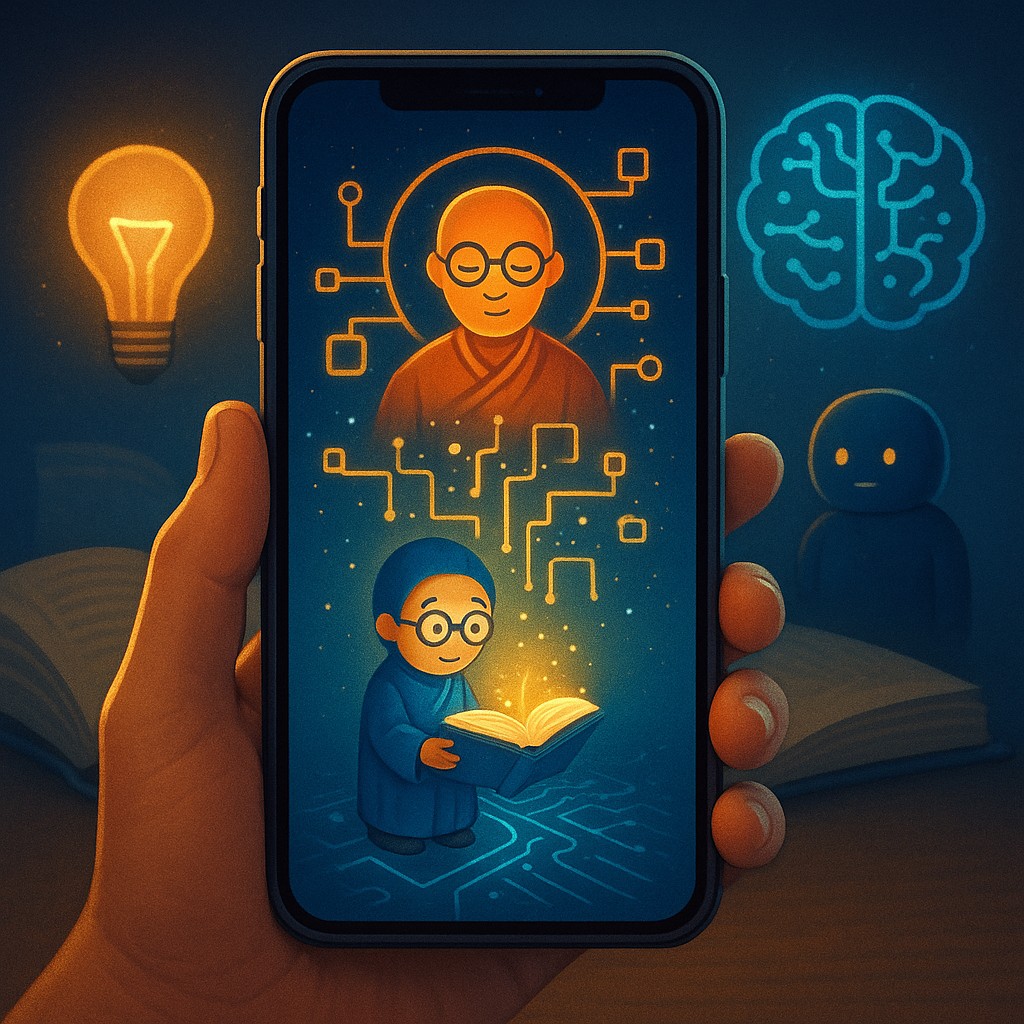
To understand how a tiny model on your phone can rival a giant in a data center, we have to look at a process called Knowledge Distillation. Think of it as the ultimate apprenticeship. In this scenario, we have a "Teacher" model, a massive Large Language Model (LLM) with encyclopedic knowledge of almost everything. Then we have the "Student," a much leaner model designed to fit into the limited memory of a phone or laptop.
During distillation, the Teacher does more than just give the Student the right answers; it shows the Student how it thinks. If you ask a giant model to solve a logic puzzle, it navigates a complex web of probabilities to find the solution. In the distillation process, the Student watches these internal patterns. It learns which paths lead to success and which are just distractions. By mimicking the Teacher’s refined logic, the Student can reach a similar level of reasoning without needing to store the billions of obscure facts the Teacher carries around.
This process is remarkably efficient because it filters out the noise. A massive model might know the birth date of every minor poet from the 1700s, but your phone does not need that to help you schedule a meeting. Distillation strips away the bulk and keeps the logical skeleton. The result is a Student that is ten times smaller but perhaps 80 percent as capable. This is a great trade-off, considering the Student runs locally, instantly, and for free.
Why Your Pocket is the New Frontier
Moving AI from the cloud to the "edge" (the industry term for your actual hardware) changes our relationship with our devices. When AI runs locally, your data never leaves your hand. This is a massive win for privacy. If you are writing a sensitive legal document or a private journal entry, you no longer have to worry about that text being used to train a corporate model or being intercepted. The "brain" stays entirely within your encrypted device, making it a digital vault that can also think.
Speed is the other major factor. Even with a fast 5G connection, there is always a delay when you send a request to a server and wait for the response to fly back. On-device models eliminate this lag. Since the processing happens on your local chip, specifically the NPU (Neural Processing Unit, a chip dedicated entirely to AI tasks), the response is nearly instantaneous. It feels less like talking to a distant robot and more like using a snappy tool, such as a calculator. This responsiveness makes the AI feel like a natural extension of your own thoughts.
Finally, there is the issue of reliability. We have all been frustrated when an app fails because the internet dropped for a second. With local models, your AI assistant stays awake even in "Airplane Mode." Whether you are hiking in the mountains or stuck in a basement, your ability to process information remains intact. This shift ensures that intelligence becomes a basic utility, like electricity or water, that is always available regardless of your connection.
Weighing the Heavyweights against the Lightweights
It is important to stay realistic about what these smaller models can and cannot do. While a distilled student model is brilliant at logic, it does have a "memory cap." It lacks the sheer, brute-force knowledge of a giant like GPT-4 or Claude. If you want a model to explain the intersection of quantum physics and 12th-century architecture, the massive cloud model will win every time because it has the storage space for those niche facts.
However, for 90 percent of daily tasks, the Student is more than enough. Most people spend their time summarizing emails, rephrasing sentences, or generating simple code snippets. For these functional, reasoning-heavy tasks, the distilled model shines. It is the difference between hiring a specialist who knows exactly how to fix your sink and a universal scholar who knows the entire history of plumbing but takes twenty minutes to find a wrench.
| Feature |
Massive Cloud Model (Teacher) |
Small On-Device Model (Student) |
| Location |
Remote Data Centers |
Locally on your device |
| Privacy |
Data sent to servers |
Data stays on your device |
| Connectivity |
Requires stable internet |
Works offline |
| Knowledge Base |
Encyclopedic and vast |
Task-focused and essential |
| Latency |
Network dependent (Slower) |
Instantaneous (Faster) |
| Cost |
Often subscription-based |
Free after download |
As the table shows, the choice isn't about one being "better" than the other. It is about choosing the right tool for the job. We are entering a hybrid era where your phone will use a local model for private, everyday tasks, but might still "call home" to a giant model when you ask a truly massive, complex question. This approach gives us the best of both worlds: privacy and speed for small things, and vast wisdom for the big stuff.
Correcting the Myths of Small AI
A common misconception is that a smaller model is just a "dumbed down" version of a big one, like a blurry photo of a high-resolution map. This isn’t quite right. Thanks to distillation, along with techniques like "quantization" (which lowers the mathematical precision to save space without losing meaning) and "pruning" (removing parts of the model that are never used), these models are actually incredibly dense with talent. They aren't just smaller; they are more optimized.
Another myth is that running AI locally will instantly drain your battery. While running a neural network is intensive, modern mobile processors are now built with dedicated AI cores. These cores are hyper-efficient, meaning they can handle a student model’s logic with very little power. It is often more efficient to run an optimized model on an AI chip than it is to keep your cellular radio high-powered and constantly transmitting data to a cell tower.
Finally, some fear that small models are more prone to "hallucinating," or making things up. Interestingly, distillation can actually help prevent this. Because the Student is trained specifically on the high-quality logic of the Teacher, it often avoids the "garbage in, garbage out" trap of being trained on the messy, uncurated internet. By learning from a logical mentor, the small model can stay more grounded in its specific tasks.
The Future is Compact and Personal
The trend is clear: intelligence is becoming decentralized. We are moving away from a few massive "master models" controlled by a handful of companies and toward a world where every device you own has its own unique, distilled intellect. Your watch might have a model specialized in health, while your laptop has one specialized in creative writing. They will be fast, private, and uniquely yours.
The rise of small AI means that powerful technology is no longer restricted by expensive data plans or high-speed infrastructure. It levels the playing field, allowing someone with a budget smartphone in a developing nation to access the same logical reasoning as a tech executive. It turns our devices from passive screens into active partners. The era of the "smartphone" is finally living up to its name, not because it can connect us to a smart server, but because it has actually learned how to think for itself.
You should feel empowered by this change. The next time you use an AI feature on your phone, remember that you aren't just using a remote service; you are interacting with a highly trained, distilled mind that lives in the palm of your hand. This is the triumph of efficiency over excess, ensuring that as AI evolves, it respects our privacy, our time, and our independence. The future of intelligence is not just big; it is small, sharp, and right where you need it.