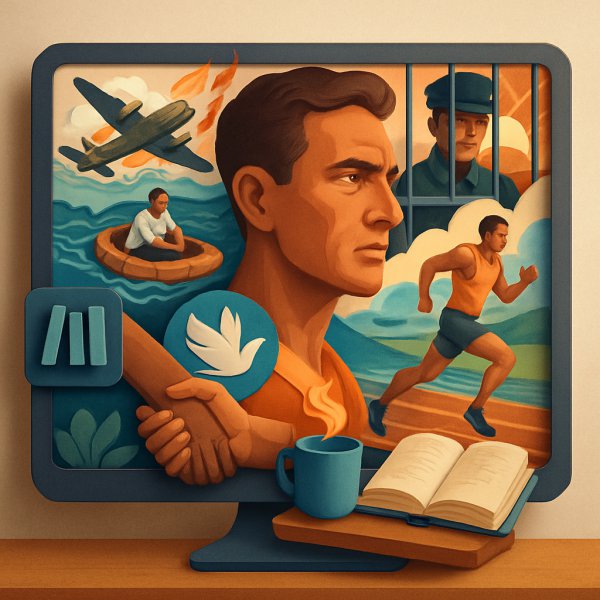
A runner who would not be broken: why Louis Zamperini still matters
Imagine sprinting so fast that your teenage troublemakers turn into fans. Imagine being tossed from the sky, clinging to a raft with strangers, watching the ocean take friends, sleeping on a sliver of hope, then being dragged into a brutal prison camp where your name is a taunt. Now imagine surviving all of that and choosing forgiveness. Louis Zamperini lived that sequence, not as myth, but as a messy, stubborn human life.
His story catches us because it is paradoxical and human-sized at the same time. It is about elite athletic discipline and low, desperate survival. It is about heroic endurance and psychological breakdown, about horrors witnessed and the radical, difficult work of forgiving people who caused them. Those contrasts make his life a powerful study in resilience, trauma, redemption, and moral courage.
You may know Louis from Laura Hillenbrand's book Unbroken or the Hollywood film that followed. But the essence that fuels lessons for us is not spectacle; it is small practices of stubbornness, a refusal to quit, and the long, uneven work of healing. This Learning Nib will trace his life, pull out practical lessons, correct common misconceptions, and give you ways to try some of his approaches in your own life.
Read on if you want a clear, human map of Zamperini's life and why he matters today. The next sections will move from his roots to his ordeal, through recovery and legacy, with short stories and concrete steps you can try right now.
From mischievous kid to record-smashing runner: early life and spark
Louis Zamperini was born to Italian immigrants in 1917 and grew up in Torrance, California. As a youth he was rambunctious and got into trouble; running started as a way to outrun consequences and bullies. What began as escape quickly became purpose. He discovered a natural talent for distance running and turned it into discipline, practicing relentlessly even as a teen.
He rose rapidly through high school and collegiate ranks, attracting attention for both speed and daring. At 19 he qualified for the 1936 Berlin Olympics, a remarkable achievement for a kid from a modest background. The early phase of his life shows an important principle: talent without channeling is raw energy, but when a clear, daily practice is added, it can produce extraordinary things.
This chapter of his life is also a reminder that many great stories begin in ordinary trouble. Zamperini’s adolescence was not polished; it was full of scrapes that later became fuel for persistence when stakes were higher.
Berlin 1936: competing on an intense world stage
At the 1936 Olympics in Berlin, Louis ran in the 5000-meter event, still a teenager among veteran athletes. The Berlin Games were politically charged, and athletes felt the weight of spectacle. For Louis, the Olympics were both achievement and a lesson in humility. He did not medal, but the experience taught him how to prepare, focus, and compete under pressure.
His Olympic moment is important because it demonstrates that reaching a pinnacle does not have to be the end of a story. For Louis, the Games were a way to sanity-check his training, a taste of international exposure, and proof that consistent effort yields opportunities. It also showed him how to perform under external pressure, a skill that later became literally life-saving.
Seen broadly, his Olympic run is a reminder: preparation gives you options later you cannot foresee.
War, a plane crash, and the 47 days adrift: the ocean as adversary
World War II interrupted many young lives. Louis enlisted in the Army Air Forces and served as a bombardier. During a rescue mission, his B-24 Liberator went down over the Pacific. The crash threw Zamperini and several crewmates into an enormous open ocean and into an ordeal of exposure, hunger, and slow despair.
For 47 days Zamperini was adrift on a tiny life raft with two other men, facing storms, sun, sharks, and the daily erosion of hope. They rationed food, caught rain where they could, and used improvisation to survive. The days bled into each other. He kept his mind working by telling stories, setting small goals, and refusing to acquiesce to the bleakness around him.
That stretch is a classic study of survival psychology. It highlights how small structures - a shared routine, a joke, a memory - can protect people against collapse. Endurance was not only about physical strength; it was about attention management and choosing mental anchors.
Prison camps and “The Bird”: enduring cruelty and psychological warfare
After rescue, Zamperini and others were captured by Japanese forces. Over the next two years he was moved through several prison camps where the treatment was harsh and sometimes sadistically personal. One camp guard, Mutsuhiro Watanabe, nicknamed "The Bird", singled out Zamperini for repeated beatings and humiliation. The abuse was not only physical; it was designed to break hope and identity.
Zamperini survived by becoming small when he had to and by preserving a stubborn internal narrative that he would outlast this. Sometimes survival meant playing dead, sometimes it meant doing what was demanded to keep breathing. The prolonged stress took a psychological toll that did not end at liberation. His story here is a blueprint for how humans adapt under cruel, prolonged pressures - through will, social bonds with fellow prisoners, and mental compartmentalization.
Homecoming and collapse: trauma after survival
Liberation in 1945 did not neatly close the book on Louis’s suffering. On returning home, he faced nightmares, anger, and alcoholism. The quiet American suburb did not match the intensity of war memories, and like many veterans he struggled to find meaning and safety. He had difficulty sustaining relationships and sank into bouts of rage.
This phase offers a crucial reality check: surviving an external threat does not erase internal wounds. Post-traumatic stress often shows up as destructive behavior, not because a person is weak, but because trauma rewires the nervous system. Zamperini’s struggles remind us that resilience is not a single event but a long process, and that help can take many forms.
Conversion, forgiveness, and the long work of healing
In 1949 Louis attended a Billy Graham crusade with his wife. His conversion to Christianity was profound. Importantly, it reoriented how he handled his trauma. He pursued forgiveness of his captors, including the notorious "Bird". He attempted to locate Watanabe in Japan, sought reconciliation, and eventually chose to let go of consuming hatred. While Watanabe never fully answered for his actions publicly, Zamperini’s choice to forgive was an ongoing spiritual practice that freed him from some of the anger that had dominated his post-war life.
Forgiveness here is not portrayed as forgetting or excusing abuse. Instead it was a deliberate, active process that allowed him to stop reliving his torment and to invest energy in family, speaking, and helping others. This stage shows that moral and spiritual frameworks can be powerful tools for post-traumatic growth.
Why his story became a cultural lens: books, film, and public memory
Laura Hillenbrand’s Unbroken brought Zamperini’s life to a broad audience in 2010. The 2014 film adaptation, directed by Angelina Jolie, presented a dramatized portrait that reached millions. These retellings distilled core elements: the athlete, the raft, the prison camps, the "Bird", the conversion, and the eventual forgiveness. They shaped how we remember him and turned his life into a public metaphor for resilience.
Cultural retellings magnify strengths but sometimes compress the messiness. They can highlight heroism while smoothing over the slow, painful work of recovery that followed. Understanding both the true grit and the messy aftermath makes his story both inspiring and instructive.
Short story: 47 days in a raft — a snapshot of improvisation
Picture this: scorching sun until it burns, nights so cold your jaw hurts, a tiny canvas raft that is a cradle for three men and a few tins of provisions. Salty wind gnaws at lips and the ocean seems to extend forever. Each morning a slim hope: maybe a ship, maybe birds, maybe land. They fashion a sail from parachute silk. They fix a crude fishing line. Louis, barely twenty-seven, becomes the group's mental anchor, telling stories from his running days to keep his companions awake and planning. At one point he swims with celestial determination to retrieve a drifting can. When a shark bumps the raft, his fear tightens like a fist, but he steadies the others. Day by day they ration, improvise, and choose to keep staring forward. That steady refusal to fold is a quiet heroism many of us can borrow: find one small, repeatable action that feels meaningful and do it again tomorrow.
Short story: a meeting at a crusade — the work of forgiveness
Imagine a packed stadium at night, voices raised in hymn and speech. Louis sits restless, a man whose mind is a battlefield of images. As the preacher speaks about forgiveness, something in Louis unclenches. He hears not a trivial platitude but a practical instruction: forgiveness is a tool to disarm internal torment. Over months he works through anger with his wife and community. He tries to find the guard who tormented him, not to demand vengeance, but to say he is no longer a prisoner of rage. Whether or not the other man responds, Louis’s action rewires his life. He begins to parent, to speak publicly, to help others. Forgiveness becomes a daily practice, not a single act.
Common myths and misconceptions about Louis Zamperini
- Myth: He was superhuman and never faltered. Reality: He faltered many times, struggled with alcoholism and rage after the war, and sought help.
- Myth: Forgiveness meant forgetting. Reality: For Zamperini, forgiveness was a deliberate moral choice that freed him from consuming anger, not a denial of harm.
- Myth: The film and book tell everything. Reality: Cultural retellings condense decades of complexity into scenes. Much of his post-war life involved slow, private work that cannot be fully dramatized.
Understanding these clarifications makes his story more instructive, because it becomes not a legend of perfection but a map of real recovery.
Timeline table: major milestones and meanings
| Year or period |
Event |
Why it matters |
| 1917-1936 |
Childhood and rise to running prominence |
Shows how discipline turned raw energy into elite performance |
| 1936 |
Berlin Olympics, 5000 m |
First major test on a global stage; lesson in preparation |
| 1943 |
B-24 crash over Pacific, 47 days adrift |
Study in survival improvisation and psychological anchors |
| 1943-1945 |
Captivity in Japanese POW camps, abuse by "The Bird" |
Harsh test of endurance and identity under cruelty |
| 1945-1949 |
Return home, PTSD and alcoholism |
Demonstrates that survival does not erase trauma |
| 1949 |
Conversion after Billy Graham crusade |
Marked turn toward forgiveness and moral healing |
| 2010s |
Unbroken book and film, public legacy |
Turned private story into global lessons on resilience |
| 2014 |
Louis dies at age 97 |
End of life but continuation of legacy through lessons shared |
Action plan: practicing Zamperini-style resilience and moral repair
This is a practical, short program inspired by Zamperini that you can try in your life. Imagine you are preparing for a personal ordeal - big or small. Here is a narrative way to approach it, with a bullet list for clarity.
Start by naming one challenge that currently bothers you - a workplace pressure, a relationship strain, or a fear. Picture the smallest repeatable action that would make each day slightly better: a 10-minute walk, a short conversation, or journaling.
- Day 1: Identify a single daily anchor. Commit to it for 30 days, no excuses.
- Day 5: Add one practical survival habit - better sleep, hydration, or a short breathing exercise.
- Day 10: Share a tiny part of your burden with a trusted person; practice saying “I need help.”
- Day 20: Introduce a moral practice - a forgiveness exercise, gratitude list, or letter-writing that you may or may not send.
- Day 30: Reflect on changes, and decide whether to keep, adapt, or replace an anchor.
Narrative: imagine you are adrift. Your anchor is a short ritual that gives your mind structure: breathe for five minutes, list three tasks, send one quick check-in to a friend. Then you build outward - add a habit that sustains your body, then connect to others, then practice reframing negative stories. Over time, this small scaffold becomes resilience.
Reflection questions to deepen learning
- Where in your life are you relying on will alone, and what small daily anchor could make that effort sustainable?
- Who in your life might you free by practicing forgiveness? What would a safe, realistic first step toward that look like?
- How do you balance honoring trauma without letting it define your entire identity?
Spend ten minutes writing answers to one of these questions to see what surfaces.
Key takeaways to remember
- Zamperini’s life shows that discipline turns raw energy into opportunity.
- Survival is both physical and mental; small daily practices matter.
- Trauma can last long after physical danger ends; recovery is a process, not a single event.
- Forgiveness can be a deliberate, active practice that frees energy for life.
- Public stories can inspire, but the real work often happens in private, slow choices.
- You do not need to be a hero to apply his lessons; you only need to start small.
Final thought to carry forward
Louis Zamperini’s life is a stubborn, human proof that people can survive extremes and still change themselves. He was not perfect; he was persistent. The useful part for us is not to imitate his heroics, but to borrow his method: find one small, repeatable action that anchors you each day, seek help when the burden is too much, and practice forgiveness not as a lightning bolt but as slow craftsmanship. Start there, and you will be surprised how far that steady hammering can go.
If you want, I can suggest a 30-day starter plan tailored to your specific challenge, or summarize Zamperini’s most practical habits into a quick daily checklist. Which would you prefer?