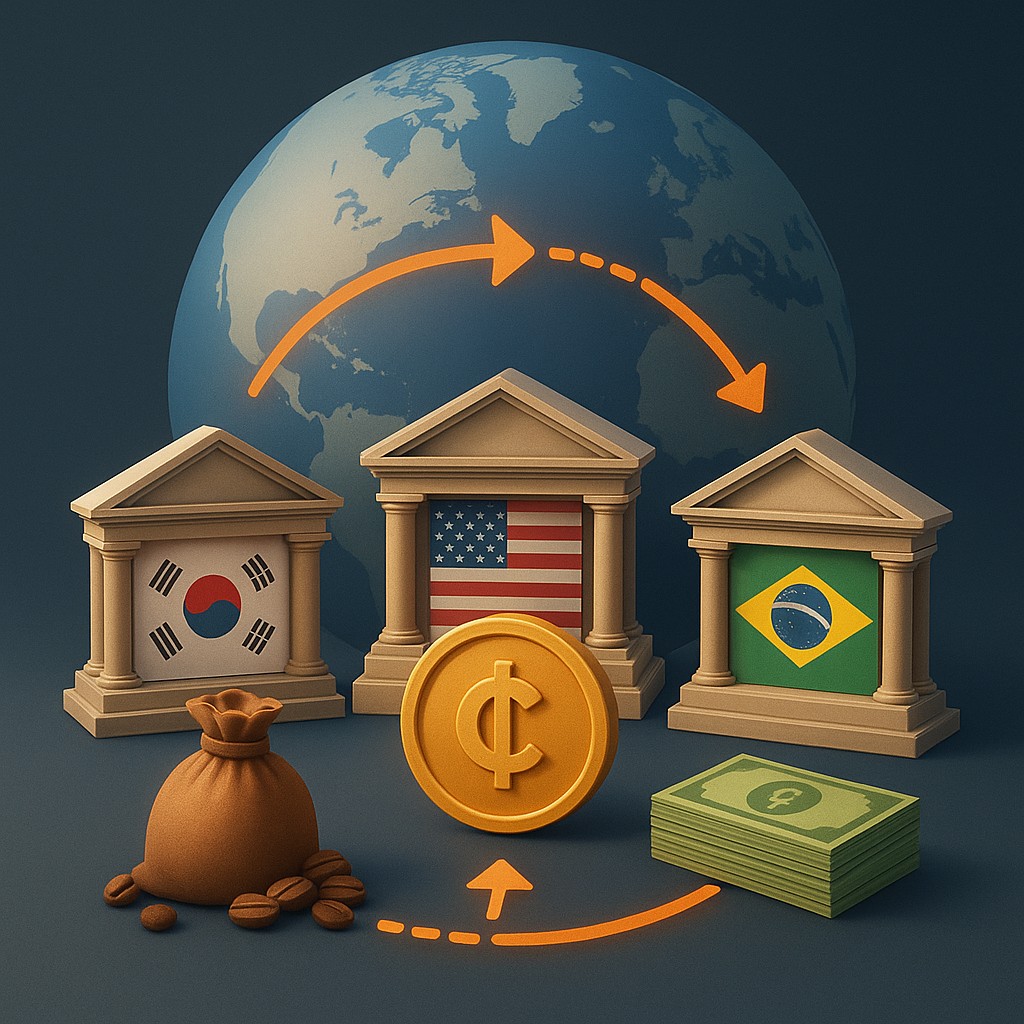
Imagine you are a coffee exporter in Brazil trying to sell a massive shipment of beans to a roaster in South Korea. On the surface, the deal is simple: you send the beans, and they send the money. In reality, that payment must survive a grueling physical and digital marathon. It starts at a local bank in Seoul, jumps to a larger regional bank, passes through a "correspondent" bank in New York to be converted into dollars, moves to a Brazilian clearing bank, and finally arrives in your account days later.
Each stop along the way requires a fee, manual verification, and a complex series of messages sent via the SWIFT network. It is a process that feels more like nineteenth-century snail mail than twenty-first-century data. This clunky setup exists because banks do not actually "send" money to one another across borders; they simply update their own private ledgers and hope the other party does the same. Because these banks do not share a single source of truth, they must rely on trust and a massive paper trail to ensure no one spends the same money twice or loses track of the decimals.
However, a quiet revolution is currently brewing inside the vaults of the world's most powerful financial institutions. Central banks are moving beyond the hype of volatile cryptocurrencies to build something much more stable and transformative: Wholesale Central Bank Digital Currencies (wCBDCs). This is not about buying a latte with Bitcoin; it is about ripping out the aging pipes of the global economy and replacing them with high-speed, programmable fiber optics.
The Ghost in the Machine of Global Finance
To understand why central banks are so eager to go digital, we first have to look at the "correspondent banking" system that haunts our current economy. Right now, if Bank A in London wants to pay Bank B in Tokyo, they usually cannot do it directly. Instead, they rely on a chain of middlemen who hold accounts for each other.
This is essentially a giant game of telephone played with billions of dollars. Each bank in the chain has its own database, its own compliance team, and its own time zone. When a payment is "in flight," it is effectively in limbo. This creates "settlement risk," the terrifying possibility that one bank in the chain might go bankrupt while the money is halfway across the ocean.
Wholesale digital currencies eliminate this ghost by creating a "Unified Ledger." Think of it as a shared Google Doc for money that every central bank can see and edit at the same time. Instead of five different banks keeping five different books, there is one authoritative record. When the South Korean roaster pays the Brazilian farmer, the digital currency moves from one "wallet" to another instantly. There is no need for a three-day waiting period to balance the books because the record is updated for everyone at the exact same moment. This concept, known as "Atomic Settlement," means the transfer of the goods and the payment happen simultaneously or not at all, ensuring no one is left empty-handed.
Distinguishing the Layers of Digital Cash
It is easy to get confused by the term "digital currency" because we use it to describe everything from gift cards to speculative "meme-coins." In the world of central banking, there is a hard line between "retail" and "wholesale" digital money.
Retail CBDC is what most people imagine: a government-issued app on your phone that lets you buy groceries without a private bank account. It is a direct claim on the central bank by a citizen. While it sounds futuristic, it is actually quite controversial because it could potentially put commercial banks out of business by draining their deposits.
Wholesale CBDC, on the other hand, is the "industrial-strength" version. It is restricted to licensed financial institutions like commercial banks and clearing houses. It is used for the big moves: interbank transfers, government debt markets, and massive international trade deals. While Retail CBDC focuses on reaching the public, Wholesale CBDC focuses on the "plumbing" of the world. It is the invisible force that makes the gears of capitalism turn faster and more efficiently, reducing the friction that currently costs the global economy billions of dollars in lost time.
| Feature |
Retail CBDC |
Wholesale CBDC |
| Primary Users |
General public and small businesses |
Commercial banks and financial institutions |
| Transaction Scale |
Small (coffee, rent, clothes) |
Massive (foreign exchange, bonds, trade) |
| Key Goal |
Financial inclusion and payment choice |
Efficiency, speed, and reduced risk |
| Access Control |
Open to all citizens |
Heavily restricted and authorized |
| Infrastructure |
High-volume consumer apps |
Shared ledgers and specialized gateways |
Programming Money to Follow the Rules
One of the most exciting aspects of wholesale digital currencies is "programmability." Current money is "dumb." A dollar bill or a standard bank wire doesn't know what it is being used for; it is just a value. A wCBDC, however, can be "smart." Because it lives on a blockchain or a similar shared record, it can be wrapped in a piece of code called a "smart contract."
This allows money to have conditions attached to it. For example, a payment for a shipment of lithium could be programmed to release to the seller only after the shipping company scans a digital receipt at the port. This eliminates the need for "escrow" services or "letters of credit," which are currently the backbone of international trade but are slow and expensive to arrange. By making money programmable, central banks are turning currency into a "digital robot" that performs tasks automatically. This automation reduces human error and ensures that the rules of the financial system are built directly into the currency itself, rather than being enforced by mountains of paperwork.
The Architecture of Trust in a Tokenized World
Building a global digital currency system is as much a diplomatic challenge as a technical one. For decades, the U.S. Dollar has been the primary language of trade because the pipes of the financial world are built around American systems. Projects like "mBridge," a collaboration between several central banks and the Bank for International Settlements (BIS), are testing how different nations can share a single platform without giving up their independence.
This architecture uses "tokenization," where a digital token represents a real-world asset or a specific amount of national currency. These tokens can be swapped instantly. If the Bank of Thailand wants to swap Baht for Dirhams from the UAE, they don't need to find a bank in London to act as a middleman. They simply trade tokens on the mBridge ledger. This bypasses the traditional "hub-and-spoke" model where everything must flow through a few major global cities. It creates a more resilient network where a technical failure in one country doesn't paralyze the entire global trade system.
Balancing Privacy and Modernization
As with any major technological shift, there are significant hurdles to overcome, mainly regarding privacy and security. In a wholesale environment, banks are protective of their trade secrets. If every transaction is on a shared ledger, could a rival bank see exactly how much cash a competitor has on hand?
To solve this, central banks are experimenting with "Zero-Knowledge Proofs." This is a cryptographic method that allows a system to verify a transaction is valid without revealing the private details of who sent what to whom. It is like proving you are old enough to enter a club by showing a green light on a machine, rather than handing over your entire ID card.
Furthermore, there is the question of "interoperability." If every country builds its digital currency on different software, we might just end up with a high-tech version of the same mess we have today. The goal is to create standards that allow a "Digital Euro" to talk to a "Digital Yen" as seamlessly as two different email providers can exchange messages.
The transition to wholesale digital currencies represents the largest upgrade to the financial world since the invention of modern accounting in the Middle Ages. We are moving from a world of slow moves and manual checks to one of instant results and automated trust. While the average person may never see a wholesale CBDC in their wallet, they will feel its effects through cheaper goods, faster services, and a global economy that finally moves at the speed of the internet.