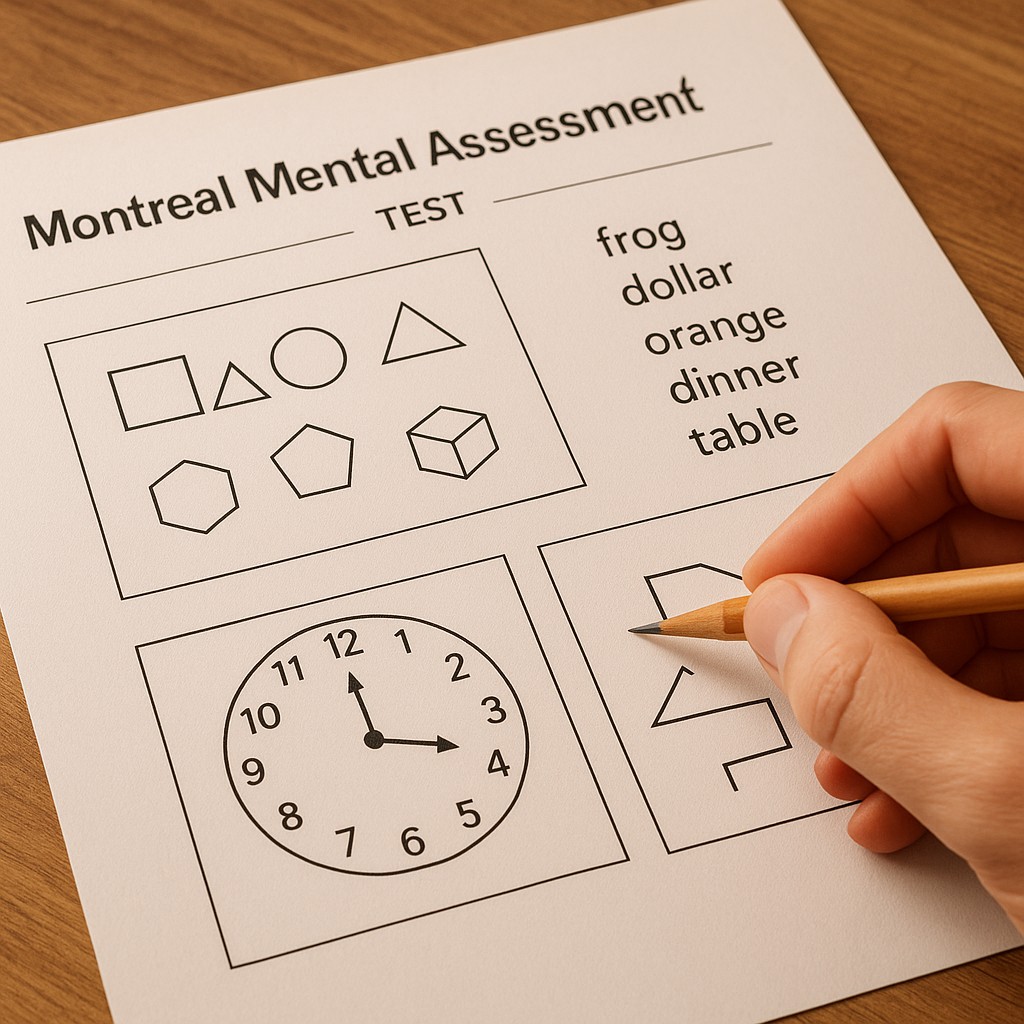
Imagine you are sitting in a quiet room. Someone hands you a single sheet of paper covered in puzzles. You are asked to draw shapes, remember a list of words, and sketch hands onto a clock face. To most people, it looks like a simple worksheet for a primary school student. But to a neurologist or a specialist in aging, this paper is a high-tech radar screen.
This is the Montreal Cognitive Assessment, or MoCA. It has become the gold standard for peeking into the complex inner workings of the human mind. The test is designed to catch the brain's subtle "check engine" lights before they turn into a total mechanical breakdown.
The beauty of the MoCA lies in its brevity and its bluntness. While it only takes about ten to twelve minutes to finish, it pokes and prods almost every major neighborhood of your gray matter. In an era where we are living longer than ever, understanding how our brains age is no longer just for doctors. It is essential knowledge for anyone who wants to protect their most valuable asset. Whether you are curious about your own mental sharpness or helping a loved one navigate their later years, the MoCA offers a window into how we reason, remember, and move through the world.
The Birth of a Modern Mental Yardstick
The MoCA’s story began in 1996 with Dr. Ziad Nasreddine in Montreal, Canada. At the time, doctors relied on an older test called the Mini-Mental State Examination (MMSE). While the MMSE was a respected pioneer, it had a glaring flaw: it was a bit too easy. It was great at spotting advanced dementia, but it often missed the "Mild Cognitive Impairment" (MCI) stage, where the brain is just beginning to stumble. Dr. Nasreddine realized that to help people earlier, we needed a test that was more sensitive, more challenging, and more thorough.
The MoCA was designed as a "stress test" for the brain. If the older MMSE is a casual stroll through the park, the MoCA is a brisk hike up a steep hill. It was specifically tuned to detect those first flickers of decline that might be overlooked in a normal conversation. By adding tasks that require problem-solving, abstract reasoning, and complex visual skills, Dr. Nasreddine created a tool that could distinguish between normal aging and the early warning signs of conditions like Alzheimer’s or Parkinson’s disease.
Today, the MoCA is used in over 200 countries and is available in nearly 100 languages. It gained unexpected fame in pop culture a few years ago when it was mentioned in political circles, leading many to wonder what actually happens during those twelve minutes. It is not an IQ test or a personality quiz. It is a snapshot of your brain’s current health, designed to provide a baseline for future comparisons and a roadmap for medical care.
Navigating the Eight Pillars of the Brain
To understand the MoCA, you have to understand the different regions of the brain it targets. The test is divided into several domains, each acting like a different department in a large company. If the "Memory Department" is struggling, the "Executive Function Department" might be able to pick up the slack for a while, but eventually, the cracks will show. The MoCA systematically audits these departments to see where the workflow is breaking down.
The first major section focuses on Visuospatial and Executive functions. You might be asked to "Make a Trail," which involves drawing a line to connect alternating numbers and letters (1 to A, 2 to B, and so on). This sounds simple, but it requires your brain to hold two different sequences in mind at the same time while switching between them. It tests the prefrontal cortex, the part of the brain responsible for planning and decision-making. If you find yourself drawing a line from 2 to 3 instead of 2 to B, it suggests a slight "glitch" in the brain's switching mechanism.
Another famous task is the clock-drawing test. You are asked to draw a clock, put in all the numbers, and set the hands to a specific time, usually ten past eleven. This task is a powerhouse of cognitive demand. You need the motor skills to draw circles, the spatial awareness to space the numbers evenly, and the abstract reasoning to understand that "ten past" means the hand points to the number 2, not the number 10. It is a deceptively difficult task that reveals how a person perceives and organizes spatial information.
Deciphering the Grading and the Results
A common question people ask is: "What counts as a passing grade?" The MoCA is scored out of 30 points. Generally, a score of 26 or above is considered "normal." However, it is important to remember that these numbers are not absolute grades like you would get on a math test. They are data points in a much larger context. A person's education level, cultural background, and even their stress levels on the day of the test can change the result.
To account for education, the test gives a "bonus point" to individuals with 12 years or less of formal schooling. This is a vital adjustment because the MoCA assumes a certain level of literacy and comfort with testing. Without this, the test might accidentally label someone as "impaired" simply because they didn't have the same educational opportunities as others. This nuance makes the MoCA a reliable clinical tool rather than a rigid, one-size-fits-all metric.
| Cognitive Domain |
Sample Task |
What it Measures |
| Visuospatial |
Clock Drawing |
Spatial layout, planning, and coordination |
| Executive Function |
Alternating Trail Making |
Mental flexibility and task switching |
| Naming |
Identifying rare animals |
Vocabulary and word memory |
| Attention |
Repeating a string of digits |
Concentration and short-term "holding" |
| Language |
Sentence repetition |
Grammar and verbal processing |
| Abstraction |
Finding similarities (e.g., fruit) |
Categorization and conceptual thinking |
| Delayed Recall |
Remembering words later |
Long-term memory storage and retrieval |
| Orientation |
Stating the date and location |
Awareness of time and place |
The Art of Naming and the Power of Attention
Further down the page, the MoCA challenges your Naming abilities. Usually, this involves looking at sketches of three animals. You might see a lion, which is easy, but you might also see a rhinoceros or a camel. This isn't just a vision test; it is a test of "lexical retrieval." Your brain has to see the image, identify what it is, and then find the specific word for it in your internal dictionary. In early cognitive decline, people often know what the animal is but find the word "stuck" on the tip of their tongue.
The Attention section follows, which feels like a mental workout. You might be asked to listen to a list of numbers and repeat them forward, or even backward. This tests your "working memory," which is like the RAM in a computer. It is the temporary storage space where you hold information while you are using it. If your attention is flagging, you won't be able to hold those numbers in place long enough to manipulate them.
Following this, the test moves into Language and Abstraction. You might be asked to repeat two sentences exactly as they are spoken, or to name as many words as you can that start with the letter "F" in one minute. This "verbal fluency" task is particularly revealing. A healthy brain can usually generate 11 or more words easily. If the brain is struggling, it might get stuck on one category (like naming only fruits) or find it difficult to jump from one word to the next. The abstraction portion asks you to name the similarity between two objects, such as an orange and a banana. If you say they are both "fruit," you get the point. If you say "you eat them," you have missed the higher-level conceptual link.
The Memory Trap and the Final Reveal
Perhaps the most famous part of the MoCA is the delayed recall. Early in the test, the administrator reads a list of five words (such as "velvet, daisy, church, red, face") and asks you to remember them. They read them twice, but they don't ask for them again until the very end. This section is arguably the most sensitive part of the test for detecting Alzheimer's disease.
This is effective because it bypasses short-term memory and tests the brain's ability to "save" information into long-term storage. Many people can repeat the words immediately, but ten minutes later, those words have evaporated. If a person cannot remember the words on their own, the administrator may provide "cues." For example, if the word was "daisy," the cue might be "it's a type of flower." If the person remembers it then, it shows the information is there, but the "retrieval system" is struggling. If they still can't remember with a hint, it suggests the brain failed to store the information in the first place.
Finally, the test closes with Orientation. You are asked for the exact date, month, year, day of the week, and the city you are in. While this seems trivial, disorientation is a hallmark of more advanced cognitive issues. Being "off" by a day isn't usually a cause for alarm, but being off by a year or a month is a significant clinical marker.
Moving Beyond the Myth of the Failing Grade
It is vital to clear up a common misconception: failing a MoCA does not mean you have dementia. There are many reasons someone might perform poorly that have nothing to do with permanent brain damage. Sleep deprivation, extreme stress, certain medications, or even a vitamin B12 deficiency can cause your score to plummet. Dehydration or a simple urinary tract infection in older adults can also cause temporary "brain fog" that mimics more serious conditions.
Think of the MoCA like a smoke detector. If the alarm goes off, it doesn't always mean the house is on fire; sometimes you just burnt the toast. However, the alarm tells you that you need to go to the kitchen and check. A low score is an invitation for more investigation. It might lead to blood tests, an MRI, or a more intensive three-hour evaluation. The MoCA is the beginning of a conversation, not the final word on a person’s mental capacity.
Another myth is that you can "study" for the MoCA. While there are versions available online, practicing them defeats the purpose. If you memorize the words or the clock time, you are creating a "false positive" of health. This is dangerous because it can hide a real problem that could be treated if caught early. The goal isn't to get a 30 out of 30; it is to get an honest assessment so you can live your best possible life.
Embracing Cognitive Health with Confidence
The MoCA might seem intimidating, but it is one of the most empowering tools in modern medicine. By identifying cognitive shifts early, we unlock a world of possibilities for intervention. From lifestyle changes like diet and exercise to newer medications that can slow the progress of certain diseases, early detection is the key to staying independent. The test is a partner in your health journey, providing a clear-eyed look at how your brain is handling the passage of time.
As we move into an era where brain health is prioritized just as much as heart health, the MoCA will continue to play a starring role. It reminds us that our minds are dynamic systems that deserve care, attention, and regular check-ups. So, the next time you hear about this humble one-page test, remember it is more than just a series of puzzles. It is a testament to our ability to map the human mind, helping us navigate our golden years with clarity, support, and grace.