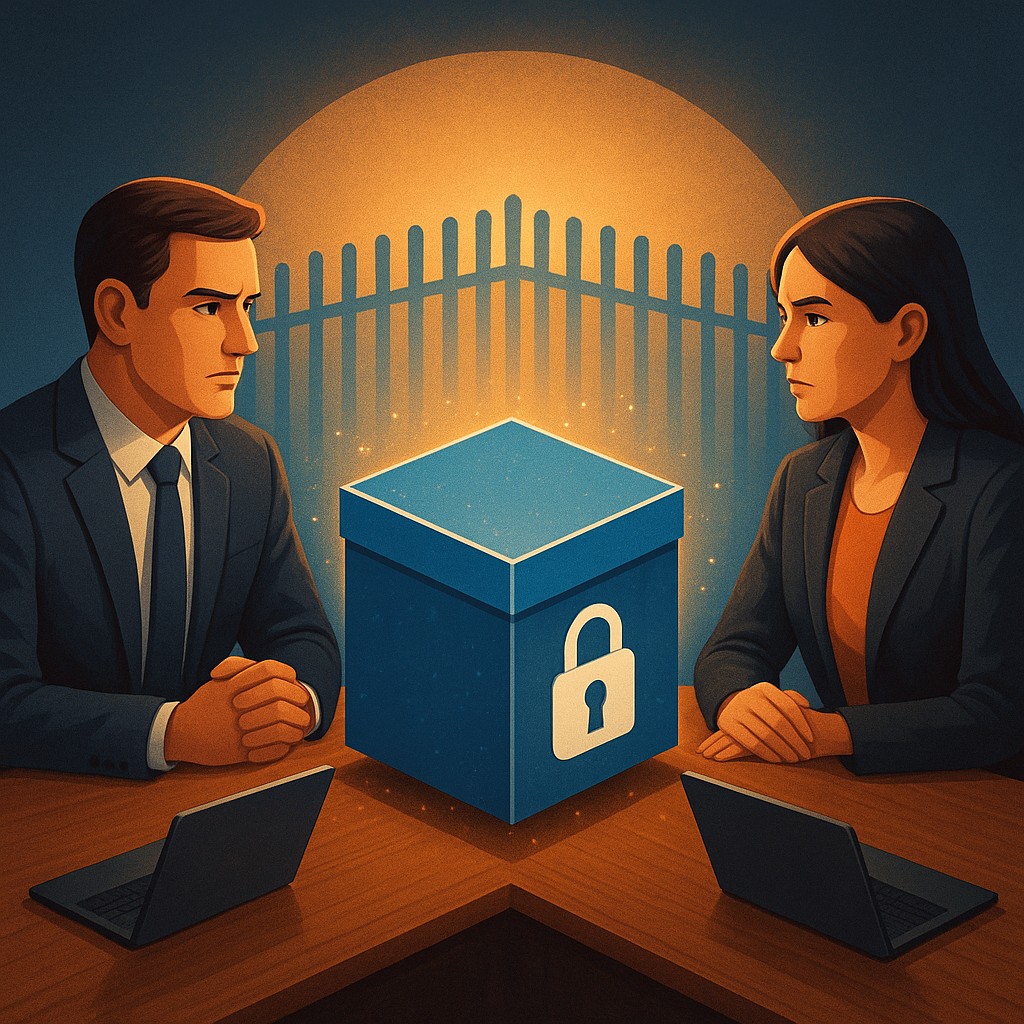
Imagine a high-stakes meeting between two corporate giants. On paper, they should be the best of partners, but in reality, they act like wary neighbors separated by a ten-foot privacy fence. One is a massive online retailer sitting on a mountain of shopping data; the other is a global beverage brand with a huge marketing budget. The drink company wants to know if the people who saw their flashy summer ads actually bought a soda from the retailer. To find out, they need to compare their customer lists, but they face a major roadblock. If the retailer hands over its list, it violates the privacy of millions of people. If the beverage brand shares its data, it gives away the "secret sauce" of its loyal customer base.
In the early days of the internet, they might have just swapped spreadsheets and hoped for the best. In today’s world of strict privacy laws and tech-savvy consumers, however, that is a recipe for a legal and PR disaster.
This is where the "data clean room" comes in, acting as a sort of digital Switzerland. It is a secure, neutral space where two or more parties can bring their data, lock the doors, and run complex math problems without ever actually showing their files to one another. It is the ultimate "trust but verify" system, powered by advanced encryption and strict software rules. Instead of sharing raw details, like "John Doe from Seattle bought a lime soda," the system only reveals the big picture, such as "35 percent of people who saw your ad bought a drink." This allows companies to study human behavior while ensuring that John Doe remains a nameless, private individual. It is a fundamental shift in how we handle information, proving that we do not have to sacrifice privacy to get useful results.
The Blueprint of a Digital Vault
To understand how a data clean room works, it helps to stop thinking of data as a static file and start thinking of it as a set of ingredients in a high-tech kitchen. In a traditional hand-off, you would give me your ingredients and I would cook the meal. In a clean room, neither of us touches the other's supplies. Instead, we both put our data into a "black box" controlled by a neutral third party or an automated system.
The clean room is built with strict boundaries called "egress controls," which are rules that dictate exactly what kind of information can leave the room. You might be allowed to ask, "How many people in this group are over thirty?" but the system will flatly reject a request like, "Give me the email addresses of everyone over thirty."
The magic behind this is often a technique called Secure Multi-Party Computation (MPC). Think of MPC as a way for a group of colleagues to calculate their average salary without any single person revealing their actual paycheck. Each person provides a piece of the puzzle that is scrambled by math. When the pieces are combined, the correct average emerges, but the individual numbers stay hidden. This is why clean rooms are so revolutionary. They allow for a shared version of the truth. The data never actually moves into a shared database where it could be leaked or stolen; it stays encrypted and separated while the math happens across protected layers.
Beyond simple calculations, modern clean rooms use a Trusted Execution Environment (TEE). This is a secure area of a computer processor that is isolated from the rest of the system. Even the person who owns the computer cannot peek at what is happening inside the TEE while the data is being processed. It is like a secure lab inside a skyscraper where even the building owner doesn't have a key. This hardware-level security, combined with smart software, ensures the data is protected not just from the partners involved, but from hackers and even the cloud service providers themselves.
Finding the Balance Between Privacy and Usefulness
Not all clean rooms are built the same. The "cleanliness" of the room depends on the technology used and the rules set by the participants. At one end of the scale, you have "walled gardens" run by tech giants like Google or Amazon. These companies let advertisers upload data to see how it matches the giant's own user base. While powerful, the tech giant usually sets all the rules. At the other end are independent, decentralized clean rooms that use complex math to ensure no single party holds all the power. Choosing the right version depends on how much you trust your partner and how much precision you need.
| Feature |
Walled Garden Clean Room |
Independent/Decentralized Clean Room |
| Data Control |
Managed by the platform owner |
Shared by all participants |
| Flexibility |
Limited to the platform's own tools |
Works across different platforms |
| Privacy Tech |
Uses internal, secret coding |
Uses MPC, Differential Privacy, or TEEs |
| Main Use Case |
Measuring ads on a specific site |
Complex partnerships and deep research |
Another vital tool is Differential Privacy. This is a mathematical trick that adds a small amount of "noise," or random statistical interference, to the data. Imagine looking at a photo made of millions of tiny dots. If you remove one dot, the picture doesn't really change; you can still tell it’s a forest. Differential Privacy ensures that the results of a query stay essentially the same whether or not any single person's data is included. This makes it mathematically impossible for a bad actor to work backward and figure out if a specific person was in the group. It provides a guarantee of anonymity that simply removing names - a process called "anonymization" - cannot match.
Debunking Clean Room Myths
One common mistake is thinking that data clean rooms are a perfect "silver bullet" for identity. Many people assume that because names and emails are hidden, the data is totally anonymous and cannot be misused. However, privacy is a sliding scale, not an on-off switch. Even in a clean room, if a company creates a group that is too small, such as "left-handed golfers in one specific neighborhood who bought a certain watch," there is a risk of "re-identification." If only one person fits that description, their privacy is gone. Responsible operators set "minimum group size" rules to prevent this, ensuring no insight is ever tied to a group smaller than, say, 50 or 100 people.
Another myth is that clean rooms are only for marketing. While that is where the most money is currently spent, the uses are much broader. In healthcare, two competing hospitals could use a clean room to compare how patients respond to a new treatment without sharing sensitive medical records. In finance, different banks could use one to spot money laundering patterns by looking for suspicious activity across their combined networks without revealing private client lists. The clean room turns data from a liability that must be guarded into an asset that can be safely explored.
Finally, some critics argue that clean rooms are just a way to bypass privacy laws like GDPR or CCPA. In reality, they embrace the spirit of those laws. The goal of privacy regulation isn't to stop the world from using data, but to stop it from exploiting individuals. By shifting the focus from "Who is this person?" to "What can we learn from this group?", clean rooms align business goals with human rights. They replace the "Wild West" era of data scraping with a structured, proven framework for working together.
The Future of Shared Intelligence
As we move toward a world without "cookies" and traditional tracking, clean rooms will likely become the backbone of the digital economy. We are moving away from a model where data is owned in a vacuum and toward a model of "federated" insights. In this future, your data stays on your device or in your private cloud, and only the "answers" to specific, authorized questions ever leave.
The most exciting part of this shift is how it opens up high-level analysis to everyone. Previously, only the biggest companies with massive data teams could perform this kind of secure computation. Now, as clean room technology becomes a standard feature of cloud services, even small businesses and non-profits can join in. They can team up to solve problems and improve their services without ever putting a single person's privacy at risk.
The true power of the data clean room is that it encourages a new kind of curiosity. When we remove the fear of data leaks and the ethical burden of handling sensitive info, we are free to ask more interesting questions. We can look for the "why" behind human behavior across different industries. This technology proves we do not have to choose between a world of constant surveillance and a world of total ignorance. We can choose a middle path where information is shared responsibly and progress is fueled by collective knowledge rather than individual exposure.