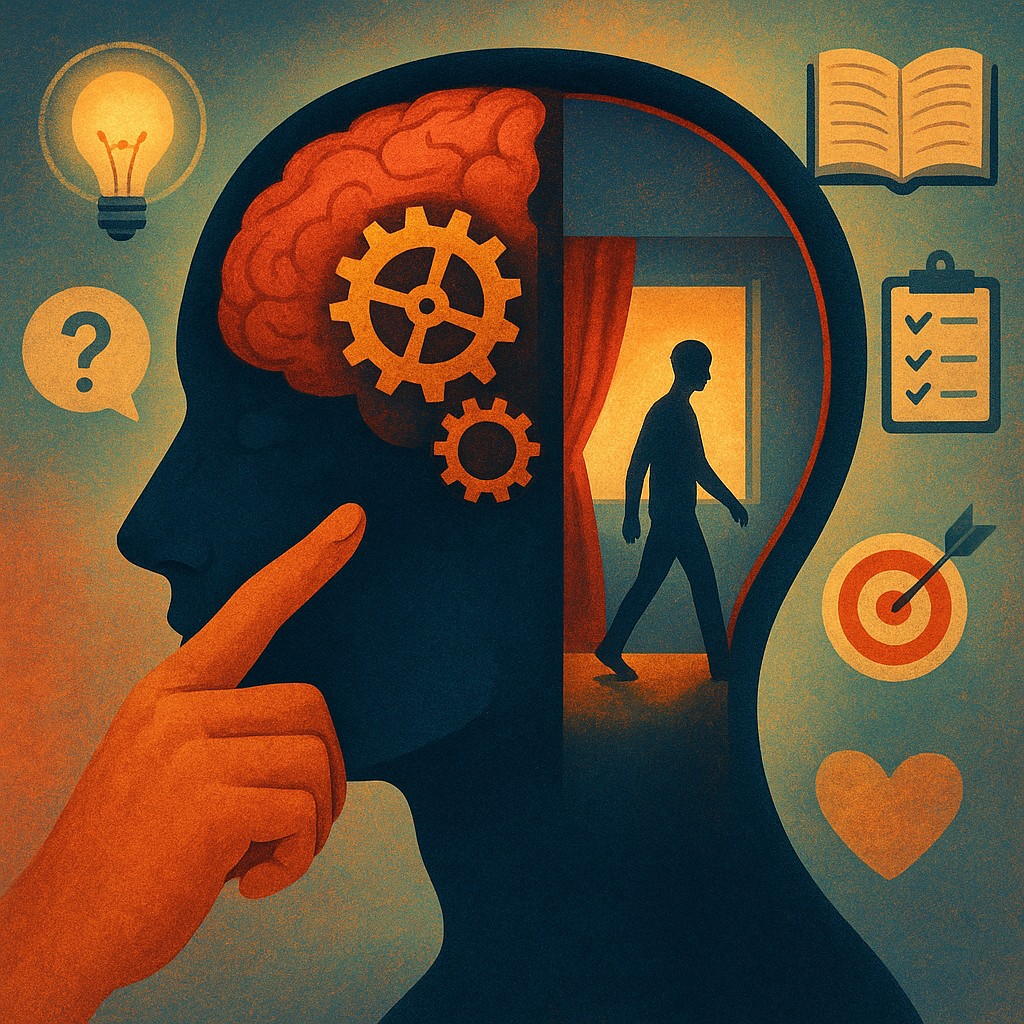
The relationship we have with our own minds is often like a marriage between two people who speak different languages. We tend to think of ourselves as the pilot of a high-tech biological aircraft, assuming our conscious thoughts are the ones pulling the levers and pressing the buttons. However, it turns out that most of the heavy lifting happens in the cargo hold, far away from the cockpit. Our brains are essentially prediction machines. They constantly scan our surroundings to guess what will happen next, preparing our bodies to react before we even realize there is a problem to solve.
Understanding how your own psychology works is more than just an academic exercise; it is the ultimate "user manual" for being human. When you pull back the curtain on how habits, emotions, and social triggers actually function, you stop being a victim of your impulses and start becoming the architect of your behavior. By looking closely at the biological and mental patterns that govern our lives, we can decode the invisible scripts that dictate everything from why we grab a snack when we are stressed to why we feel a sudden rush of anxiety in a crowded room.
The Invisible Script of Environmental Priming
One of the most startling discoveries in modern psychology is how much our physical surroundings dictate our choices without us ever noticing. We like to believe we choose our lunch based on hunger or our clothes based on personal style, but we are actually being "primed" by subtle cues at every turn. If you walk into a room that smells like freshly baked cookies, you are statistically more likely to be kind to a stranger. If you sit in a hard, uncomfortable wooden chair during a negotiation, you are more likely to take a rigid, uncompromising stance on the deal.
Our brains are always looking for shortcuts, and the easiest one is simply to react to what is right in front of us. This is why "friction" is the most powerful force in building habits. If your phone is sitting next to your bed, your brain views checking notifications as the path of least resistance. If the phone is in another room, the mental effort of getting up creates a barrier that allows your conscious mind to step in and say, "Actually, let's keep sleeping." By intentionally designing our spaces, we can stop relying on willpower, which is a limited resource, and start letting our environment nudge us toward the person we want to be.
Decoding the Language of Your Internal Alarm System
We often label emotions like fear, anger, or sadness as "bad," while seeing joy and excitement as "good." In reality, the brain does not see emotions as moral judgments; it sees them as data points. Anxiety is not a character flaw; it is a high-functioning alarm system that thinks it is protecting you from a predator, even if that "predator" is just an unread email from your boss. When we try to suppress these feelings, we are essentially trying to cut the wires to a smoke detector while the kitchen is on fire.
The key to emotional intelligence is learning to translate these physical signals into useful information. When your heart starts racing during a presentation, your brain is flooding your system with adrenaline to help you perform. If you call that sensation "anxiety," your performance will likely suffer. However, if you call it "excitement" or "readiness," you can channel that energy into your delivery. This process, known as cognitive reappraisal, allows us to change our internal story without needing to change the situation itself.
The Feedback Loop of Small Wins and Dopamine
Modern life is often a battle for our dopamine, the chemical in the brain responsible for motivation and reward. Many of us fall into the trap of "cheap dopamine," which involves scrolling through social media or playing video games that provide instant, effortless hits of pleasure. The problem is that these spikes are often followed by crashes, leaving us feeling more drained than when we started. To build a satisfying life, we have to learn how to trigger "expensive dopamine," which is the long-lasting satisfaction that comes from effort and achievement.
The brain is wired to repeat behaviors that result in a win, no matter how small. This is why common advice like "make your bed" or "write one sentence" actually works. By completing a tiny task, you signal to your brain that you are someone who gets things done. This creates a positive feedback loop. Instead of waiting for a massive burst of motivation to start a big project, you can create a series of micro-tasks that keep the dopamine flowing at a steady, sustainable rate.
| Psychological Concept |
How It Works in the Brain |
Real-World Application |
| Priming |
Subtle cues trigger subconscious associations that influence behavior. |
Keep your gym shoes by the door to make it easier to go for a run. |
| Cognitive Reappraisal |
Changing the "label" we give to a physical feeling or situation. |
Reframe "nervousness" as "excitement" before a big meeting. |
| Dopamine Looping |
Chemicals reward the completion of tasks and goals. |
Break large goals into tiny "micro-wins" to stay motivated. |
| Loss Aversion |
The brain feels the pain of losing twice as much as the joy of winning. |
Focus on what you will lose if you don't change to create a sense of urgency. |
The Social Mirror and Peer Influence
Humans are naturally tribal creatures, and our brains are specialized to track our standing within a group. This is why the fear of public speaking often ranks higher than the fear of death; in our ancient past, being rejected by the tribe meant certain death. Today, this shows up as a deep need for social approval and a tendency to mimic the people around us. If everyone in your social circle spends their weekends complaining about work, you will likely find yourself doing the same, regardless of how much you actually like your job.
To master your own psychology, you must become highly aware of your "social proximity." We tend to adopt the habits, attitudes, and even the financial goals of the five people we spend the most time with. This isn't just about peer pressure; it is about "mirror neurons," brain cells that naturally sync our behavior with our surroundings. If you want to be more disciplined, spend time with people who value discipline. If you want to be more creative, find a community of artists. You don't have to change your entire life overnight, but changing who you listen to can shift your internal compass more effectively than any self-help book.
Navigating the Trap of Loss Aversion
Our brains are not naturally designed to make us happy; they are designed to keep us alive. Because of this, we are hard-wired with "loss aversion." Research shows that the mental pain of losing a hundred dollars is twice as intense as the joy of gaining a hundred dollars. This evolutionary quirk keeps us stuck in bad jobs, stale relationships, and unhelpful habits because the risk of trying something new feels like a loss we aren't willing to handle.
Overcoming this requires a conscious shift in how we look at our choices. Instead of asking, "What might I lose if I try this?" we need to ask, "What am I losing right now by staying the same?" When we view "staying the same" as a loss of time, health, or potential, our brain's loss-aversion mechanism actually works in our favor. It pushes us toward growth because the cost of standing still suddenly feels higher than the cost of failure. Learning to flip this switch is one of the most powerful tools you can have.
Building the Foundation for Lasting Change
The journey of understanding your mind is not about being perfect, but about developing "metacognition," or the ability to think about your own thinking. When you realize that your moods are often just biological weather patterns and your habits are just neurological grooves, it becomes much easier to handle the ups and downs of life. You stop blaming yourself for being human and start using that human nature to your advantage. Every day is a fresh opportunity to experiment with these ideas and see what works for your unique brain.
As you move forward, remember that the goal is not to control every single thought, but to become a better observer of them. By recognizing the patterns of priming, the power of dopamine loops, and the influence of your social circle, you can start to lead your life with more intention. You have the ability to rewrite the scripts that haven't been helping you. Take heart in the fact that your brain is remarkably "plastic," meaning it is never too late to create new pathways and become the version of yourself you have always wanted to be. The tools are now in your hands; it is simply a matter of putting them to work.