Swashbuckling & Pirates
A Brass Compass, a Coded Beacon, and the Harbor's Reckoning
September 20, 2025
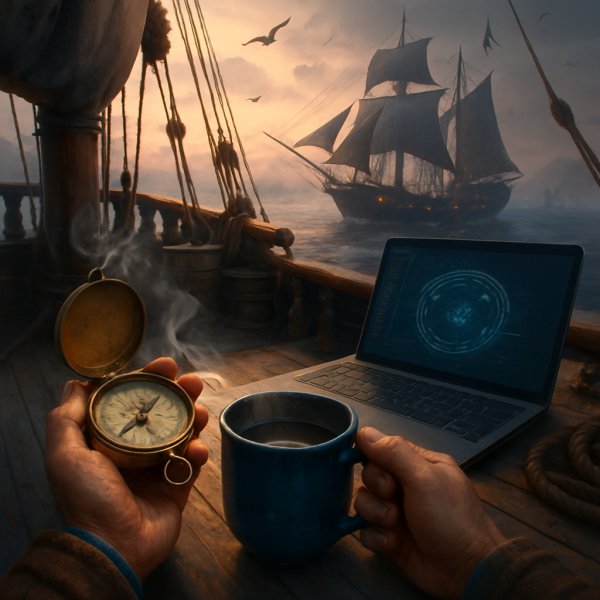
The coffee in Hubert's hand steamed like a small blue harbor against the cold wind off the Saint Lawrence. He thumbed the chipped brass compass in his palm until the brass warmed, an old habit he had kept since his grandmother pressed it into his fist and said, Keep your bearings, wherever you go. On the deck of the festival ship L'Esprit, laptop open to his prototype beacon, Hubert felt two kinds of tide - one of code that hummed in his head, and one of gulls and rope and varnish underfoot.
Then someone shouted from the mouth of the river and the air changed. Black canvas swallowed the horizon, sails cutting the dawn like knives. Lanterns winked along a hull varnished so dark it drank in light. The smell of tar and salt hit the quay, thicker than the coffee. Men and women in weathered coats and mismatched boots swung aboard with the practiced violence of a tide. Steel flashed. A voice like gravel and coal called out demands.
Pirates, here, now, in the little festival tucked behind Quebec's old stone walls. Why them? Why here?
Hubert closed his laptop and felt the compass like an answer that wouldn't speak. He liked people - he made friends while lining up for porters, he patched a teacher's laptop with a grin and a borrowed screwdriver. So he stepped forward the way you step toward someone with a hurt dog. "We can talk," he said, voice steady. It was both permission and question.
The pirate who answered was broad-shouldered, coral-handled knife at his belt. He rubbed a thumb over a silver coin as if counting its ghosts - a small habit Hubert watched and catalogued. "Talk to the captain," he said, and waved them toward the aft. She waited there, half in shadow and half in sun, a dark coat cinched at the waist. Captain Sable had salt in her braid and a grin that never warmed to a joke. Her visible goal was simple: take the beacon and get out. Her hidden fear, Hubert guessed as he met her gray eyes - losing the respect that kept her crew from turning on her.
"You are not as I expected," she said, stepping forward. Her lip curled when she saw the compass. "Young, clean. Why would you make such a thing?"
Hubert's hands were small, quick. He explained in short pieces - a beacon to guide small craft, a secure signal to open the harbour for community boats in fog. He said the words people wanted to hear: safety, aid, keeping children from drifting into trouble. His explanation was an appeal: useful things could be used for good. He added nothing about the hidden algorithm that could, in the wrong hands, lock shipping routes the way a vampire shutters windows.
"We need it for a map," Captain Sable said, and smiled without humor. "A map with locks only the maker can open. Bring it."
When they drug the case open and the beacon lay between them like a second heart, Hubert's palms cooled. He could refuse. He could run. But Marcel, the old fisherman who had given him the job of testing the device that morning, stood with a rope around his wrist. A young volunteer, Eva, clung to the rail. Hubert heard small voices behind him - the festival, the town, the people who had trusted him. His hidden fear - of causing harm if his tools fell into the wrong hands - tightened like a knot.
He asked, instead of refusing, if he could finish one last calibration aboard their ship. It was a gambit, practiced in his head the way one gently explains a bug to a coworker. Captain Sable's eyes flicked to the coin under her thumb and then to the eager faces on the quay. She permitted it, because a man who makes things can make things faster than one who steals them later. What she could not know was that Hubert's code carried a small kindness he had hidden for just this kind of tide.
They took him below, where the wood smelled of old stories and spilled rum. A young crewmate, who said his name was Finn, sat close and snatched at his explanations like a child at a puzzle. Finn's habit was to twist the laces of his boots when nervous. Huberts' likability did what it always did: it opened Finn. Finn's visible goal was to be someplace with a horizon that wasn't shrinking. His hidden fear, Hubert realized, was that he was already a prisoner of the sea and the life it had scraped him into.
Hubert set his laptop on the table and the ship breathed around them. The beacon was stubborn, as beacons sometimes are. He narrated the calibration out loud, half to teach and half to distract. He let Finn help, guiding his fingers. "See? Make it request a challenge token first," he said. "Only someone who knows the right answer can unlock the map." He typed a sequence that was almost a lullaby.
When Sable's lieutenant, a wide man with salt-caked braids, demanded speed, Hubert slowed. He prospected the crew with words, questions, laughs - small exchanges that make people like you by inches. He learned who feared the captain, who wanted a new life ashore, who kept a little coin like a rosary. He learned that Sable's coin had been kept to remind her of a harbor she'd never returned to. He learned, in the same breath, that she had a soft spot for the safety of her crew.
That knowledge was the first thing he traded. The second was code.
Hubert planted a backdoor that looked like an extra security loop but was really a misdirection: when the beacon broadcast its unlock, it would first call a routine he wrote to ping the compass he kept in his pocket. If the compass - the brass one that smelled faintly of cedar when warmed by his palm - was not part of the handshake, the map would not reveal coordinates but a fake set leading to a shoal off Anticosti Island. In the worst-case it would trigger a dense fog-cue to nearby mariners. It was a lie dressed as safety.
He wrote it cleanly, as one writes mercy. Finn watched with wide eyes. "You could have run," the boy said later, voice low. He had been watching Hubert's fingers, counting the small kindness tucked into code.
"Running hurts others," Hubert said, and the ship leaned, and the world outside seemed to incline toward his words. "Staying and finding a way that doesn't break everything, that does what I promised? That's the better risk."
They took the beacon and sailed into open water, black sails glinting. The town gathered at its edges, angry and helpless. Hubert's refusal to leave them anchored him. Marcel came with an oar and a plan - a fisherman’s cunning that involved slipping lines under chain and making an anchor useless. His small carved oar rattled in his hand like a metronome. The town's visible goal was to get their beacon back. Their hidden fear was that this was the beginning of losing the harbour itself.
At dawn, the beacon lit, and the ship set its course for the fake coordinates. For a breath, Hubert felt the inevitable approach like a rising wave. Then the tide turned.
Finn, who had been bored with theft and hungry for something kinder, walked the deck with Hubert. He let the knife at his hip clatter into the ropes and said, "You gave me a choice. I'm choosing."
They cut the mainstay, and the chaos turned into a ballet. Sailors shouted, the captain swore, the rope snapped like a pulse. Hubert climbed the rigging with a borrowed courage fingernail-deep. The salt licked his face. The night sky opened to a vast, cold ceiling. Below, the town's small boats bobbed like conspirators in the fog Marcel had promised to raise. Where the pirates had expected a clear route to riches and command, the sea offered shoals and nets and a tide that favored those who knew its moods.
The decisive moment came when Sable, blade drawn, faced Hubert on the deck. Her coin rubbed thin in the line of her fingers. "You tricked me," she said, and there was not exactly rage on her face, but a tiredness that looked like grief.
"You wanted the map," Hubert said simply. "I wanted to keep people safe."
"For your town," she muttered. "For your people. You made a choice."
Hubert felt the compass in his pocket, heavy and warm. He could have stepped back and let the crew turn on her. He could have used the confusion to wedge himself into a captain's chair. But his hand went up to halt the shift. "We can give you something else," he offered, because it was what he knew to do: trade, not kill. He offered fair quarters in the harbour if the crew agreed to abandon raiding in these waters. He offered to teach them safe navigation; he offered work and a way off the dark coin of piracy. It was the kind of bargain people make when they are tired of stealing and tired of losing what they loved.
Finn laughed, hoarse and surprised. "You're mad," he said.
"Mad about what?" Hubert asked.
"That you think they will accept," Finn said, but when Sable hung in the balance between the coin and the harbor, the coin slipped from her fingers into the sea with a splash like the closing of a book.
The crew mutinied in small ways, a handful choosing the shore over a captain whose fear had hardened her. They lowered rowboats and pulled their lines. Others stayed, clinging to the life they'd known. Sable stepped back from the rail and watched the town help those who had been violent to it. It was an ugly, human moment of choices laid bare.
When the navy, alerted by the false beacon signals and Marcel's quick note, arrived to take those who would not change, it was quiet. The town worked together to patch sails and mend nets. Hubert's code had protected more than maps - it had given them a chance to make a different tide.
Hubert's palms still smudged with salt and oil, he cleaned his compass on his shirt hem and turned it over in the morning light. Finn clasped his shoulder, then went ashore with a red handkerchief tucked in his pocket, the same color as Lila's scarf, which she had folded small and kept like an offering to herself. Captain Sable knocked his shoulder once, a hard, respectful tap, and left without measuring him.
Back on the quay, children ran by with laughter like wind chimes. Marcel handed Hubert a hot bun and spat out a long thread of tobacco, his habit a punctuation that meant all was properly back in order. "You did good, la preuve," he said. The town looked at Hubert with a new sort of weight in their eyes; they had turned to him when the tide came in and he had answered like someone who understood both machines and mercy.
Hubert opened his palm and the compass needle trembled, then rested, pointing a little north of the harbor. He had thought its direction mattered most on charts, but now he understood: bearings are also where you belong. He threaded it back into his pocket as if it were a heart kept safe.
A gull cried, and above the breath of the river, the town's church bell rang to mark a morning saved by unlikely grace. Hubert watched the light spill over the old stones and thought of the captain's coin, the way she had watched it, as if it measured her at the end.
He had learned, in a way his code had taught him, that good work needed hands and a will to stand. He had learned that kindness could be a cunning as bright as any blade. He folded his hands and smiled at the sea - not in triumph exactly, but in the curious, careful way a man looks at the horizon he means to cross.
Someone called his name. He answered and began walking, the compass warm against his thigh, a small weight guiding him home.
Swashbuckling & Pirates