Imagine you are standing on a packed subway platform or sitting in a high-stakes boardroom just before a big presentation. Your heart is hammering against your ribs like a trapped bird, your palms are slick with sweat, and your breathing has become shallow and frantic. This is your nervous system’s "fight or flight" response. It is an ancient evolutionary gift designed to help you outrun a saber-toothed tiger, but it is remarkably poorly suited for modern stressors like an overflowing inbox or a social blunder. In these moments, people often tell us to "just relax" or "think positive." However, trying to think your way out of a physical spike in adrenaline is like trying to put out a wildfire by whispering to the flames. The body is in charge now, and it does not care about logic.
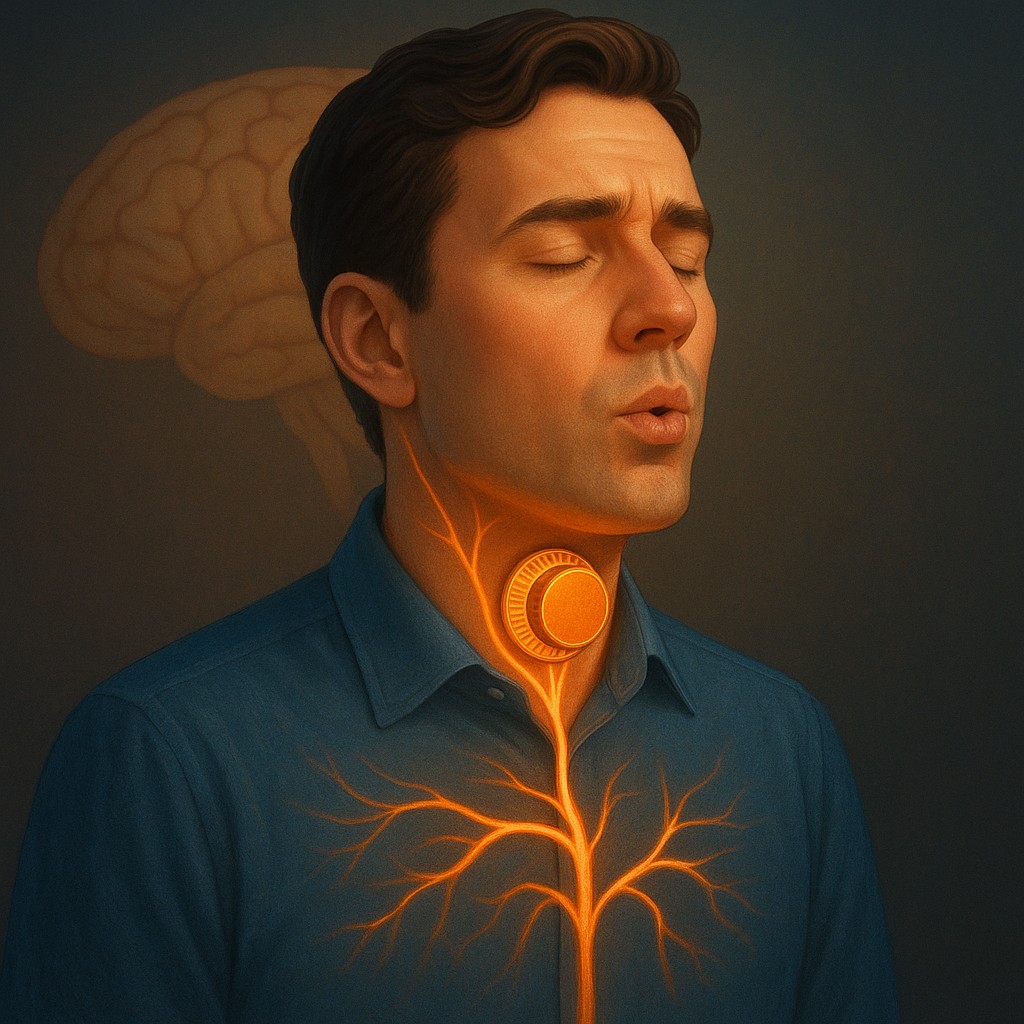
Luckily, there is a hidden physical "off-switch" tucked inside your throat. It can override this biological red alert without a single minute of meditation or a bottle of prescription pills. By simply closing your lips and creating a low, steady vibration, you are performing a form of biological hacking. This isn't just a quirky distraction or a placebo effect; it is a direct, physical intervention into your body's electrical wiring. When you hum, you are essentially "knocking" on the door of the longest and perhaps most influential nerve in your body. This sends a clear signal to your brain that the emergency is over and it is safe to stand down.
The Superhighway of the Human Soul
To understand why a simple "mmm" can calm a panic attack, we have to look at the anatomy of the vagus nerve. The word "vagus" is Latin for "wandering," which perfectly describes this sprawling neural cable. It is the tenth cranial nerve. Unlike its neighbors that mostly stay in the face and head, the vagus nerve travels from the brainstem all the way down to the colon. Along the way, it touches almost every major organ, including the heart, lungs, liver, and stomach. It is the primary commander of the parasympathetic nervous system - the "rest and digest" branch of your internal wiring that balances out the "fight or flight" system.
Think of the vagus nerve as a massive fiber-optic cable that handles two-way communication between your brain and your body. While we often think of the brain as the boss, about 80 percent of the fibers in the vagus nerve are actually sensory. This means they carry information from the body back up to the brain. This is a game-changer for stress management. It means that if we can manually change the physical state of the organs the vagus nerve touches, we can trick the brain into changing its emotional state. We aren't just waiting for the brain to feel calm so the body can relax; we are forcing the body to relax so the brain has no choice but to follow suit.
The vagus nerve is the literal physical source of a "gut feeling" or a "lump in your throat." Because it is so deeply woven into our torso, it monitors the rhythm of our heart and the expansion of our lungs. When we are stressed, the vagus nerve reports that the heart is racing and the chest is tight, which makes the brain feel even more in danger. But the vagus nerve has a specific physical vulnerability we can use to our advantage: before it reaches the heart or the gut, it passes through the neck. It winds its way around the larynx (your voice box) and the pharynx (the back of your throat). This creates a unique opportunity to interact with the nerve using nothing more than sound.
Tuning the Internal Instrument
The mechanical magic of humming happens because the vagus nerve is physically connected to the muscles in the back of the throat and the vocal cords. When you hum, you create a rhythmic, low-frequency vibration that echoes through these tissues. Because the vagus nerve is essentially "wrapped" around these areas, these vibrations act like a gentle massage for the nerve fibers. It is a form of nerve stimulation that requires no needles and no electricity - just the air in your lungs and the vibration of your vocal folds. This physical stimulation triggers "vagal tone," which is a measure of how effectively your vagus nerve can shift your body from stress to calm.
When the vagus nerve is stimulated by these vibrations, it sends a signal to the sinoatrial node in the heart, which acts as the body's natural pacemaker. The message is simple: "Slow down." In response, your heart rate drops and the timing between heartbeats becomes more consistent - a sign of a healthy, resilient nervous system. At the same time, the brain receives word that the physical body is occupied with a rhythmic, controlled activity. This state is incompatible with the chaotic demands of a life-threatening emergency. As a result, the production of cortisol, the body's primary stress hormone, begins to drop. You are essentially using your throat as a remote control for your adrenal glands.
This process is remarkably similar to how high-tech medical devices work. In hospitals, doctors sometimes use Vagus Nerve Stimulation (VNS) devices - small implants that send electrical pulses to the nerve - to treat severe depression or epilepsy. Humming is essentially a "low-tech" version of this medical treatment. By humming, you are giving yourself a dose of VNS. It is particularly effective because it combines physical vibration with a long, controlled exhale. Since we can only hum while breathing out, it forces us to lengthen our breaths, which is another proven way to trigger the "rest and digest" system. It is a double-whammy of biological calming techniques.
Why Vibration Beats Silence in the Heat of the Moment
Many people struggle with traditional meditation because it requires a "quieting of the mind." This is nearly impossible when your body is flooded with stress hormones. If your brain is screaming that you are in danger, sitting in silence and trying to "clear your mind" can feel frustrating or even threatening. This is where humming shines as a practical tool. It is a physical or "bottom-up" approach. This means it starts with the body and moves to the brain, rather than a "top-down" approach that starts with your thoughts. You don't have to believe it will work for it to work; the physics of the vibration and the response of the nerve are purely biological.
| Feature |
Mindfulness Meditation |
Humming / Chanting |
| Main Mechanism |
Mental focus and awareness |
Physical nerve stimulation |
| Difficulty Level |
High (requires mental discipline) |
Low (anyone can make a sound) |
| Physical Effect |
Indirect, through thoughts |
Direct, through throat vibrations |
| Reaction Speed |
Gradual (minutes to hours) |
Rapid (seconds to minutes) |
| Best Used For |
Long-term mental strength |
Immediate "emergency" resets |
| Biological Target |
Prefrontal cortex (logic center) |
Vagus nerve and brainstem |
As shown in the table above, humming offers a much faster path to calm than many other techniques. It provides a physical sensation that anchors your attention. Instead of trying to ignore your racing thoughts, you give your brain something else to process: the buzz in your lips, the vibration in your chest, and the sound in your ears. This sensory experience acts as a "pattern interrupt" for the cycle of anxiety. It is much harder to spiral into "what-if" thoughts when you are busy maintaining a steady, low hum. It serves as a bridge between a state of panic and a state of peace.
Historical and cultural practices have understood this for thousands of years, even if they didn't have the term "vagus nerve" to describe it. Think of the "Om" chanting in ancient traditions, the repetitive humming of monks, or the soft "hush" a parent uses to soothe a crying baby. All of these involve low, sustained sounds that naturally stimulate the throat and chest. We have been "vagus hacking" since the dawn of humanity; we are only now starting to understand the neurological maps that explain why these traditions are so effective at steadying the human mind.
The Limitations of the Biological Reset
While humming is a powerful tool, it should be treated as a tactical "reset" rather than a permanent cure for life's problems. If your stress is caused by a toxic job, a lack of sleep, or money troubles, no amount of humming will fix those facts. Think of humming like hitting the "refresh" button on a computer screen that has frozen. It clears the immediate error and lets the system run smoothly again. However, if the website you are visiting is broken, the screen will eventually freeze again. It gives you a temporary window of clarity and calm, which you can then use to address the real causes of your stress.
Furthermore, the effects of humming are temporary and depend on how much you do it. The drop in heart rate and stress hormones will last for a short period after you stop, but the body is designed to react to its environment. If you go right back into a high-stress, high-caffeine environment, your nervous system will eventually ramp back up. To get the most out of humming, use it as a "circuit breaker" to prevent a stressful moment from turning into a stressful day. By frequently "checking in" with your vagus nerve throughout the day, you can keep your baseline stress level lower.
There is also a social limit: humming loudly in a crowded supermarket line might get you some strange looks, which could actually make you more anxious. However, the beauty of the vagus nerve is that even a very quiet, almost silent hum can be effective. As long as you can feel the vibration in your neck and chest, the nerve is getting the signal. You can hum under your breath in a car, in a bathroom stall, or even hum a tune in your head while making a slight "mmm" sound. The goal is the physical resonance, not the volume of the performance.
Embracing Your Inner Beekeeper
By understanding the physical link between your throat and your nervous system, you gain a superpower that most people ignore. You are no longer a passive victim of your body's stress responses; you are an active participant in your own biology. The next time you feel the walls closing in or your pulse starting to gallop, don't try to argue with your brain. Instead, take a deep breath, close your eyes if you can, and let out a long, low hum like a happy bumblebee. Feel the vibration rattling through your jaw and down into your chest, knowing that you are literally massaging your nervous system into a state of peace.
This simple act is a reminder that we are not just floating minds attached to troublesome bodies. We are integrated biological systems where the physical and the emotional are tied together. When you hum, you are speaking the language of your nerves, bypassing the noise of the modern world to talk directly to your heart. It is a small, quiet rebellion against the chaos of life. So, go ahead and find your frequency. Trust that your "wandering" vagus nerve is listening, ready to guide you back to calm whenever you need it most.